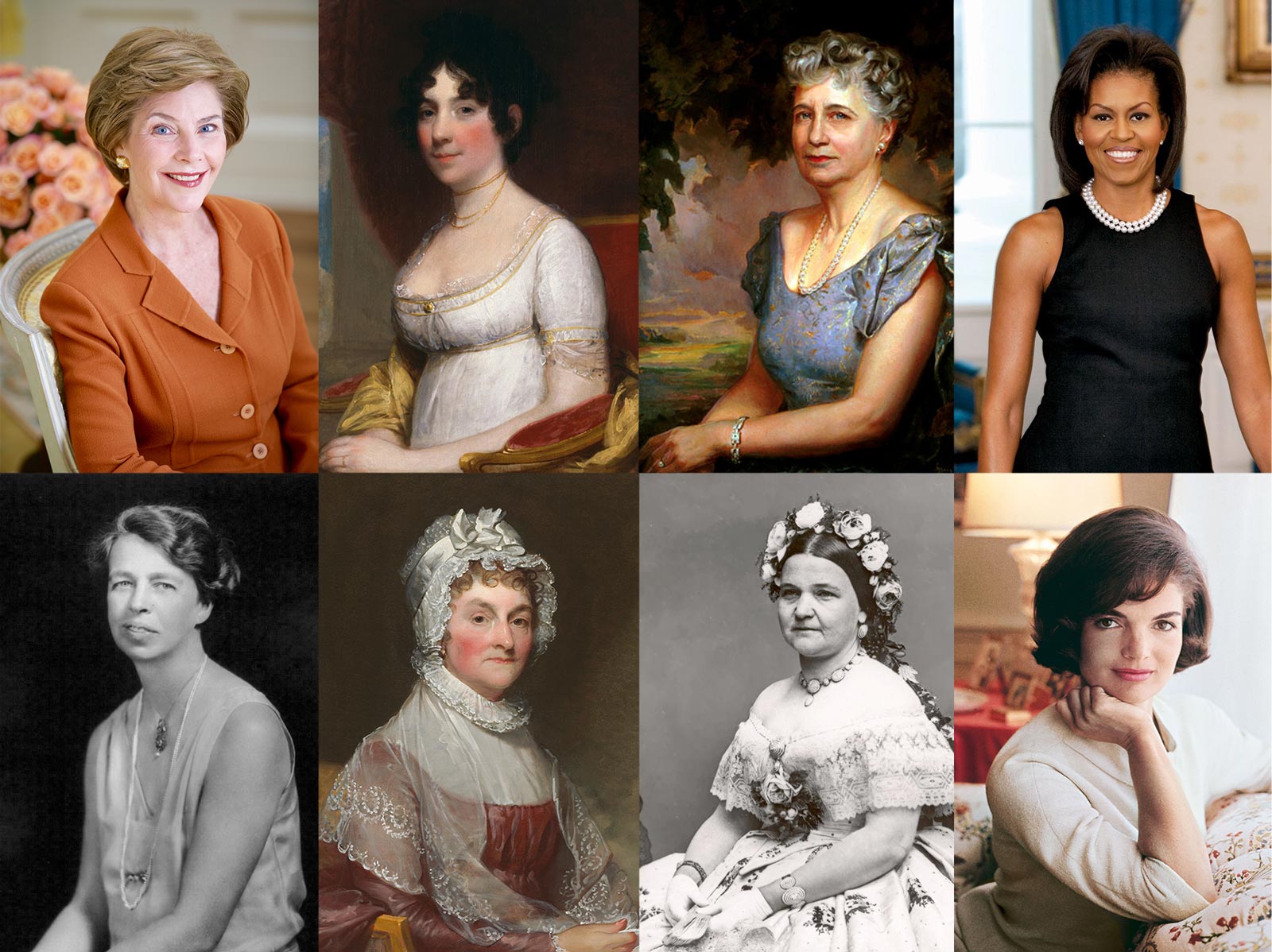
When Martha Washington arrived at the presidential household in April 1789, she was greeted with parades and receptions. George Washington knew he would need Martha’s support, says Anita McBride, WSP ’81, former chief of staff to First Lady Laura Bush and director of American University’s First Ladies Initiative. He wanted the nation’s citizens to see her as she was: a partner in the country’s founding. The first lady, McBride suggests, is at once an “advocate, a diplomat, and a representative of the American people.”
An executive in residence at the Center for Congressional and Presidential Studies (CCPS) in the School of Public Affairs, McBride is one of the nation’s leading scholars of this exclusive political sorority. As a founding member of the First Ladies Association for Research and Education (FLARE), housed at SPA, she coauthored the 2023 textbook U.S. First Ladies: Making History and Leaving Legacies—the first scholarly account to provide a comprehensive history of the office.
Through her research, McBride has identified a recurring theme: the delicate balance required of the role. To “lead a private life in the public eye,” she says, is to walk a fine line, wielding power and exuding grace under close and often painstaking scrutiny. In this, First Lady Caroline Harrison was exemplary, raising money for the Johns Hopkins School of Medicine on the condition that it admit women, which it did in 1893. Ellen Wilson, too, leveraged her platform to visit federal agencies and advocate for improved working conditions for women. It’s a title that confers both power and influence; for McBride, “how they choose to use it when presented with a challenge or opportunity” is the true measure of the office.
McBride saw this influence firsthand as chief of staff to Bush. She worked closely with the first lady, then chair of the National Park Foundation, to protect the country’s natural wonders and advocate for national literacy programs. “She wanted people to understand her love of reading, of being a teacher, and the joy that she got from knowledge,” McBride says. In the wake of 9/11, that role shifted toward national healing. “She immediately spoke to the children of the country and to their parents to tell their kids that they are safe,” McBride says. “No advisor can tell you that. That is a natural instinct. The country needed comfort.”
McBride is now helping to chronicle these legacies as cochair of In Pursuit, a nonpartisan project featuring 70 essays about and by former presidents and first ladies. Released via Substack throughout the nation’s semiquincentennial year, the project includes McBride’s own writing on one of her favorites: Bess Truman.
Chaired by former Archivist of the United States Colleen Shogan—the keynote speaker at FLARE’s 250 Years of First Ladies Making History conference at AU in May—In Pursuit is “a catalog of wisdom for future generations,” McBride says. The project chronicles lessons in leadership, failure, crisis, and character to help fortify democratic institutions and renew civic trust. A congress of Eagles also contributed to In Pursuit, including Smithsonian Secretary Lonnie Bunch, CAS/BA’74, MA’76; historian Karin Wulf, CAS/BA ’85; and Michael Cohen, director of CCPS’s project on the correspondence of Zachary Taylor and Millard Fillmore.
To reflect on the nation’s history during its semiquincentennial is to recognize the pivotal role the first lady has played—and continues to play—in telling the American story. She remains a vital lens through which we “examine who we are as a nation and who we want to be.” In looking back at these women of the White House, McBride ensures that their once-pivotal influence remains a permanent part of our public progress.