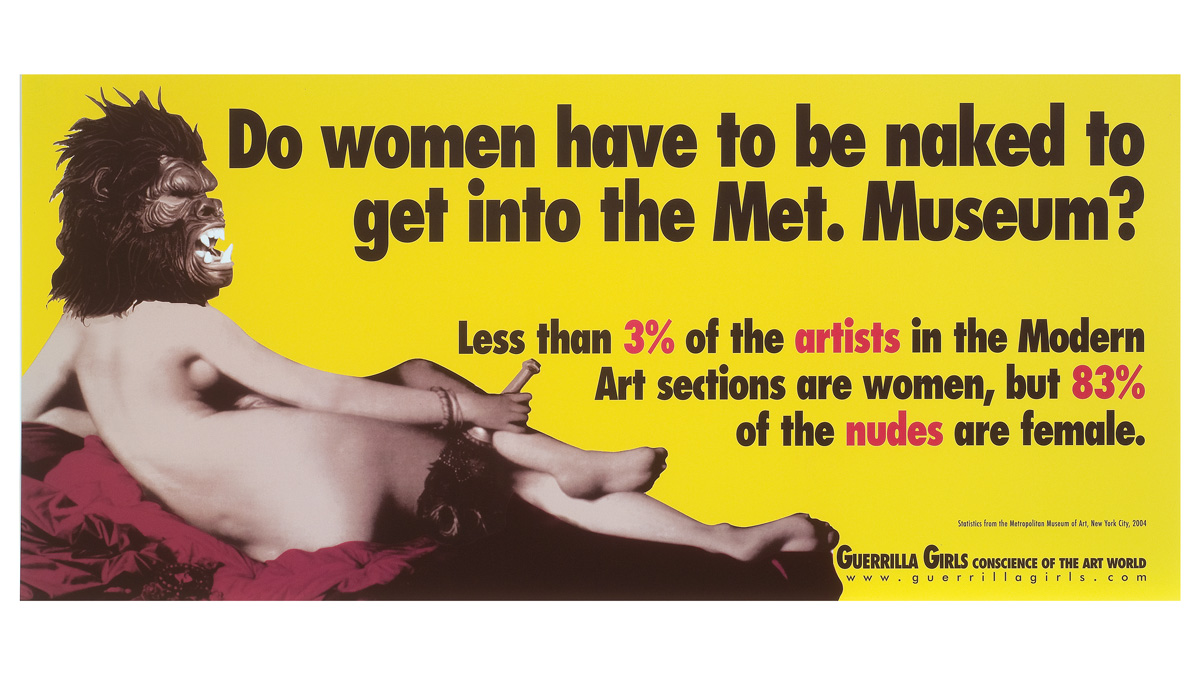
One of the most recognizable Guerrilla Girls posters features the reclining nude from Jean-Auguste-Dominique Ingres’s Grande Odalisque. But unlike the French painter’s 1814 oil—its sitter languid, sinuous in the warm light—the Guerrilla Girls present her with an ape’s head, lounging on swaths of blood-tinged silk before a stark yellow ground. The overlaid text is no less jarring: “Do women have to be naked to get into the Met. Museum?”
Featured in Guerrilla Girls: Making Trouble, which ran from April to September at the National Museum of Women in the Arts, where several Eagle alumni are on staff, the poster is a testament to the group’s subversive practice. Formed in 1985 in response to a Museum of Modern Art survey where fewer than 10 percent of the artists represented were women, the Guerrilla Girls were interested not only in highlighting the gender gaps in the art market, but also in narrowing them, striking hard and fast, like a punch to the gut.
At a moment when “no one was willing to step up and take responsibility” for the dearth of women and people of color in museums and galleries, says assistant curator Hannah Shambroom, SIS/MA ’15, the Guerrilla Girls, an anonymous group of feminist-activist artists, were “the conscience that was missing.”
That willfulness, at once cerebral and pulsating, runs through their work. A 1989 print of bold, black lettering reads, “You’re seeing less than half the picture.” A photograph of the group, from 1985, shows them donning masks and wheat-pasting posters on the streets of New York City. The picture is unsettling: three figures before a darkened brick wall splattered with white paint. They are anonymous but intentional, plunging headlong into an uncertain future. The Guerrilla Girls spoke for the silenced, Shambroom observes, “in a way that couldn’t be ignored.”
A hot-pink picture featured in the show is especially difficult to ignore. “Dearest Art Collector,” the oversized letter opens. “It has come to our attention that your collection, like most, does not contain enough art by women.” The tone is light, even wistful: “We know that you feel terrible about this and will rectify the situation immediately.” The Guerrilla Girls here aren’t so much asking for change as insisting on it, the note a kind of afterthought, signed, as if with a smirk, “All our love.”
The response from the art world has been slow going.
“Much has changed in the past 40 years,” Shambroom says, “but there’s still a lot of work that needs to be done.”
In 2023, the Guerrilla Girls echoed that sentiment: “It’s a real sea change starting, but it’s very hard to roll that rock up a hill.” That tension between what is and what can be will always be there, Shambroom notes, but it’s precisely that disconnect which informs the group’s practice, enlivening their work for decades. “The Guerrilla Girls have been among the most vocal champions of equity in the visual arts,” says Nika Elder, a professor in the College of Arts and Sciences. They are women of action, advocating for a vision of the arts only they can see. As the group once pronounced, “You can’t stop artists.”
The Guerrilla Girls aren’t stopping. Their message, quick-witted and acerbic, is about lifting up artists rather than vilifying institutions. “Of course be critical of the system,” one of the group members said, “but be really open to the art.”
That’s the spirit of the Guerrilla Girls, Shambroom asserts—a belief in the possibility of a different world. “They wanted to see things shift.”
It’s that gaze, glass-sharp and cutting, that guides the Guerrilla Girls. They imagine the world as it could be, ushering it along with humor and verve. However pristine, Ingres’s odalisque cannot stand in for every woman, the Guerrilla Girls imply. There are other forms of beauty, other ways of seeing.