
For generations, American University students have looked to Capitol Hill to gain real-world experience in government—and often to launch lifelong careers in public service. But this dynamic pipeline is more than just a by-product of proximity; it is the realization of a founding vision that anticipated the modern capital.
When Methodist Bishop John Fletcher Hurst chartered AU through an act of Congress in 1893, he did so with a specific, groundbreaking dream: to create a national university in Washington, DC, that would explicitly train public servants for the future. Long before the Metro reduced the downtown commute to a matter of minutes, AU’s founders established an institutional culture rooted in a global outlook, practical idealism, and an unwavering passion for public service.
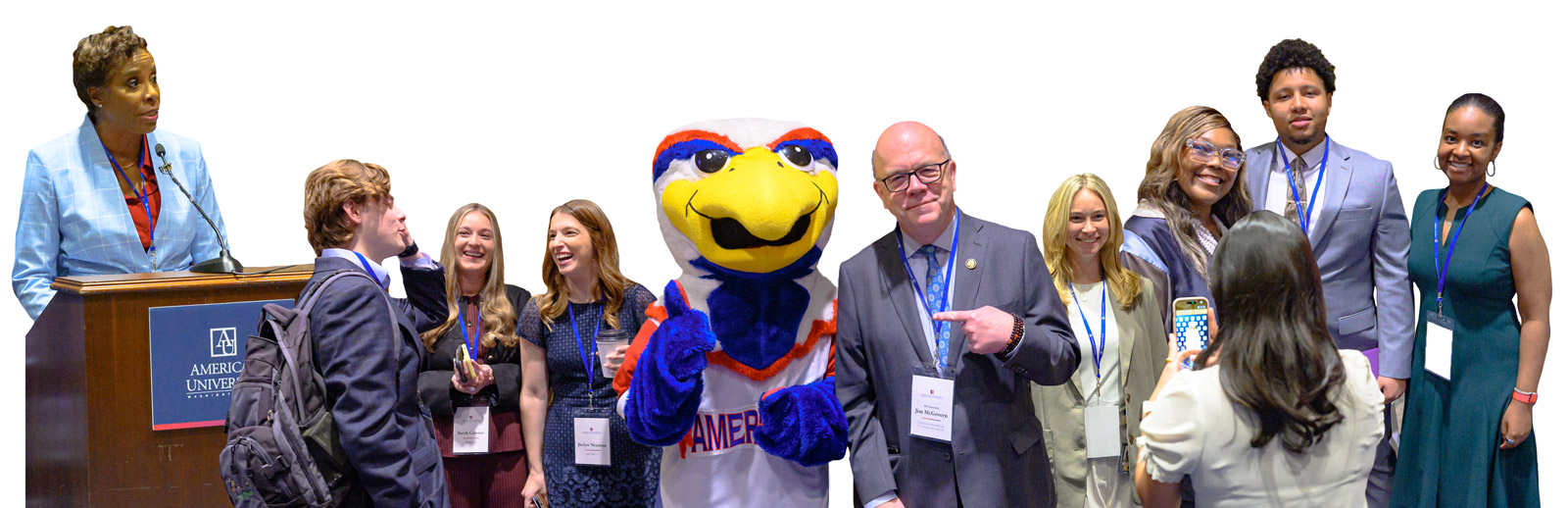
That century-old legacy was on full display on May 20 at the inaugural AU on the Hill Day at the Rayburn House Office Building. Alumni working as legislative staffers and lawmakers, along with student interns, gathered over pastries and coffee to celebrate the university’s expanding network across Congress.
The event—hosted by AU’s Office of Community and Government Relations and University Advancement—featured remarks from Delegate Stacey Plaskett (D-Virgin Islands), WCL/JD ’94, and Representative James McGovern (D-MA), CAS/BA ’81, SPA/MPA ’84, both of whom reflected on how the university shaped their paths to leadership. Today, the practical idealism of AU’s founders translates to a staggering impact: More than 3,000 Eagle alumni currently work in the federal government, including more than 300 on Capitol Hill and six current members of the House.
Along with Plaskett and McGovern, the congress of Eagles in the lower chamber includes Representative Julia Brownley (D-CA), Kogod/MBA ’79; Representative Sarah McBride (D-DE), SPA/BA ’13; Representative Jamie Raskin (D-MD), HON ’21, ’25, WCL professor emeritus; and Representative Haley Stevens (D-MI), SPA/BA ’05, CAS/MA ’07.
This strong presence is a testament to both AU’s physical proximity to Capitol Hill and its enduring appeal to students eager to immerse themselves in politics, policymaking, and public service from the moment they arrive on campus.
Higher education plays a vital role in preserving democracy and shaping future civic leaders. Rooted in the ideals of its founders, AU remains deeply committed to ensuring students graduate not only with a strong academic foundation, but also with the practical skills, hands-on experience, and professional networks required to succeed.
As part of this commitment, AU has pledged to provide students the opportunity for a university-funded internship or research experience starting sophomore year. While 87 percent of students complete at least one internship, the university is pushing to make that opportunity universal.
The initiative—one of the cornerstones of Meet Our Moment, AU’s five-year strategic plan—is designed to level the playing field, ensuring that hands-on learning experiences are accessible to all students, regardless of their financial ability to accept unpaid internships. AU also plans to expand alumni mentorship through a program launching next year that will pair graduates with participating students, initially focusing on sophomores and transfer students.
That emphasis on experiential learning deeply resonated with many of the 300 alumni in attendance, including those who started on the Hill as AU interns.
Shannon “Shan” McDermott, SPA/BA ’18, director of operations and scheduling for Rep. Lizzie Fletcher (D-TX), credited AU’s focus on internships with helping to launch her career. “My senior-year internship is what got me my first job out of college,” she said, “and that first job is what got me my current job.”
Throughout the morning reception, students and alumni, including many recent graduates, traded business cards, stories, and career advice with lawmakers and senior staffers—offering a vibrant snapshot of AU’s pipeline into government and public life.
For many alumni, those initial campus connections evolve into lifelong friendships and professional networks. McDermott said that many of her closest friends chose to stay in Washington after graduation. In fact, about 40 percent of Eagles remain in the DC area after collecting their diplomas.
“Everywhere I walk in DC, I’m saying hi to people I met as an orientation leader or who had a radio show before me at WVAU,” McDermott said. “Those smiles, quick hellos … can lead to strong, genuine professional connections later on.”
AU’s legacy of public service has historically been intertwined with inclusion and breaking barriers; the university welcomed women before they could vote and provided a home to Black students during the era of segregation. That tradition of resilience and trailblazing is mirrored in Plaskett’s journey to the House.
Now in her sixth term representing the at-large congressional district of the US Virgin Islands, Plaskett reflected on her time as a night student at the Washington College of Law, where she balanced motherhood and a full-time job while earning her degree.
She called AU’s collaborative culture one of its defining features, recalling how classmates created briefing books to help her keep up with coursework after the birth of her third child. That sense of community extended to the faculty as well. Plaskett pointed to Raskin, her former constitutional law professor—now her colleague in Congress—as part of the broader AU network that shaped her approach to leadership.
Plaskett said that spirit of mutual support continues to inform her work today, crediting AU with reinforcing the core values of adaptability, negotiation, and service.
“I don’t see myself as a politician,” Plaskett said. “My life—my professional life—has been in public service, and I just happen to have a job in public service that requires people to elect me.”
McGovern, a double Eagle, noted that his interest in politics crystallized soon after arriving at AU, when he landed a paid three-year internship in the office of the unrelated Senator George McGovern (D-SD).
“It was an incredible experience for me, and it instilled a sense of purpose with regard to public service,” he said, adding that he was inspired by colleagues who viewed government service as “an honorable profession.”
As an undergraduate, McGovern chose to study history—a decision that tied him directly to the deep-seated historical foundation of the university itself. In 1902, President Theodore Roosevelt laid the cornerstone of AU’s McKinley building, cementing the university’s ties to the presidency and the nation’s unfolding narrative. Decades later, McGovern sat in AU classrooms learning the gravity of those historical intersections.
“I still remember with great affection the history professors who taught me about history in every part of the world,” McGovern said. “But one of the things they instilled in me is that if you want to be a good leader, you have to have a sense of history so you don’t make the same stupid mistakes over and over and over again.”
In fact, it was McGovern’s AU professors who ultimately urged him to run for Congress, reminding him that “there are worse things in life than losing. Not trying, not giving it your best, is worse than that.”
He also recalled a history professor who ended every class with the same reminder: “The world will not get better on its own.”
“At the time, I didn’t know what he meant,” McGovern admitted. “I do now.”
Reflecting on his nearly 30 years in Washington, he emphasized that lasting change only happens when “like-minded people come together and make things happen, make the change for the better.”
Looking out on the crowd at the Rayburn building, McGovern noted that the AU students now interning on Capitol Hill are following the exact same pipeline that brought him to Congress decades ago. From Hurst’s foundational vision in 1893 to the halls of Congress today, it’s a path defined just as much by a shared mission of civic leadership as by career opportunity.
“DC—and AU—is a place full of passionate people that all care about something,” McDermott added. “I bring that passion and care for serving constituents every day.”
Supporting Our DC Alumni
With 40 percent of American University’s 160,000 alumni—about 62,000 Eagles—living across Maryland, Virginia, and the District, AU’s Office of University Advancement is committed to strengthening and expanding local programming with the goal of creating the No. 1 alumni network in the region.
A new initiative, Power Up the DMV, is specifically designed to foster networking opportunities and increase awareness of events both on campus and throughout the greater Washington area.
Last fall, AU hosted its inaugural Knowledge is Power breakfast, which focused on the current higher education landscape, as well as a Books and Brunch gathering featuring speakers from WAMU 88.5—one of the most trusted public radio stations in the DMV. These events ran alongside the School of Public Affairs’ popular Classes Without Quizzes program, which welcomed hundreds of furloughed public servants, contractors, and others impacted by the October government shutdown.
“There is a longstanding network of AU alumni based in the DC region who occupy some of the most powerful roles in our country’s modern democracy,” says Vice President of University Advancement Matthew Eynon. This cohort includes trailblazing Representative Sarah McBride (D-DE), SPA/BA ’13, and Smithsonian Secretary Lonnie G. Bunch III, CAS/BA ’74, MA ’76, and Wall Street Journal publisher and Dow Jones CEO Almar Latour, SOC/MA ’96, HON ’25.
“Our Office of Alumni Relations is laser-focused on activating these network ties to connect alumni with each other, with current and prospective students, and with the life of the university at large,” Eynon continues.
Alumni: Visit american.edu/alumni to update your contact information to ensure you receive the latest news, updates on DMV regional events, and information on broader Show Up for AU initiatives.