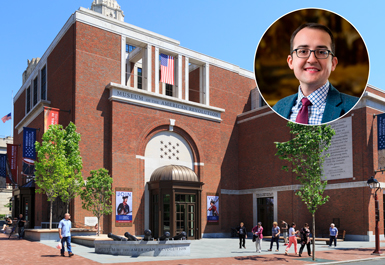
Matthew Skic, CAS/BA ’14, doesn’t take his daily commute for granted.
His walks past Independence Hall on his way to work in Old City Philadelphia serve as a constant reminder that the American Revolution is not a distant memory trapped in a dusty history book. “It’s an ongoing experiment,” he says.
Like American democracy itself, the eighteenth-century building where the Declaration of Independence and the Constitution were debated and signed still stands, underscoring what Skic calls the “ongoing relevance of the American Revolution to our daily lives.”
“The founding of this nation continues to be the reference point for generation after generation of Americans [regarding] what this nation is all about,” says Skic, director of collections and exhibitions at the Museum of the American Revolution, located two blocks from the Liberty Bell. “You might not have an ancestor who fought at the Battle of Bunker Hill, but you’re still connected to the American Revolution through its ideals.”
Skic, who studied history and met his wife, Kelsey, CAS/BA ’14, at American University, serves as the chief caretaker for the museum’s 5,000 artifacts. Today, these relics—which belonged to both ordinary individuals and Founding Fathers—are the closest thing to a time machine back to the rebellion that birthed a nation.
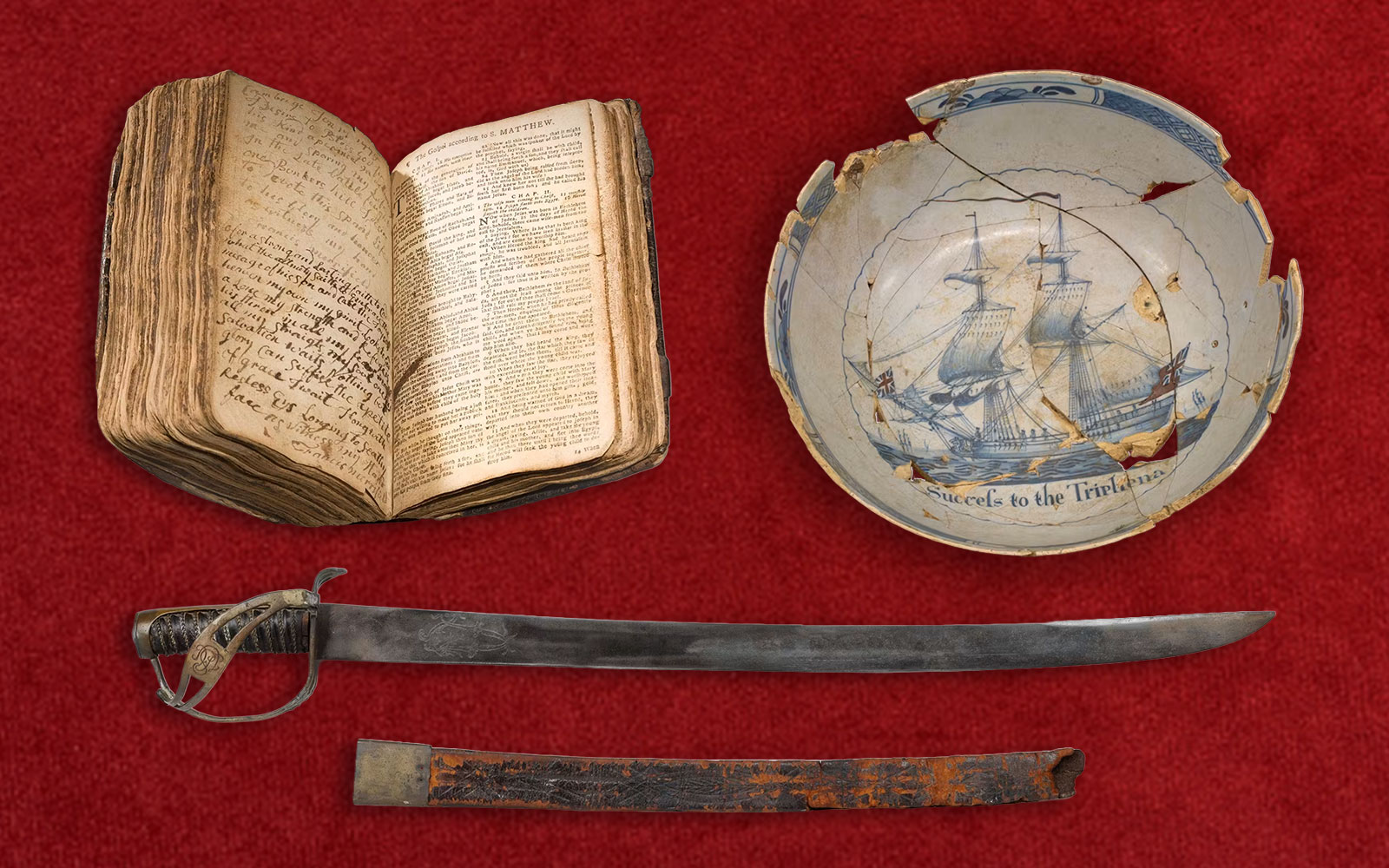
Images courtesy of the Museum of the American Revolution
Commemorate the United States’ semiquincentennial with 10 of Skic’s favorite Revolutionary-era artifacts from the Museum of the American Revolution:
- Triphena Punch Bowl: While digging the foundation for the museum, archaeologists uncovered 85,000 artifacts buried inside Revolutionary-era privy shafts for taverns that once operated on the site. Among the finds was a broken bowl commemorating the Triphena, a merchant vessel that sailed between Liverpool, England, and Philadelphia. In 1765, the Triphena carried a message to Britain urging the repeal of the Stamp Act. This bowl, likely used to drink rum punch, offers a tangible connection to the early political friction that ignited the American Revolution.
- Poems on Various Subjects, Religious and Moral: This 1773 original copy of the first book of poetry published by an African American is autographed by the author, Phillis Wheatley. Born in West Africa and enslaved as a young girl, Wheatley survived the Middle Passage and was brought to Boston by the Wheatley family, who named her after the slave ship that carried her. After receiving an education from her enslavers, she became a noted poet. The book features affidavits from prominent Bostonians attesting to the authenticity of her authorship. It’s a real treasure that we have a book that Wheatley once held in her own hands.
- Captain David Brown’s Hunting Gun: A fowling piece carried by Captain David Brown stands as a “witness object” to “the shot heard round the world”—the Battles of Lexington and Concord, which ignited the Revolutionary War on April 19, 1775. Brown, who commanded the Concord Minute Company, lived just yards away from the North Bridge where the fighting broke out.
- Bunker Hill Bible: On June 17, 1775, soldier Francis Merrifield of Ipswich, Massachusetts, fought at the Battle of Bunker Hill. While the battle was a technical defeat for the Patriots, the British sustained twice as many casualties and lost numerous officers. Immediately after surviving the clash, Merrifield inscribed a note inside the Bible he kept in his knapsack: “I desire to bless God for his kind [appearance] in delivering me and sparing my life in the late battle fought at Bunker Hill. I desire to devote the spared life to his glory and honor.”
- Fringed Linen Hunting Shirt: The museum houses one of the few surviving American-made garments that came to define the visual identify of the Continental Army. Hunting shirts were George Washington’s preferred uniform for his troops because they were closely associated with riflemen, who carried highly accurate muskets. In an act of psychological warfare, Washington believed that outfitting as many troops as possible in these shirts would strike fear into the British army—even though many of the soldiers wearing them actually carried far less precise muskets.
- “Melted Majesty” Musket Ball: On July 9, 1776, following a public reading of the Declaration of Independence at Bowling Green in Lower Manhattan, an American mob tore down a gilded lead equestrian statue of King George III. The lead from the fallen monarch was shipped to Connecticut, where a group of women melted it down into 42,000 musket balls to be fired back at the British. This small musket ball in the museum’s collection was recovered from the Battle of Monmouth, proving that even the smallest artifacts can carry monumental stories.
- William Burke Tableau: As a museum intern in 2015, my full body was cast at Studio EIS in Brooklyn to create a life-size figure of William Burke, a real 24-year-old British soldier. Born in Galway, Ireland, Burke was one of the British Army’s early recruits to fight in America. Because he had no prior military experience before seeing action in New York City in August 1776, his story shatters the common misconception that the British Army was composed entirely of seasoned veterans.
- The March to Valley Forge Painting: In 1883, Pennsylvania artist William B. T. Trego painted a scene found in almost every American history textbook. The museum holds the original oil-on-canvas masterpiece. Though painted a century after the fact, Trego really captures the grim, downtrodden reality of Washington’s army marching into its winter encampment at Valley Forge in December 1777. Up to that point, Washington had lost the majority of his battles, and the capital of Philadelphia had just been captured. Trego’s painting depicts barefoot soldiers trudging through the snow—including one soldier tipping his hat to the commander in chief—at a time when few were certain the revolution would survive. The story behind the masterpiece is equally interesting. Trego suffered from a debilitating childhood illness, likely polio, that left him without the use of his hands. He completed this iconic work by strapping a paintbrush to one hand and guiding it with his opposite arm.
- George Washington’s War Tent: Nicknamed “the first Oval Office,” the museum’s signature exhibition features the 23-by-14-foot canvas tent that served as George Washington’s mobile home and headquarters. It was here that he slept, strategized, and drafted letters during the highest and lowest moments of the war. After Martha Washington died in 1802, the tent was passed down through generations of descendants. By 1861, it belonged to Mary Custis Lee, Martha Washington’s great-granddaughter and the wife of Confederate General Robert E. Lee. At the start of the Civil War, Mrs. Lee fled Arlington House—now situated in Arlington National Cemetery—which was promptly seized by Union forces. Selena Gray, an enslaved woman and descendant of Mount Vernon’s enslaved workers, saved the tent from destruction. Following the Union victory, it was displayed in Washington, DC, before eventually being returned to the Lee family. In 1909, Reverend W. Herbert Burk purchased the tent for $5,000, viewing it as a symbol of unity for a divided nation. It became the centerpiece of the Valley Forge Historical Society, the predecessor to the current museum. Since 2017, more than a million visitors have stood before it.
- Jeremiah Keeler’s Hanger: This short sword, or hanger, belonged to Jeremiah Keeler, a veteran of the Siege of Yorktown in 1781—the war’s final major land engagement. Keeler served in the Continental Army’s light infantry under the Marquis de Lafayette. Lafayette personally presented the sergeants and corporals of his unit with these swords, which are engraved with the “USA” cipher. Keeler lived long enough into the nineteenth century to sit for a photograph in his old age, proudly holding his surviving sword. That photograph and the sword are displayed in the museum’s final gallery, putting a human face on the individuals who secured American independence and reminding visitors that the spirit of the revolution continues only if we choose to carry it forward.