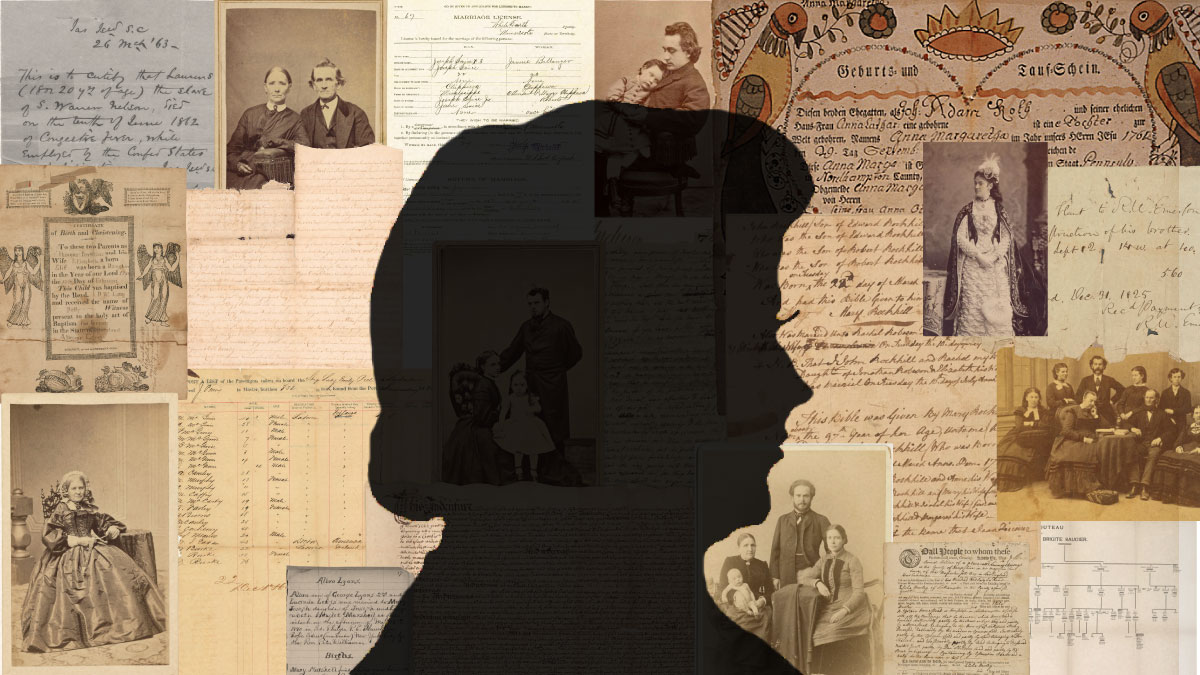
When Karin Wulf, CAS/BA ’85, was researching eighteenth-century women writers, she encountered a recurring oddity: small, scattered scraps of paper containing detailed genealogical information. “I thought, Why are they doing this?” Wulf says, noting the era’s reputation as “the great age of individualism.”
To Wulf’s surprise, she described that compiling family histories was a widespread practice in eighteenth-century America, serving as vital records of both individual and communal lives. “Once I started looking for it, it was everywhere,” says Wulf, director and librarian of the John Carter Brown Library and a professor of history at Brown University
Indeed, family histories were legion. From the red-dyed goat leather of an English king’s ledger to the humble folded papers of everyday citizens, the practice was commonplace. These records did more than track lineages; they told the story of society in early America.
Recorded by families, churches, and governments, these histories tracked information about births, deaths, and marriages. As Wulf writes in her new book, Lineage: Genealogy and the Power of Connection in Early America, they encapsulated a full spectrum of human experience: “love, hope, and joy, and despair, grief, and disappointment.” While some records were tucked away in account books or Bibles, others were more personal, containing locks of hair or chronicling migrations, travels, and voyages at sea.
However, these eighteenth-century histories were also fundamentally patriarchal. “Family in the British American mode,” Wulf writes, “was governed by men,” with property handed down to husbands and sons. These histories were also used as “an explicit instrument of power” to enslave people. Some family records included lists of enslaved individuals, complicating traditional notions of early America and suggesting that family structures shaped much of everyday life.
Even Benjamin Franklin—long enshrined as the quintessential self-made American—was deeply rooted in these familial structures. While his autobiography is often read as a manual for individualism, it tellingly opens with a trip taken to England with his son to trace the lineage of their ancestors. Far from being a solitary genius, Franklin had a keen interest in genealogy and “was supported by a network of family relationships” that fueled his social and political ascent.
Franklin’s fascination with his roots underscores why Wulf believes it’s crucial to remember those structures. “We think about the individual striving American,” but these histories point to a collective past webbed with communal ties. She notes that the historical record “has always privileged the loudest, [most] powerful voices,” empowering them to “shape the contours of what we know about the past.” Yet, to live in early America was to move through the world under the banner of one’s ancestors.
From the distribution of property to the denial of basic freedoms, genealogy leveraged “startling” power over people, Wulf ways. Ultimately, she views these records as a way of “telling the story of humanity.” Studying them remains fundamental to understanding the country’s origins, proving that family remains “an extraordinarily potent aspect of human experience.”