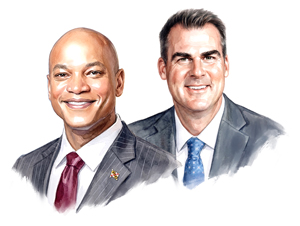
Governor Wes Moore (D-MD) and Governor Kevin Stitt (R-OK)
May 6
In an era where the only thing Republicans and Democrats seem to agree on is that the other side is wrong, Oklahoma Governor Kevin Stitt and Maryland Governor Wes Moore are trying to prove that the path toward a functional future starts with a different kind of conversation.
The Sine Institute of Policy and Politics hosted the governors this spring for a virtual dialogue on the capacity of state executives to shape the national trajectory by prioritizing results over rhetoric. Stitt and Moore serve as the chair and vice-chair, respectively, of the National Governors Association and are both Sine Institute 250+ at American Distinguished Lecturers.
Representing vastly different political backgrounds and geographic regions—Stitt, a Republican in the final months of his second term, and Moore, a Democrat currently campaigning for his second term—the governors explored how state leadership can serve as an engine for policy innovation and a model for restoring public trust in government.
A key theme of the conversation was the necessity of bipartisan collaboration in tackling the complex challenges facing the country, from economic stability to the general well-being of the next generation. The governors reflected on their roles as bridge-builders, arguing that the success of their individual states depends on the ability to work across ideological differences.
Moore, a 2021 Sine Institute Fellow, highlighted the contrast between the legislative gridlock in DC and the proactive nature of governorship. “While Washington often gets bogged down by partisan fights, governors are proving every day that we can still reach across the aisle to get things done,” he said.
He expressed his commitment to choosing partnership over division, suggesting that when leaders focus on the real work of delivering for their people, they show the rest of the country that meaningful progress remains possible. “The American journey has never been a smooth one,” Moore added. “The history of this country is remarkable, and it’s been remarkably uneven. Glory is worth it—and that’s why we keep on putting in the work.”
Stitt offered a similar perspective, focusing on a results-driven approach that prioritizes state excellence over national political theater. Stitt said he often encourages his constituents to “let DC play politics” while he focuses on making Oklahoma a “top-10” state for job growth, education, infrastructure, and government accountability.
Reflecting on the broader mission of governance, Stitt noted the distinction between equity and opportunity. “As leaders, we can’t teach people that there are equal outcomes, but it’s our job to make sure everyone has equal opportunities to chase their dreams,” he said. “The American dream doesn’t need to be reimagined. It needs to be reignited.”
Almar Latour, SOC/MA ’96, HON ’25
April 22
“ChatGPT or any AI application looks so different today than it did even a month ago … so it’s almost a fool’s errand to [predict] what things will look like in 10 [or] 15 years from now. But in broad brush strokes, I do believe there’s going to be a fruitful marriage between reporting and human intelligence and data that will spawn a significant number of new jobs.”
The Dow Jones CEO and Wall Street Journal publisher—a former Eagle reporter—framed the current media era as an AI-driven “gold rush,” positioning the United States at the center of a radical reinvention. Speaking during the final installment of the spring semester’s 250+ at American Presidential Speaker Series, Latour—a distinguished lecturer with the Sine Institute of Policy and Politics—characterized this technological shift as a transformative force for information-based businesses. He revealed that the soaring demand for reliable data helped lead Dow Jones to the most successful year in its 142-year history.
Representative Jamie Raskin (D-MD)
May 16
“Nothing is self-executing. The law of war is not like the law of gravity. It doesn’t work on its own. If someone commits war crimes … God does not strike them down. An indictment does not appear under their pillow like a dollar from the tooth fairy. Every part of the Constitution just sits there on paper waiting for a brave citizen, a great lawyer, to come along to make it real. … The laws of the country mean nothing unless and until some brave citizens and lawyers decide to use them to fight for justice—in court, in the legislature, in the streets. … The law will only be as strong as your understanding of it, your physical and mental energy to engage with it, and, above all, your moral and existential courage to fight for it.”
The former constitutional law professor—who spent 25 years at WCL before leaving academia for the US Congress in 2017—delivered a powerful call to action at the school’s commencement. Raskin, now in his fifth term and serving as the ranking member of the House Judiciary Committee, urged the 400 members of WCL’s Class of 2026 to bring their “tremendous talent and boundless promise” to become “instruments of justice” amid a changing legal landscape.
María Teresa Kumar
February 25
“Generation Z and Generation Alpha are technically the largest cohorts of potential voters in this country. However [and] whenever you decide to participate, it will change the course of the country.”
The Voto Latino cofounder and CEO highlighted the decisive power held by the nation’s youngest voters during her seminar as a Sine Institute 250+ at American Distinguished Fellow. Joined by Representative Joaquin Castro (D-TX), Kumar also discussed how the “multicultural generation” can overcome strategic disenfranchisement and legislative obstacles like the SAVE Act. By positioning youth as the primary influencers within their families, Kumar framed civic participation not just as a right, but as a vital “infrastructure of opportunity” essential to shaping the future of American democracy.
Nicholas Boggs, CAS/MFA ’09
March 25
“We often talk about Baldwin the witness, but we should also talk about Baldwin the collaborator. He understood that the struggle for visibility was never a solo project.”
The award-winning author of 2025’s Baldwin: A Love Story—the first biography of literary giant and civil rights visionary James Baldwin in 30 years—was the headline guest for the annual Bishop C. C. McCabe Lecture and the 250+ at American Presidential Speaker Series. Boggs offered a fresh appraisal of Baldwin’s radical vision, focusing on the “un-standard” beauty found within his later career. Through a deep dive into Little Man, Little Man, Boggs illustrated how Baldwin’s collaboration with his last great love, French illustrator Yoran Cazac, remains a radical document of human witness for our modern world.

Renée Fleming
April 14
“For so long, we’ve treated the arts as the first thing to be cut or the last thing to be funded. But when you look at the impact on patients with Alzheimer’s or children with autism, you realize that the arts are often the only key that can unlock certain parts of the human experience.”
The world-renowned soprano and National Medal of Arts recipient shared her groundbreaking work in neuroarts—the study of how creative experiences measurably change the body, brain, and behavior—as part of the university’s 250+ at American Presidential Speaker Series. Arguing that creative expression is a biological necessity rather than a luxury, the World Health Organization’s Goodwill Ambassador for Arts and Health championed neuroarts as a noninvasive, cost-effective intervention for complex conditions like dementia and Parkinson’s disease.
David Aldridge, CAS-SOC/BA ’87
February 24
“There’s a reason why a lot of people compare basketball to jazz—it’s a group of people that play different instruments, but if they play them together, they create this incredible sound. That’s where I think basketball is kind of the American ethic of sacrifice for each other toward greater goal or greater good. It doesn’t matter if somebody scores 10 points or 2 points or 30 points. If they help their team win, that’s the most important thing.”
The senior Athletic columnist—and the first of five guests in the spring semester’s 250+ at American Presidential Speaker Series—shared insights from a storied career that has included nine years at The Washington Post and 14 years covering the NBA for Turner Sports. Beyond the spectacle of the game, the native Washingtonian argued that the arena reveals fundamental human truths about resilience and the necessity of trial and error. “Sports is a constant state of failure,” he said. “The best baseball players in the world make outs 7 out of 10 times. What do [they] learn from the other seven? Sports are the embodiment of humanity.”
Walter Isaacson
May 9
“At the official signing of the Declaration of Independence 250 years ago, John Hancock wrote his name with his famous flourish. ‘There must be no pulling different ways,’ he insisted. ‘We must all hang together.’ [Benjamin] Franklin replied, alluding to what would happen to them if their revolution failed, ‘Yes, we must, indeed, all hang together, or most assuredly we shall all hang separately.’ As Franklin pointed out, our life-or-death challenge as a nation, whether it be in 1776 or 2026, is this: When there are so many forces dedicated to dividing us, how can we best hang together?”
The best-selling biographer of Benjamin Franklin, Albert Einstein, Leonardo da Vinci, Steve Jobs, and others—in his address to graduates of the School of Public Affairs during AU’s 151st commencement—highlighted three essential traits embodied by his subjects: curiosity, humility, and mission. Isaacson’s latest book, 2025’s The Greatest Sentence Ever Written, examines what he considers to be the more revolutionary line in the Declaration of Independence.
Mary Beth Tinker
March 26
“I was in eighth grade, I was 13 years old, and I was so upset about the war. That’s really what motivated me. There’s always somebody around to say, ‘Well, life’s not fair. Get used to it.’ I really hate when people say that, because life should be fair, and you should never get used to life not being fair.”
The First Amendment activist told students that the landmark 1969 Supreme Court decision that bears her name is fundamentally about the necessity of conflict. The ruling—which established free speech rights for public school students following her 1965 suspension for wearing a black armband to protest the Vietnam War—serves as a mandate for civic dialogue. “It says that we must be able to talk about controversial things in school,” she said. “Otherwise, we don’t have school, we don’t have education, and we don’t have democracy.” The event was cohosted by the Kennedy Political Union and the ACLU at AU.