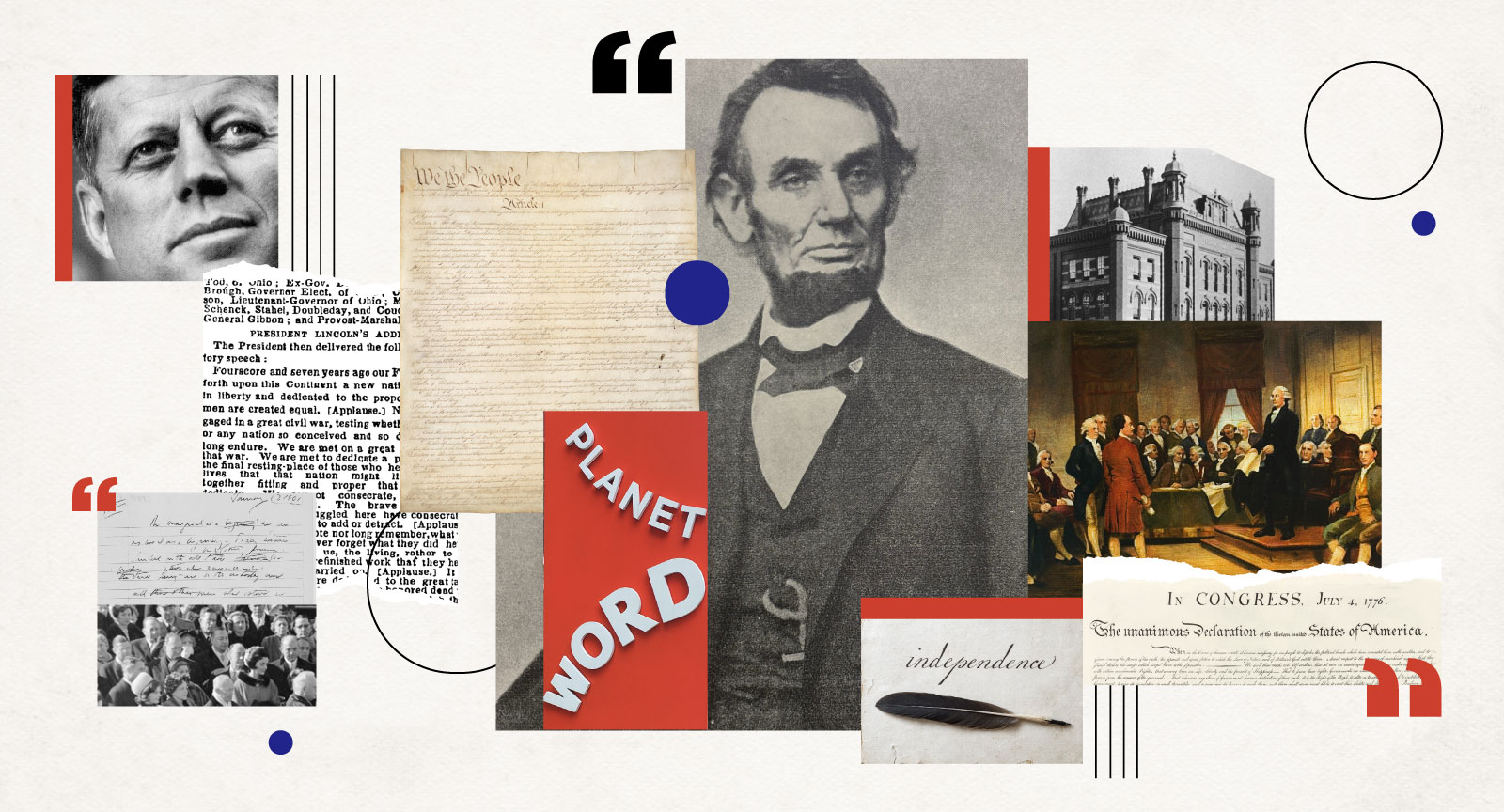
“Ask not what your country can do for you,” President John F. Kennedy pronounced, when he was sworn in on January 20, 1961—“ask what you can do for your country.” It’s a line that lingers, urging listeners forward.
Nearly a century earlier, President Abraham Lincoln struck a similar resonant chord: “Four score and seven years ago, our fathers brought forth on this continent, a new nation, conceived in Liberty, and dedicated to the proposition that all men are created equal.”
These are the types of enduring phrases that fascinate Ann Friedman, SOE/MAT ’98, founder and CEO of Planet Word, a Washington, DC, museum dedicated to the power of language and literacy. To Friedman, a former first-grade reading teacher, the written word does more than communicate; it carries a history and a culture that can “stir your soul” and “galvanize you into action.”
That power can be found in the whimsical as well as the weighty. As a child, Friedman reveled in the dialects of Frances Hodgson Burnett’s The Secret Garden and luxuriated in rhythmic poetry of A. A. Milne, creator of Winnie-the-Pooh. “We are the language we use,” she says. “It forms us.”
This formation is central to the museum’s Language and Liberty series, where scholars and practitioners reflect on the continued resonance of America’s seminal texts. On March 3, the museum hosted Anne Curzan, professor of English and linguistics at the University of Michigan, who reminded the audience that even our most “essential” documents are products of evolving linguistic moments.
In her program, Sounds of 1776—Curzan explored the accents, languages, and linguistic debates of the Revolutionary era. She noted a surprising fact: The title Declaration of Independence never appeared on the original document, which was instead titled “The unanimous Declaration of the thirteen united States of America.” Furthermore, while the text mentions “independent” four times, the word “independence” is entirely absent. In 1776, “independence” and “independency” were in fierce competition; the founders could have easily chosen the latter. Even the use of the archaic “hath” was a deliberate stylistic choice intended to provide legalistic weight.
Language, Friedman says, “is alive and vital,” changing, as culture does, into a dense “amalgamation of influences.” Studying these nuances is part of a larger mission. Caitlin Miller, CAS/MA’13, Planet Word’s director of education and public programs—and one of several Eagles on staff at the museum, which opened in 2020—views this exploration as “the ongoing, shared project of building ‘a more perfect union.’” Language, Miller insists, is “the way humans transfer visions of the future from one mind to many.”
That vision is ever-changing. Ben Connors, SOC/BA ’06, director of museum technology, notes that the Declaration explicitly asserts “the right of the people to alter or abolish [the government],” and the US Constitution is “constantly reinterpreted and remade.” As evolving documents, they reflect the founders’ era as much as our own—a history of a nation forever in progress.
Ultimately, these texts remain the bedrock of the American experiment, containing within them the contours of a new nation. Jen Giambrone, CAS/MA ’16, senior manager of curatorial affairs, observes that the Declaration and the Constitution together “conceptualized and organized an entire system of government.” In a very literal sense, she says, they “spoke a country into being.”