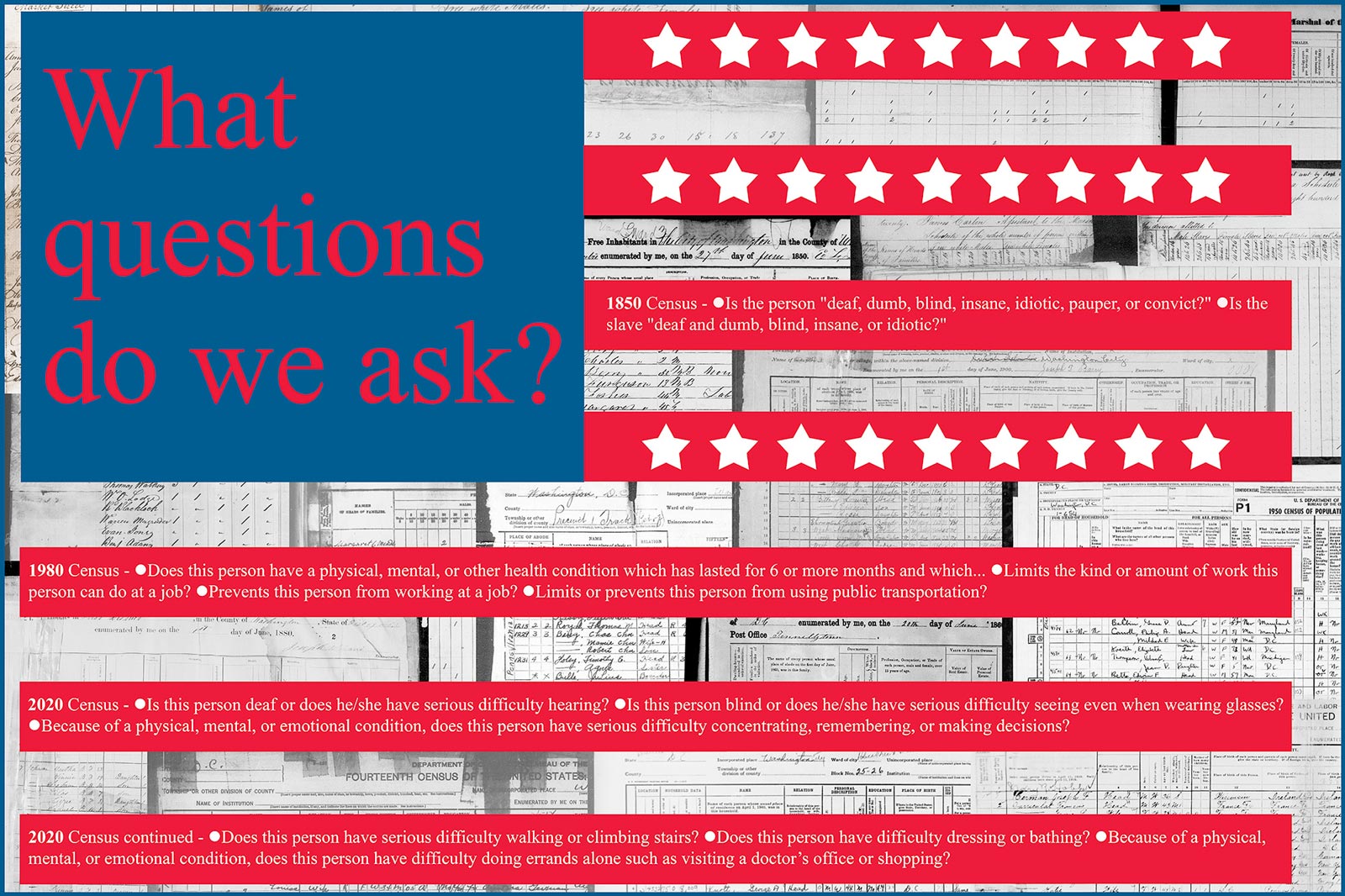
What does it mean to be American? For centuries, the United States Census has tried to answer that question. Encircling the doors of the American University Museum, a striking installation of 11 American flags mounted on aluminum reveals lines of text featuring exact US Census queries asked of citizens from 1790 to 2020.
Making its Washington, DC, debut as one of seven summer exhibitions at the AU Museum running through August 9, What Questions Do We Ask? originally opened at the California Museum of Photography in Riverside, California. In this local iteration, DC-based photographer Gail Rebhan brings to bear a long-standing interest in the Census, a form she notes is “in constant flux.” It’s important to revisit these documents, Rebhan insists, “to know our history, to know where we came from.”
The Census is ever-evolving, the installation makes clear, its questions revealing much about life in America across the centuries. In 1790, for instance, the Census asked citizens to note the number of “free White males” and “slaves” in their households.
By 1850, people with disabilities were referred to as “deaf, dumb, blind, insane,” among other terms. Before 1960, citizens weren’t asked how they got to work, as commuting was less common; and, until the 1970 Census, only “ever-married women (married, widowed, or divorced)” were asked if they had children.
In Rebhan’s view, the Census “tells us both about American history and about what our values were, what categories we were interested in.” On the nation’s 250th anniversary, work like Rebhan’s is newly resonant, says M.J. Rymsza-Pawlowska, professor of history in the College of Arts and Sciences, offering visitors “a moment to reflect, revisit, and, hopefully, redouble our efforts.”
Indeed, this work is a reminder, says Jack Rasmussen, CAS/MFA ’75, MA ’83, PhD ’94, the inaugural C. Nicholas Keating and Carleen B. Keating Director of the AU Museum, that “the American experience is never fixed or complete.” In this, Rasmussen continues, “artists play an essential role in helping society see itself more clearly, ask difficult questions, and imagine new possibilities.”