As Philadelphia prepares for the semiquincentennial, historians are looking beyond the Founding Fathers to uncover the stories of the everyday individuals who shaped the American Revolution.
At the center of this cultural excavation is Les Whitehead, CAS/MA ’25, a collections assistant at the Betsy Ross House. A lifelong love of musicology and eighteenth-century classical music originally sparked Whitehead’s fascination with how early American identity developed through transatlantic cultural exchanges. Driven by this deep interest in the cultural and material history of early America, Whitehead now manages the vast archive of flags, personal artifacts, and historical mysteries at Ross’s mid-eighteenth-century colonial rowhouse, just blocks from Independence Hall.
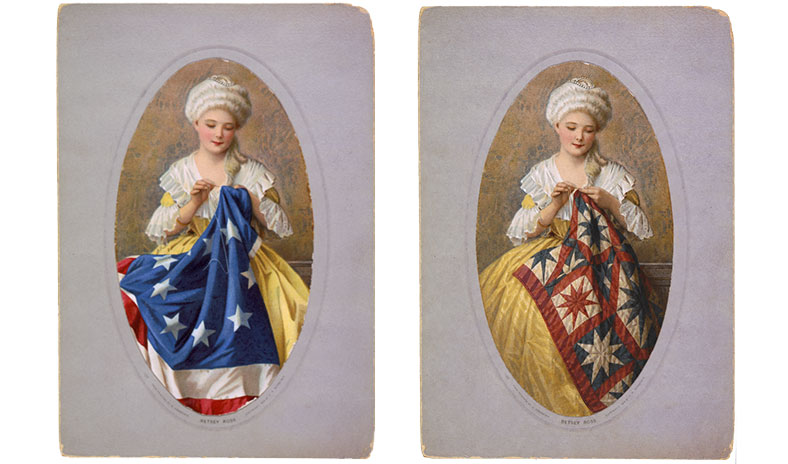
For generations, Ross has been immortalized as the patriotic seamstress who single-handedly stitched the first Stars and Stripes in 1776 at the request of George Washington. However, modern historians view this narrative as a complex mix of history and national lore.
This lack of contemporary primary sources has given rise to a classic case of vexillological vexation—a historic debate over the banner’s origins that continues to stymie scholars and capture the public’s imagination. Did this ordinary middle-class upholsterer actually launch an American icon in her parlor, or is the story an elaborate family myth popularized a century later to drive early American tourism?
In this conversation, Whitehead discusses the enduring power of American myth, the reality of colonial businesswomen, and why vulnerability makes history accessible to everyone.
Q: Most Americans grew up learning that Betsy Ross sewed the first American flag, but modern scholarship suggests that narrative is more complicated. Is the story of the first flag rooted primarily in myth?
A: When you look closely at the primary sources—or rather, the lack thereof—we simply don’t know definitively if she made that first flag. The vast majority of that narrative originates from an oral history passed down by her descendants from her third marriage to John Claypool. They carried out her trade and were deeply familiar with sewing military flags, but their familial accounts didn’t enter the mainstream until a massive promotional push in the 1880s and 1890s when the Weisgerber family purchased the house and heavily marketed it as the “birthplace of Old Glory.”
Even the legendary story of the secret parlor meeting where Betsy used her scissors to convince George Washington to switch from a six-pointed star to a five-pointed star with a single snip is part of that constructed lore. But as an oral historian, I don’t think the lack of definitive paperwork makes her legacy any less vital. Admitting that we don’t have all the answers introduces a wonderful vulnerability to the discipline, making history feel like an accessible mystery we are all solving together rather than a rigid set of facts living in a vacuum.
Q: If we step away from the flag myth, who was the real Betsy Ross, and why does her story still matter to visitors today?
A: What makes her profoundly compelling is that she was a highly skilled, fiercely independent middle-class woman who ran a successful upholstery business in the eighteenth century. Her story allows everyday people to connect with the Revolutionary War on a human scale. It reminds us that you didn’t have to be a towering political figure like Thomas Jefferson or George Washington to play a meaningful role in the movement for American independence.
Furthermore, the evolution of the Betsy Ross myth itself is an invaluable piece of cultural history. It forces us to examine what is being taught in schools, how historical narratives shape our modern perspectives, and why our society tends to only value individuals if they are attached to a monumental achievement. She represents a bridge to the lived experience of the late 1700s.
Q: What are some of your favorite personal artifacts that reveal the unexpected realities of Betsy Ross’s everyday life?
A: The personal belongings hidden away in our archives are phenomenal puzzle pieces. One of my absolute favorites is an original Delft tile from the house, which was built between 1740 and 1760. Delft is a tin-glazed earthenware from the Netherlands designed to mimic expensive Chinese porcelain. It was incredibly popular because it allowed regular colonists to project a sense of class and domestic refinement in their homes without paying foreign luxury prices.
Another crowd favorite is Betsy’s personal snuffbox. Visitors are always shocked to learn that she regularly used snuff—a finely powdered tobacco inhaled through the nose—because she was a Quaker woman. People assume it was a vice out of character for her faith, but using snuff was actually popularized by Queen Charlotte and became an incredibly fashionable activity among elite Quaker women in eighteenth-century Philadelphia. Betsy may have even used snuff for medicinal purposes as well as recreationally.
These objects tell us so much about the vibrant transatlantic exchanges of culture that defined early American identity.