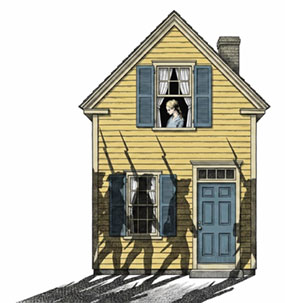
In April 1775, Hannah Winthrop was forced to flee her home in Cambridge, Massachusetts. Her residence—once a place of “calm philosophy,” as the poet and playwright Mercy Otis Warren recalled—was suddenly “occupied by the boisterous sons of Mars,” where the only sound was “the din of arms, and the shrill clarion of war.”
So begins Lauren Duval’s The Home Front, an exploration of the lived experience of the Revolutionary War and its turbulent aftermath. Duval, CAS/PhD ’18, a historian of early North America and the Atlantic World at the University of Oklahoma, writes that the nation’s founding was “a fundamentally domestic story.”
That narrative departs from the traditional lore of Paul Revere and the Minutemen, focusing instead on the realities of everyday life: rampant disease, food shortages, theft, and the pervasive fear “of illness, of death, of bloodshed, of starvation.” Duval insists that studying the domestic sphere is essential to understanding what the Revolutionary War meant for ordinary Americans. In this era, the home was more than a place of rest; it was a symbol of American nationhood and the independence the founders sought to secure. “The war happened not just in those grand moments,” Duval explains, “but also in these quiet, quotidian ones.”
Among these quiet histories is that of Elizabeth Anderson, a domestic servant in New York hired by Lieutenant Colonel Nisbet Balfour and sent to Charleston to prepare his estate. In South Carolina, Anderson oversaw laborers and servants, experiencing a “taste of power” typically reserved for the elite. In her letters, she gushes about the estate, its lush gardens, and its strollable grounds. According to Duval, Anderson represents the many women who viewed the war’s social upheavals as “an opportunity to better their lives.”
The British also influenced the domestic landscape by offering freedom to enslaved people who joined their cause. Many took the risk, seeking what Duval describes as “a possible path to freedom for themselves and their loved ones.”
Duval also highlights the story of Elizabeth Drinker, a Philadelphia Quaker whose home was occupied by a Scottish officer. Despite the intrusion, the two developed a polite rapport: “They had tea together and drank coffee,” Duval says. “He got to know her friends, and she got to know his fellow officers.” While Drinker’s husband was frustrated with the arrangement, the domestic boundaries further blurred when one of their workers ran away to marry an officer’s servant. Duval describes this “nexus of relationships” as a reflection of how people experienced military occupation in ways that were “deeply personal and deeply tied to how they live their lives.”
At the heart of these histories lies a fundamental question: What does American independence mean? “For a lot of people,” Duval says, “it means being safe at home with their families and being secure in their property.”
Following the war, the home front emerged as a symbol of domestic tranquility and American values. Duval contends this was epitomized by the image of George Washington returning to Mount Vernon—a moment “celebrated throughout the nation because it shows the conquering hero returning home.” This emphasis on domestic security is even encoded in the Bill of Rights, which Duval notes underscores the importance of protecting land and loved ones.
“The domestic experience of war,” Duval says, “helped to define the very meaning of American independence.”