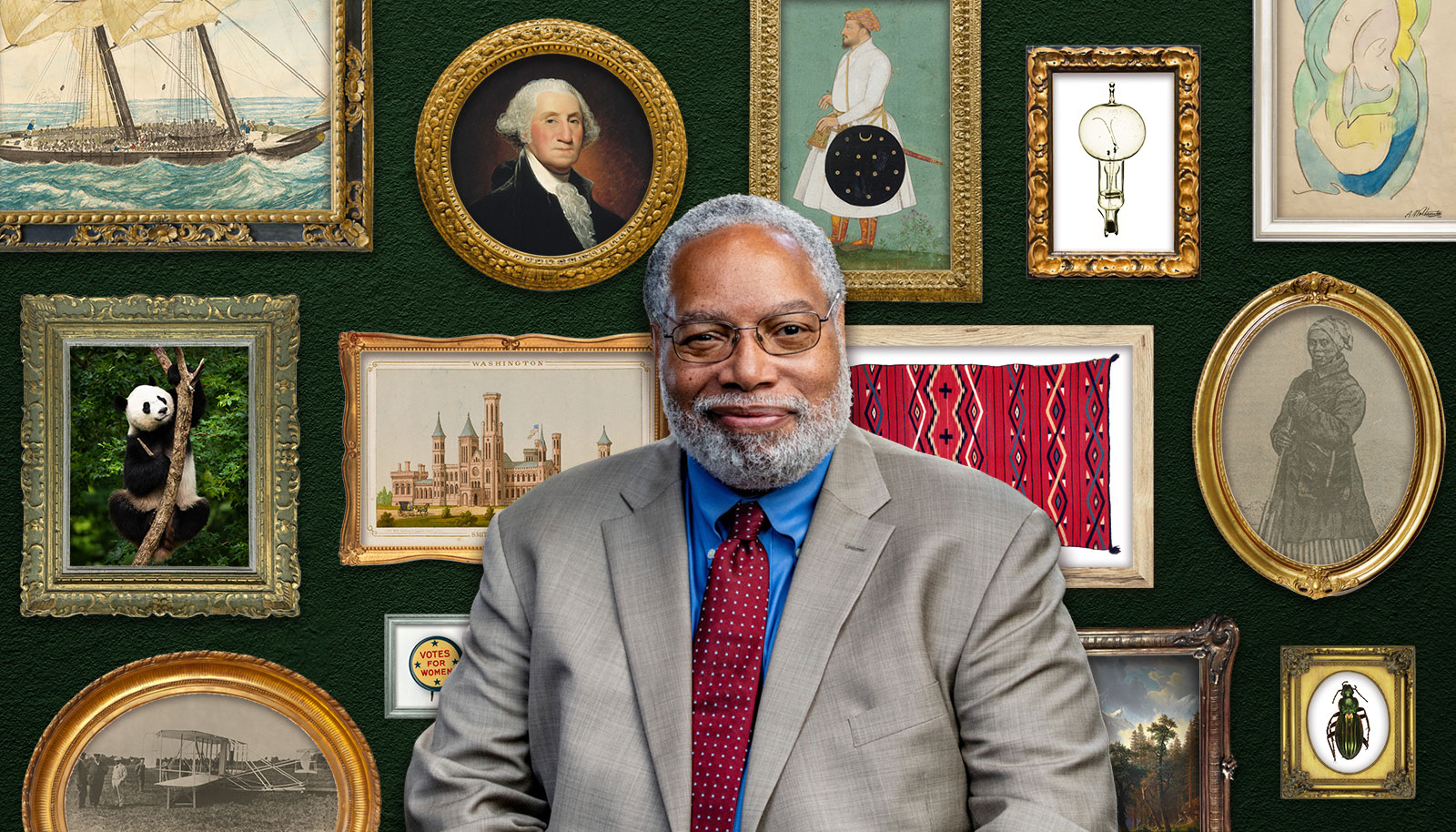
Before he made history of his own as the first African American and the first historian to lead the Smithsonian Institution, Lonnie G. Bunch III, CAS/BA ’74, MA ’76, received a mandate from a man whose memories stretched back to the era of slavery.
Bunch, then a curator at the Smithsonian’s National Museum of American History, was visiting a rice plantation near Georgetown, South Carolina, when he met Princy Jenkins, a nonagenarian who had lived in one of the property’s cabins with his enslaved grandmother. “If you are a historian,” he told Bunch, “then your job better be to help people remember not just what they want to remember, but what they need to remember.”
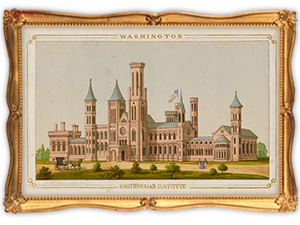
As the 14th secretary of the Smithsonian—where he oversees 155 million objects and specimens at 21 museums and the National Zoo—Bunch lives by that conviction every day, championing history of, by, and for the people. His leadership comes at a pivotal moment of expansion, as he is currently overseeing the development of two forthcoming museums on or near the National Mall, authorized by Congress in 2020: the National Museum of the American Latino and the Smithsonian American Women’s History Museum.
On March 4, Bunch, founding director of the National Museum of African American History and Culture, sat down with American University president Jon Alger to discuss his work and the stories the world’s largest museum, education, and research complex is telling on the nation’s semiquincentennial. The fireside chat was part of AU’s 250+ at American initiative.
“We celebrate America,” Bunch said, “as both a place and an ideal.” It’s that vision—a belief in an unrealized future—that set the nation apart, he told Alger, stirring the founders and stirring us still. “The great strength of America is the opportunity to look at how we have fought, debated, struggled, and protested in order to make concrete the ideals of the Declaration of Independence.”
In this conversation, which has been edited for length and clarity, Bunch reflects on that vision, his work as a historian, and the road that lies ahead—for the Smithsonian and the country.
Q. What role do you think the Smithsonian plays in telling the nation’s story?
A. The Smithsonian is a reservoir that the public can dip into to understand art, history, culture, and science. It is one of the most trusted sources in the world. At a time when people are challenging expertise, at a time when people don’t know what source [they] can count on, the Smithsonian has to be that place that is going to give you an educational opportunity to know more [even if you] may not agree with [it] all the time.
 Q. What exhibitions or permanent collections at the Smithsonian best capture the American spirit?
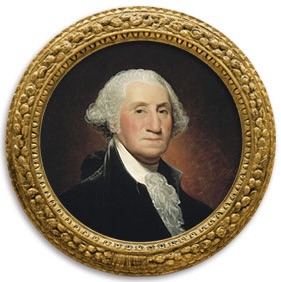
A. The challenge is that America is too big for any one building—it might even be too big for the whole Smithsonian. There are [narratives] that really speak volumes. I love the American Presidency show [at the National Museum of American History]. I helped to curate it, to give people a sweep of the importance of that institution in America.
The Smithsonian has things that inspire, whether it’s Jefferson’s desk or Edison’s light bulb.
It also has things that remind us of the challenges a nation faces: remnants of a slave ship or suffragette buttons from the early twentieth century. It is also a place that allows us to tap into the innovation of a nation, looking at the amazing transformation from the Wright Flyer to going to the moon. The Smithsonian captures the best of America, the challenges of America, and the potential of America.
Q. Is there one artifact that is personally the most meaningful to you?
A. When I was president of the Chicago Historical Society, I was introduced to Mamie Till-Mobley, the mother of Emmett Till. She spoke for seven hours about what happened from the moment she kissed her son goodbye [to] the time she [buried him]. She said to me that for 50 years, she had carried the burden of [his] memory, and then she said, “It’s your turn now.” The next day, she passed away.
I came back to the Smithsonian, and they found [Till’s] original casket. He had been disinterred by the Justice Department in a new casket, and they were supposed to take care of the old casket, but it was thrown in a shed. I initially decided we would collect it and just preserve it. I built a room so nobody could see it, but as we were building the exhibition, I kept hearing [Till-Mobley] say, “It’s your turn to carry that burden,” and I realized that the story wasn’t just the broken body of a young man—it was the courage of a mother at the worst moment of her life, saying, “I’m going to help transform a nation.” The exhibit is the only [one] in the Smithsonian [visitors] can’t photograph.
 Q. What do you think it takes to be a curator and a secretary right now?
A. You’ve got to master your discipline. You’ve got to understand that exhibitions are visual mediums—a mosaic of ideas, words, and images. [But] the reality is that this is a political environment. It used to be that [judging] the totality of a work, people might say, “I don’t like that interpretation, [but] okay, I get it.” Now the totality doesn’t matter. It’s, “You’re telling that story that I think no one should know.”
I would argue that as a curator, you want first to always be driven by the Bible of scholarship. But being smart and being right isn’t enough today. You’ve also got to think about how it plays out [to] take [people] from where they think they are to where you want them to be. Being secretary is the ultimate political game. You’ve got to have thick enough skin so that you don’t fight every day.
You’ve [also] got to remember that, no matter what, it’s about the joy of the Smithsonian. It’s the excitement of going from pandas to dinosaurs, to presidents, to aviation, to science in Panama. You’ve got to always remember that that’s why you’re here. Don’t let anybody take that joy.
Q. What are your guiding questions?
A. How do I help a country understand itself? How do I help a country be better? How do I help bring people together? And how do I celebrate the ideals of a nation but also make those ideals concrete [through] the work that we explore?
 Q. Who has influenced you the most in your life?
A. I used to always watch my parents, two teachers who were probably some of the most educated people in the neighborhood [in Belleville, New Jersey]. They were always tutoring the neighbors’ kids—not for money, just to help them. That notion of giving to make somebody else better, even if it doesn’t help you financially, [is] something that has always shaped me.
The inspiration from my parents was that it’s never about you. It’s about something greater. We used to talk about it all the time, about the greater good. For me, it is, “What’s the greater good I can perform? How do I use history as a tool of transformation? How do I help a nation remember that one of the keys to success is fairness?”
Q. How can the Smithsonian help bridge our current national divides as we approach the nation’s 250th anniversary?
A. I remember the bicentennial; I was in graduate school here at AU, and I would go down to the Mall every afternoon [for] the Folklife Festival. I remember thinking that America in 1976 was a very divided country; we were getting over Watergate [and] Vietnam. [But] I would go down to the Smithsonian and see this amazing array of cultures that contributed to what America was—Navajo code talkers and French Canadian lumberjacks—and that just brought people together at that moment.
I received a letter a couple years before I became secretary, [which] began, “Dear liberal historian. What happened to the Smithsonian I love? It used to tell great, positive stories, and now it’s going to tell stories that are better left unsaid.” And then there was a line I’ve never forgotten: “Don’t you know America’s greatest strength is its ability to forget?”
I think America’s greatest strength is [that] it is a work in progress. My commitment is to tell the full story of America because I believe so strongly that Americans should not be afraid of their own story. [We can’t] erase the rough edges of history.