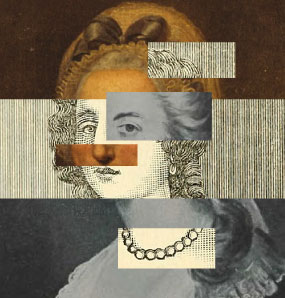
Before she was ever a monument, she was a blank canvas.
Historians know frustratingly little about the daily life, thoughts, or feelings of Mary Ball Washington. Yet over the last two centuries, the mother of the nation’s first president has been repeatedly refashioned—transformed from an idealized icon of nineteenth-century domesticity into a post-Reconstruction slave mistress and later into a needy, overbearing twentieth-century parent.
Now, as America marks its semiquincentennial, history professor Kate Haulman reveals that the changing myths surrounding Washington have never actually been about the woman herself—but rather the evolving motives of the nation she helped birth. Her new book, The Mother of Washington in Nineteenth-Century America, traces this legacy to reveal how the stories we tell about history change over time, and why.
To understand how this happens, Haulman says, we must ask five questions: Who or what is being remembered? When? Why? By whom? And for what purposes?
In the book, Haulman uses Washington as a case study to explore how these changing ideas about motherhood, family, and nationhood fill the gaps left in the historical record. This tension between documented history and collective memory is central to Haulman’s work.
“The discipline of history is grounded in evidence,” she says. “Historians work to understand the past on its own terms. But memory is shaped by the stories that families, communities, and nations tell about themselves. Memory is often more emotionally charged and as much about the present as the past.”
Who Was Mary Ball Washington?
Washington was born around 1708 into a prominent Virginia family. Her childhood was shaped by both wealth and upheaval.
“She lost her father when she was very young,” says Haulman, “but with that loss, she inherited land and enslaved people. The two together—privilege and loss—would in some ways typify the rest of her life.”
Washington’s mother remarried, but both she and Washington’s stepfather also died, leaving Washington orphaned before she was 13 years old. She lived with relatives until marrying Augustine Washington at age 22. Their first child, George, was born the next year, followed by a sister, three brothers, and another sister who died in infancy.
Augustine died when Washington was in her mid-30s. She never remarried—an unusual choice for women of her era. Though records show she lived into her eighties, the details of her daily life remain difficult to reconstruct.
“There’s just a fair bit we don’t know about her, certainly her thoughts and feelings about things,” Haulman says. Only a handful of letters, legal documents, and books survive, leaving the historical record fragmentary.
Imagining the “Mother of Washington”
The first biographical sketch of Washington was published in 1826, more than 30 years after her death. It was written by George Washington Parke Custis—George Washington’s step-grandson and adopted son—who considered himself the ultimate guardian of the family legacy. In his piece, Custis elevated her into the “Mother of Washington”—an idealized maternal figure whose virtues helped explain her son’s greatness.
“Custis created a canon of stories that were picked up by other writers and biographers,” says Haulman. “They repeated, elaborated on, and tried to find documentary evidence for these stories, many of which are still with us today.”
The result was a powerful and enduring image of Washington as the ultimate symbol of traditional domesticity. Her legacy was measured entirely through her son.
“It’s very much part of this thinking that the proof of her greatness as a mother was in the pudding,” Haulman says—“the pudding being George.”
As Haulman notes, once these stories entered the public imagination, they took on a life of their own. Repeated often enough, they came to be accepted as fact. “That’s one of the ways that historical narratives take shape,” she says.
Memories That Change with the Nation
Over time, Washington became many different things to different generations.
In the nineteenth century, Custis’s version of her as an emblem of domestic motherhood dominated public memory. Her image also served as a traditional counterpoint to the real-world women who were beginning to enter public life to advocate for abolition and women’s rights.
That image was reinforced in Fredericksburg, Virginia, where supporters broke ground in 1833 to build a monument in her honor at her burial site. It was a highly unusual tribute, Haulman points out, because monuments at the time were almost exclusively dedicated to male war heroes and political leaders. Financial constraints caused the project to stall, leaving the monument unfinished for decades.
More than 60 years later, women’s organizations—including a local group in Fredericksburg and a national society connected to the Daughters of the American Revolution—stepped in to complete the memorial. The resulting simple obelisk is a smaller version of the Washington Monument, which, coincidentally, had also stood incomplete for years.
After the Civil War, new layers were added to the elder Washington’s memory. Though she had been a lifelong slaveholder, slavery and enslaved people did not appear in accounts of her life until the 1880s. Informed by post-Reconstruction white supremacy narratives and popular plantation fiction, writers increasingly portrayed her as a firm yet kind Virginia slave mistress.
The tone shifted again in the twentieth century. “She becomes more complicated,” Haulman says. “In fact, her reputation as mother underwent a dramatic reversal.”
Some biographers began describing Washington as difficult, needy, and overbearing. Drawing on limited evidence—such as her opposition to 14-year-old George joining the British Royal Navy—they reinterpreted her role in his life. These modern interpretations reflected twentieth-century psychological trends and a cultural desire to give George sole credit for his own greatness.
What is important to remember across all these shifts, Haulman says, is that the woman herself never changed—only the motives of the people describing her did.
History in the Present Tense
Now, as the nation marks its 250th anniversary, this myth-making process continues to unfold.
As Americans encounter historical commemorations, monuments, and exhibits during the semiquincentennial, Haulman hopes they will look closer at who is telling the story, how, and why.
“What is being foregrounded in the national conversation about the founding era and what is being downplayed or left out entirely?” she asks.
History, she notes, is always evolving as scholars uncover new evidence and ask new questions.
“Historians are trying to recover the past and do right by the people who lived it,” she says. “We do this to understand both the past and the present, strengthen knowledge, build empathy, and inform how we show up in the world today.”