For Joshua Bayer, musician in residence in the College of Arts and Sciences, jazz is more than a genre. “It’s our classical music.”
Jazz originated in New Orleans in the early twentieth century. There, the original Dixieland jazz band, the New Orleans Rhythm Kings, ushered in a distinctive, fluid sound, inflected with the blues. It was a uniquely American music, drawing from Caribbean and European roots but reverberating with rhythms all its own.
The swing era followed with Duke Ellington and Benny Goodman, known for their large, bombastic orchestras, or, as Bayer puts it, “the music your parents wouldn’t let you go see.”
Bayer, director of the American University Jazz Orchestra, has spent his career mastering those rhythms. A prolific jazz guitarist, bassist, and composer, he has performed at premier venues and festivals worldwide, honing an ear for the dips and swerves of a perfect tune.
Bayer’s journey began in Cleveland, where he started piano lessons at age four. His father later built him a wooden turntable and gifted him his first Miles Davis record. In high school, Bayer joined the jazz band, drawn to the music’s inherent improvisation, the sense of controlled serendipity.
That spontaneity sets jazz apart, Bayer says—a bold improvisation, the artist’s ability to “rewrite the song on the spot.” Yet, he notes, jazz is far from unplanned. It is meticulously studied, with each performer working within a song’s delineated structure—its chords and melody—to arrive at something new.
It’s that love of experimentation which defines the best players, Bayer says, a willingness to keep at their art, to perfect their craft. “It’s not a gift,” he adds. “The only gift jazz musicians have is the ability to practice and be willing to try new things.”
Here, Bayer shares his definitive jazz catalog:
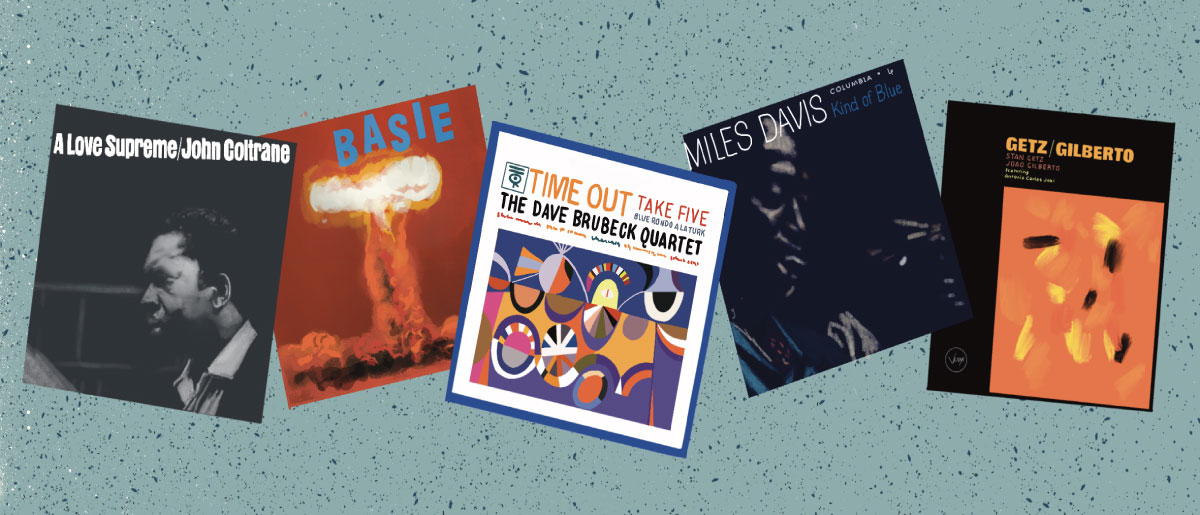
The Atomic Mr. Basie (1958): One of Bayer’s favorite albums and a rare big-band crossover into the pop charts, this record captures a “phenomenal” 16-piece sound. Its ricocheting energy fills a room with a buoyant, freewheeling atmosphere. Arranged by Neal Hefti—of 1966 Batman theme fame—the album features the same powerhouse ensemble that backed Ella Fitzgerald and Frank Sinatra and includes a track that Bayer says “saved my life.”
Kind of Blue (1959): This Miles Davis masterpiece “stripped it back down again,” replacing dense complexity with a mellower, modal feel and sparser harmonies. Featuring luminaries like John Coltrane and Bill Evans, the album defined a new era of individual style. These were not show tunes adapted for the stage, but “jazz tunes written for jazz music’s sake,” many of which became the genre’s first true standards.
Time Out (1959): The Dave Brubeck Quartet wowed listeners with this album, which “makes use of unusual time signatures, in particular the 5/4.” It possessed a dexterity and rhythm all its own, and the result was an “incredibly popular commercial success” that proved jazz could be both brainy and bankable.
Getz/Gilberto (1964): Credited with ushering in the bossa nova craze of the 1960s, this collaboration between American saxophonist Stan Getz and Brazilian guitarist João Gilberto produced a landmark sound. The album featured the global hit “The Girl from Ipanema,” which famously beat out the Beatles for 1965 Record of the Year at the Grammys.
A Love Supreme (1965): John Coltrane’s seminal work marks the moment “when jazz became American art.” Arranged as a continuous suite rather than a collection of songs, it reimagined the genre as “experimental modern art”—not unlike a Picasso painting. Its diaphanous tracks push modern harmonic techniques to their limit, offering a sense of spirituality that remains influential decades later.