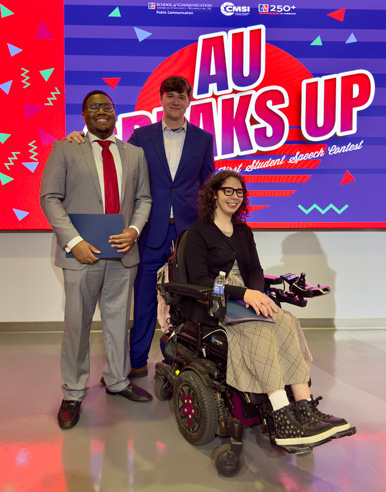
For five years, an idea quietly lingered in the back of the minds of School of Communication faculty: a public speaking showcase that would celebrate not just oral delivery, but the profound substance of student speechwriting.
So, when the university announced its 250+ at American initiative exploring the history and future of democracy, the timing was finally perfect. Funded by a partnership with SOC’s Center for Media and Social Impact (CMSI), the inaugural AU Speaks Up speech contest was born.
The parameters were rigorous. Open to students across the entire university, participants were tasked with writing an original 650–750-word speech reflecting on the constitutional promise of “We the people.”
After a preliminary review by faculty judges, eight finalists were selected to deliver their words on May 6 before a packed house at SOC’s Media Innovation Lab. Students were evaluated not by standard academic rubrics, but by seasoned professional speechwriters, including former Clinton chief speechwriter Terry Edmonds and Biden administration speechwriter Mary Robbins, SOC/MA ’11, and Professor Caty Borum, executive director of CMSI.
“Each student raised vital questions and delivered unique insights on what it means to be a part of this country,” says Robbins, host of The Speechwriter’s Room podcast. “It made judging the contest difficult but the event worthwhile. As a speechwriter, I was impressed; as an alumna of SOC’s grad program, I was proud.”
While some entries leaned into policy and debate, the top winning submissions stood out for their deeply personal vantage points.
The top three winners took home a combined $1,000 in cash prizes—and the reach of their words will soon extend well beyond campus. The speeches delivered by first-place winner Demar Goodman, SPA/BA ’27, and third-place winner Anja Herrman, SPA/BA ’29, are slated for publication on July 2 in the Harvard Advanced Leadership Initiative journal, Social Impact Review.
Goodman—one of a handful of CLEG (communications, legal institutions, economics, and government) majors to compete in AU Speaks Up—says that the event serves as a call to action for the university community. “Outlets like this are essential to surviving the next 250 years and challenge us not to be complacent, [as] there is always still work to do.”
Event organizer Dina Inverso, SOC/BA ’97, MA ’06, recalls being profoundly impacted by the students’ words. “I walked out, and I was so happy, my heart was so full,” says the Hurst senior professorial lecturer and director of SOC’s public communication division. “I was so impressed not just with their writing abilities and their poise but with their messages of inspiration.”
Following the success of this first showcase, Inverso says SOC hopes to expand the competition to graduate students and establish it as an annual signature event for the school.
Below are the powerful, evocative texts from the three top prize winners—speeches that ultimately left the panel of judges and the campus community with an enduring message of hope for the next 250 years.
First place: Demar Goodman, SPA/BA ’27
We the people isn’t just a phrase, it’s a promise unkept.
You see, I know what we the people means to my people. To us, we the people is a slap in the face. We the people, to us means, we the people who built the people’s house brick by brick, stone by stone and lifted up the occupant of it on our backs. But its office wasn’t made for us, but its powers and duties are routinely enacted on us. We the people who are supposed to grit our teeth and turn the other cheek.
I know what we the people means to my people. It means we the people who fed children in the mornings with the Fred Hampton, who revolutionized art and culture with Maya Angelou, and who advanced our sciences like George Washington Carver. And then, we the people who this country is going to hit in its crossfire. Like Crispus Attucks, an African American man who was the first American killed in the American Revolution. Like Private Charles Lewis, Sergeant Major John Green, Robert Truett, Herman Arthut, and the many more veterans and soldiers who were murdered after serving this country in World War I. Like Ahmaud Arbury who was shot for jogging in the midst of racial unrest for rights in this country. We the people who are expected to fight wars in defense of this country while dealing with a war on us by this country.
It is easy to dismiss the interpretations of these words as semantics, but that is a gross misunderstanding of all 250 years of this country’s history. Semantics gave us the Declaration of Independence that established our sovereignty from the British empire. Semantics gave us three coequal branches and a Constitution shaped by debate from the Federalist Papers. Semantics gave us the Civil Rights Act that ended legal segregation and discrimination. Semantics gave us Title IX that prohibits sex-based discrimination. Semantics are essential to surviving the next 250 years.
So, when I say that we the people cannot just be words that are left to be fading on paper, it is semantics but also an instruction to remember the past to preserve our future. DEI protects minorities, pronouns protect identity, but ethnic equity can and will protect this nation. We the people must make it so. It doesn’t matter if you’re Black, white, Hispanic. Gay, straight, or queer. Male, female, anything in between, or everything outside. We the people too.
For the next 250 years, we the people too.
And every year after that, we the people too.
Second place: Samuel Stiles Williams, SPA-SOC/BA ’27
Our nation’s story has centered around defining who’s included in that phrase.
For the majority of history, America’s definition was far too restrictive.
Our institutions, our political systems, even the document where these words originated, were based on a “we” that consisted of some.
White, wealthy, heterosexual, men.…
Thankfully, our history did not end there.
Through the rifles of rebellion and the soldiers of the Civil War, we the people grew.
Through the songs of suffragettes and the chants of child laborers, we the people grew.
Through the sermons of Southern preachers and the influence of immigrants, we the people grew.
Using the bridges of Selma and the bricks of Stonewall, Americans fought to be included in our country’s story.
Now, at our 250-year anniversary, we stand at a crossroads.…
The better path.…exchanges partisanship for pluralism.
It demands that we engage with those we disagree with, without shutting down or pulling away.
That’s what our founding documents call us to.
To embrace the conflict within we the people while continuing to build something better.
Because the United States.…sets itself apart by aiming towards a “more perfect union.”
Not a utopian fantasy.…but a messy, conflicting, active movement.
Third place: Anja Herrman, SPA/BA ’29
It wasn’t until I had my first taste of true civic rebellion, that I realized what we the people really is: a call to create community.
When I joined a local disability rights advocacy group, I never expected to be lobbying in DC.…As my new friends and I gazed at the Capitol’s impressive (and intimidating) dome, we were chiefly aware that the framers didn’t consider any of us, as people with bodies and brains so brilliantly far from “normal” in their we the people when drafting the Constitution. But what did that matter?…
When creating community, it’s not about finding the absolute “right” thing but rather listening to everyone and creating what’s right together.…
Now, it’s critical that we heed the framers’ call to build community on our own campus. How? By seeing disagreement as an opportunity to understand perspectives that are different from yours and use that understanding as a starting point for discussion.…
These moments may seem small, but they are how you build and build upon the community that’s all around you. We the people was never meant to be finished. We all have to build it, together.