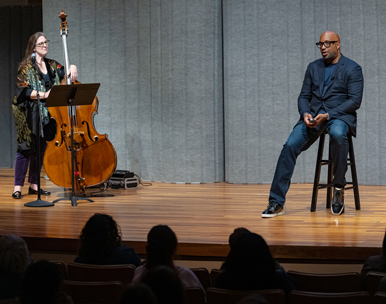
When Emmy-winning producer, poet, and Sine Institute 250+ at American Fellow Kwame Alexander stepped onto the stage at the Katzen Arts Center’s Abramson Recital Hall on April 8, he was supposed to have a familiar partner by his side. His close friend and longtime artistic collaborator, the singer and composer Maritri Garrett, had been scheduled to perform with him.
But just two weeks before the event, Alexander received devastating news: Garrett had passed away.
Alexander met Garrett decades ago at an open-mic night in Georgetown. She was “a consummate jazz musician,” Alexander says, who “knew music intimately.” In the days after her passing, Alexander turned to poetry, an art form with “a transformative and restorative power.”
As a child, Alexander gravitated to the poetry collections of Dr. Seuss and Lucille Clifton. He was so enraptured by Nikki Giovanni’s 1976 “Dance Poem”—beginning “Come Nataki dance with me”— that he begged his mother to name his newborn sister Nataki.
Grieving Garrett, Alexander turned to a different kind of poem, something that would capture the weight of his loss and honor the years they had spent performing together, delighting in the rhythms of verse.
The work he arrived at was a seemingly simple one: “Poem (To F.S.),” by Langston Hughes.
Accompanied by the somber notes of bassist Amy Shook, Alexander read the piece in Garrett’s honor. Composed of only six lines, the poem lands perfectly, each word selected with care. “I loved my friend,” it reads. “She went away from me / There is nothing more to say.” The poem has the quality of a whisper, ending, Alexander observes, “as softly as it began.”
Hughes, whom Alexander calls “the Shakespeare of Black America,” was a distinctive stylist whose lines spoke directly to the masses. “He had a way,” Alexander notes, “of distilling the whole human heart in so few words.”
There are insular poets, he continues, and then there was Hughes, “who was not writing for other poets; he was writing for the people.”
For Alexander—the bestselling author of 46 books, including Say Yes: Find Your Passion, Unlock Your Potential, Transform Your Life, inspired by his 2024 commencement address to graduates of AU’s College of Arts and Sciences and School of Education—language is a “life-giving breath” that allows us to survive despair and imagine new futures.
Poems like these, which explore the language of truth through life’s ongoing trials, take on a new cast as the nation celebrates its 250th anniversary, says Alexander. They offer “a view of America through the heart and through the soul.”
Kwame Alexander will present “The Power of Storytelling: Poetry, Identity, and Social Change” on July 14 from 6:30 to 8 p.m. at the Olney Theatre Center. AU’s Sine Institute of Policy and Politics will stream the performance live.