The deadliest military conflict in human history arrived on the shores of the contiguous United States on Sunday, January 11, 1942.
Operation Drumbeat began with the deafening explosion of a torpedo ripping into the Cyclops. With just 18 hours left in its one-month voyage to Nova Scotia, the British freighter was “struck without warning” by a German U-boat off the coast of New England, according to Ed Offley’s The Burning Shore. The attack tore a gaping hole in the vessel’s starboard side, quickly sinking it.
The Cyclops was the first casualty in a wildly successful, monthslong Axis submarine campaign targeting Allied cargo ships to sever the flow of fuel and supplies across the Atlantic.
During the operation, which the Nazis nicknamed “American shooting season,” U-boats “rampaged practically unopposed” from January to mid-June. According to The Burning Shore, they sank 226 Allied merchant ships and prevented 1.25 million gross registered tons of provisions from reaching their destination. While the barrage killed 4,000 people, only seven German U-boats were lost during the entire operation.
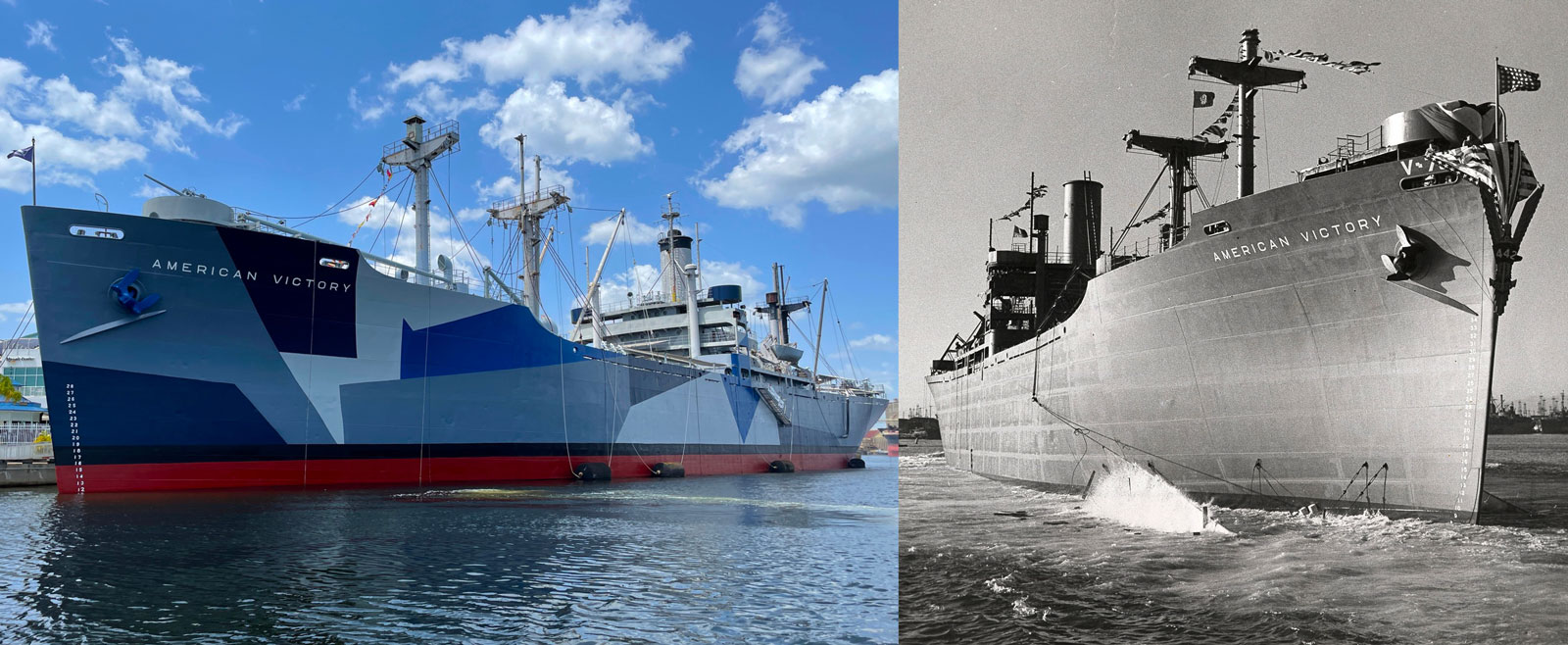
The urgent quest to end this coastal havoc led directly to the creation of a cargo vessel named for American University. A surviving symbol of the industrial might that turned the tide of the war, that very ship still sails today.
From the Quad to the Coast
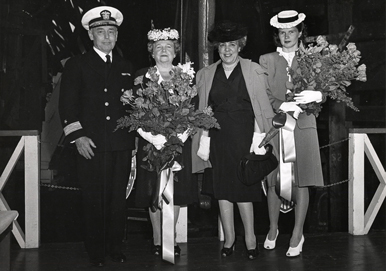 The SS American Victory launched from the California Shipbuilding Corp. shipyard in Los Angeles on May 24, 1945. The ship was christened by the wife and daughter of Captain George J. McMillin, who had been taken prisoner of war in Guam the day after Pearl Harbor and remained in Japanese captivity.
Built primarily by women, the 455-foot-long ship was completed in just 55 days at a cost of $2.5 million. The US Maritime Commission named it after AU to honor the university’s vital contributions to military training during both world wars.
During World War I, AU turned over its unfinished campus to host Camp American University and Camp Leach, serving as a hub for the Engineer Officers’ Reserve Corps and the Bureau of Mines. During the Second World War, the university again mobilized, transforming its campus into a specialized training facility for Women Accepted for Voluntary Emergency Service, a division of the US Navy Reserve established in 1942; the Red Cross; military communication schools; and the Navy Bomb Disposal School, which graduated over 1,000 bomb-disposal experts.
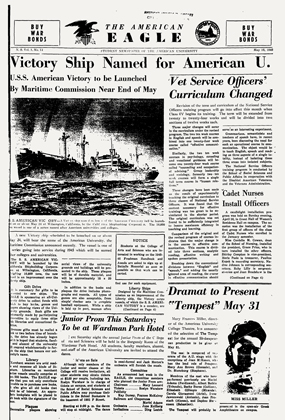 When news of the ship’s impending completion reached campus, The Eagle organized a drive for books, records, and games that could help mariners pass the time at sea. “It is hoped that students, faculty, and alumni of the university respond wholeheartedly to furnish the ship that honors our university name,” read a May 15, 1945, front-page story.
The student newspaper also contributed decorative plaques featuring aerial views of campus grounds, cementing the bond between the school and the ship.
Today, the SS American Victory is one of only three fully operational ships left from the 531 Victory-class vessels built during the war. Since 2003, it has served as a museum and memorial honoring the United States Merchant Marine—the civilian-staffed fleet that sustained Allied forces by transporting food, equipment, and ammunition to the front lines.
During the war, more than 243,000 American merchant mariners sailed to the European and Pacific theaters. Approximately 1 in 26 died in the line of duty—a higher casualty rate than any branch of the US armed forces. Although they were civilians employed by the wartime Maritime Administration, these mariners were retroactively granted veteran status in 1988.
“They have returned voluntarily to their jobs at sea again and again, because they realized that the lifelines to our battle fronts would be broken if they did not carry out their vital part in this global war,” President Franklin D. Roosevelt said of the Merchant Marine in 1943.
Mass Production, Massive Impact
Before the American intervention, the Axis powers severely underestimated how heavily an Allied victory would rely on US production lines. “An American intervention by mass deliveries of planes and war materials will not change the outcome of the war,” German dictator Adolf Hitler confidently declared in 1940.
But in December 1940, Roosevelt famously called upon the nation to become the “arsenal of democracy.” At his behest, American manufacturers pivoted from civilian goods like toys and automobiles to airplanes, guns, tanks, and ships.
“We cannot outfight our enemies unless, at the same time, we outproduce our enemies,” Roosevelt stated in his January 1942 budget message to Congress. “We must outproduce them overwhelmingly, so that there can be no question of our ability to provide a crushing superiority of equipment in any theater of the world war.”
By 1945, the United States was producing nearly two-thirds of all Allied military equipment. Cargo ships were the lifeblood of this supply chain, but the Allies faced a crippling shipping shortage.
That changed on January 3, 1941, when Roosevelt announced a $350 million plan to build 200 new merchant vessels based on a rugged British design. Thanks to an efficient mass-production system devised by industrialist Henry J. Kaiser, these “Liberty ships” could be built in a matter of weeks. From 1941 to 1945, shipyards churned out more than 2,700 Liberty ships—the largest fleet ever assembled—creating an armada so massive that supplies kept flowing despite relentless U-boat attacks.
“The whole war would have ground to a halt if they didn’t have this fleet,” says Christian DeJohn, SPA/BA ’92, an Army veteran and military history instructor at Liberty University.
Ramming Through the Cold War
By 1944, Liberty ships were being superseded by larger, faster, and more durable Victory ships, which could carry 10,750 tons of cargo and boasted a maximum cruising range of 23,500 miles.
The SS American Victory was the 442nd ship built at the California Shipbuilding shipyard. By the time it reported for duty in the spring of 1945, the war was nearing its end. As “Rosie the Riveter” and “Wendy the Welder” put the finishing touches on the hull, Germany surrendered. Just over two months after the ship hit the water, the US dropped atomic bombs on Hiroshima and Nagasaki, Japan, forcing Japan’s surrender on September 2, 1945.
In May 1945, the SS American Victory carried military cargo on its inaugural voyage to Manila, Philippines, and Shanghai, China. By November, as global demobilization began, the ship sailed to Calcutta, India, and Egypt to collect supplies, delivering them to New York City in January 1946.
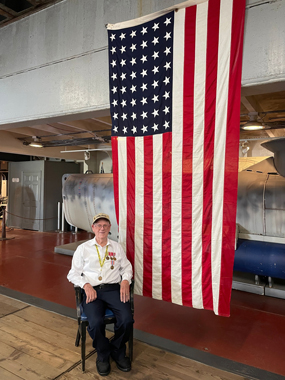 Remarkably, the ship’s service to the nation spanned several more decades. Under the 1947 Marshall Plan—a $13.3 billion US aid package to rebuild war-torn Europe—the vessel delivered vital food and machinery to ports of call in Trieste, Italy; Constanta, Romania; Piraeus, Greece; Antwerp, Belgium; and Odesa, Ukraine.
It was in Odesa, in January 1947, that a moment of American stubbornness foreshadowed the shifting global order. Stranded in the frozen Black Sea, the crew was asked by a Soviet icebreaker to delay the ship’s departure for a week until the ice could be cleared. Captain A.D. Cushman refused. Ordering full steam ahead, the American Victory spent 36 grueling hours repeatedly ramming the ice to forge its own path out—much to the irritation of the Soviets.
In 1952, the ship was reactivated to supply American and United Nations troops in the Korean War. In March 1953, it made a solemn voyage home carrying the bodies of 370 American soldiers killed in action.
After a brief deactivation in 1954, the ship was called upon yet again in 1966 to transport military vehicles, ammunition, and heavy equipment to South Vietnam.
Sailing into History
The aging vessel spent three decades mothballed in the James River Reserve Fleet between 1969 and 1999. It was slated to be scrapped in October 1999 when Captain John C. Timmel, a Tampa Bay harbor pilot, purchased it. Timmel had been searching for a historic vessel to convert into a World War II museum and memorial.
“It was really the name American Victory that [sealed] it,” says Lindsay Ryan, museum consultant for the American Victory Ship and Museum, who has worked on the vessel for five years. “How could you pass up that name? It can’t get much better than that.”
Over a 17-day, 2,400-mile journey, a skeleton crew dodged Hurricane Floyd while towing the ship from Virginia to Tampa. It then took four years and nearly 80,000 volunteer hours to restore the SS American Victory to its pristine 1940s condition.
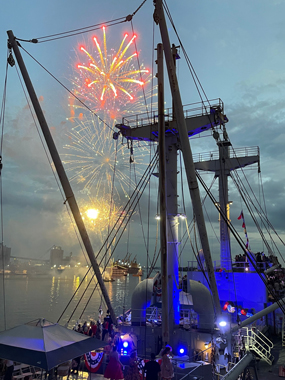 Since opening to the public in 2003, the museum has welcomed about 36,000 visitors annually. Guests can explore three levels of cargo holds, the radio and gyro rooms, the hospital, the galley, weaponry platforms, and steering stations.
“You can teach history a lot of different ways, but being able to explore the ship leaves a lasting impact on people,” Ryan says.
The vessel remains in full working order today—no small feat for a ship built for brief wartime shelf life. “These ships were not meant to last,” Ryan notes.
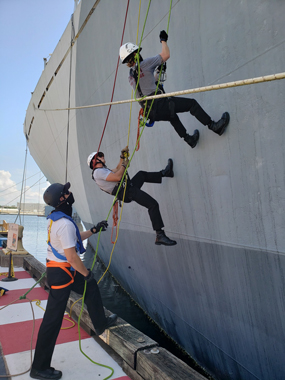 Recently, Governor Ron DeSantis designated the SS American Victory as Florida’s official state flagship. Today, it serves as a unique training platform for local fire and police departments, as well as the FBI.
For Ryan, the legacy of a ship built largely by women during a time of immense global crisis is a powerful reminder that “everybody has a part to play” in democracy.
Adds the military historian DeJohn: “When you look at the ship’s history, it shows you what Americans can do when they unite behind a common cause. For our [nation’s] 250th anniversary, the country desperately needs more stories of what [we] can do when [we] come together.”