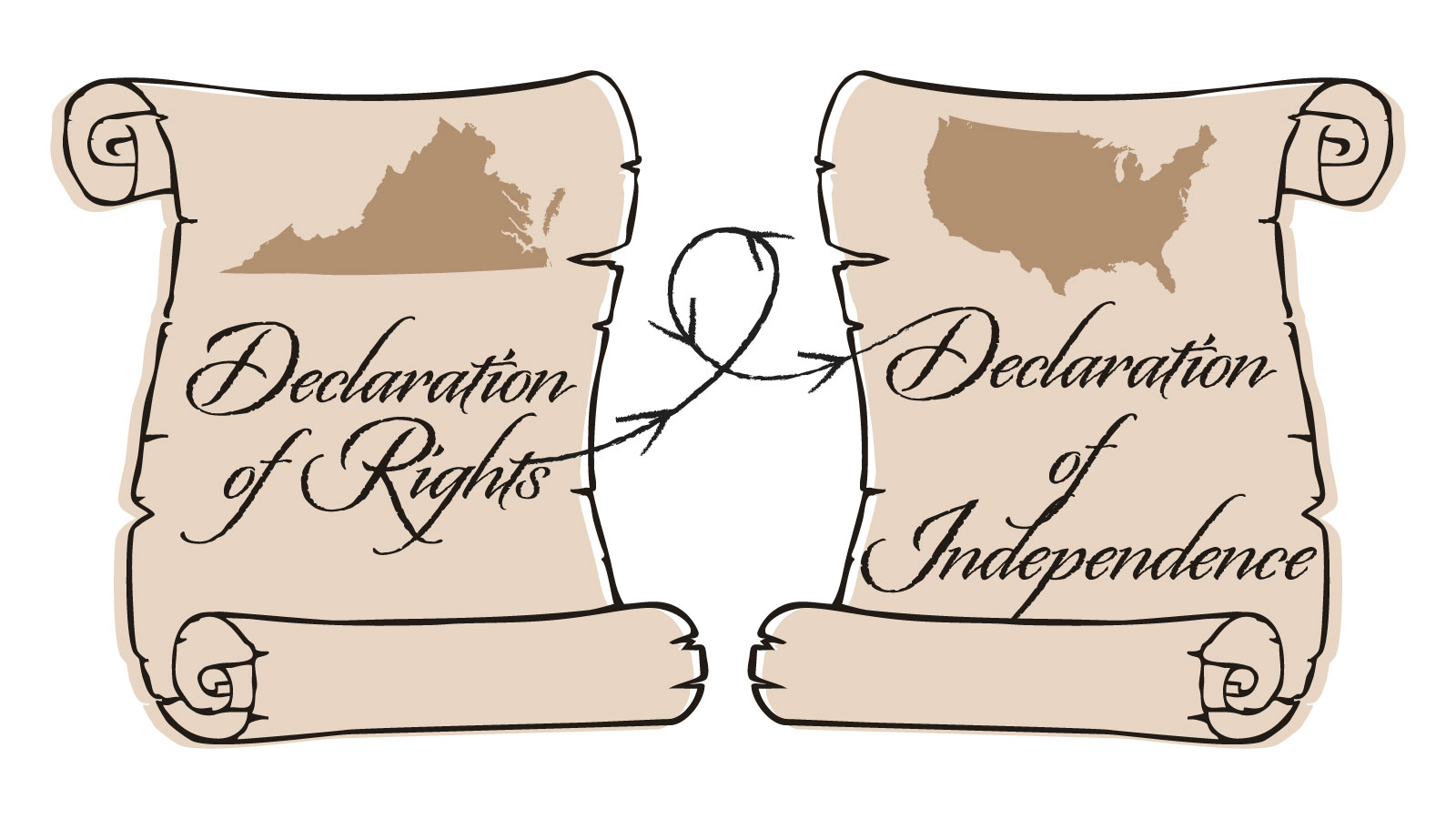
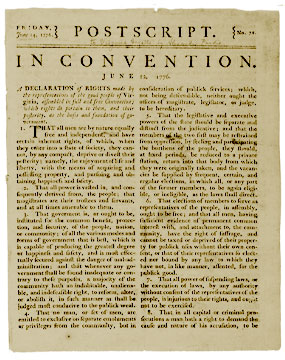
Weeks before the Declaration of Independence was signed, the Virginia Constitutional Convention adopted a decree of its own, enumerating the rights of its citizens, beginning with “the enjoyment of life and liberty” and the pursuit of “happiness and safety.”
Drafted by George Mason in May 1776, the Virginia Declaration of Rights remains a cornerstone of American government—what Daniel Dreisbach, a professor of justice, law, criminology, and security in the School of Public Affairs, calls “a remarkable distillation of the republican thinking of the day.”
By severing ties to Great Britain, Dreisbach explains, Virginia was effectively declaring its sovereignty and, by extension, the rights of its citizens as human beings. The document functions as a “social contract,” he says, asserting Virginia’s authority in a new political order. According to Dreisbach, one of the central questions the text answers is, “What would it mean to Americans at the time to be an independent republic?”
For Mason and his contemporaries, it started with basic freedoms: a free press, the right to a public trial, and self-government led by representatives of the people. It’s a declaration of “the basic principles of republicanism,” Dreisbach says.
Those principles were far-reaching. Indeed, the Virginia Declaration of Rights left its mark on many other foundational texts, including the Declaration of Independence, with its famous promise of “life, liberty, and the pursuit of happiness.” It is, Dreisbach says, “about as close as Americans have to a political creed.”
Historians know a draft of the Virginia Declaration circulated throughout the colonies, eventually ending up in Thomas Jefferson’s hands. It also informed other state constitutions; the Declaration of the Rights of Man and of the Citizen, adopted in France in 1789; and the Universal Declaration of Human Rights of 1948. “It may well be the most imitated of American founding documents,” Dreisbach says.
Of its 16 sections, the final one, concerning religious freedom, is particularly telling. In his original draft, Mason wrote about tolerating the free exercise of religion. James Madison, a young delegate at the convention, objected. “He said, ‘Look, toleration is not good enough. What we have to argue for is religious liberty,’” Dreisbach explains.
The distinction is critical. “Toleration assumes that there’s an authority that’s granting you the right to practice your religion,” Dreisbach says. “But if there’s an authority that can grant you that right, they can just as easily take it away. They can revoke it.” Madison argued that the declaration must be rooted in natural rights—inherent privileges that government cannot strip away.
It’s “a profound innovation in the way we think about the free exercise of religion,” Dreisbach says. Ultimate in its scope, the Virginia Declaration stands as a brilliant encapsulation of the very principles on which the nation was founded.
 Founding Fathers, Familiar Phrases
Before Thomas Jefferson penned the Declaration of Independence, George Mason had already drafted the blueprint in the Virginia Declaration of Rights. While few long phrases carried over word for word, a direct comparison of the final texts reveals how Jefferson seamlessly adapted Mason’s structural framework and core vocabulary. By elevating Mason’s regional declaration into a universal manifesto, Jefferson transformed a localized social contract into an enduring creed for an entire nation.
The parallel evolution of these founding ideals is strikingly evident when comparing four key passages side by side:
Virginia Declaration of Rights: “… that all men are by nature equally free and independent …”
Declaration of Independence: “… that all men are created equal …”
Virginia Declaration of Rights: “… and have certain inherent rights …”
Declaration of Independence: “… that they are endowed by their Creator with certain unalienable Rights …”
Virginia Declaration of Rights: “… namely, the enjoyment of life and liberty, with the means of acquiring and possessing property, and pursuing and obtaining happiness and safety.”
Declaration of Independence: “… that among these are Life, Liberty, and the pursuit of Happiness.”
Virginia Declaration of Rights: “… that whenever any Government shall be found inadequate or contrary to these purposes, a majority of the community hath an indubitable, unalienable, and indefeasible right, to reform, alter, or abolish it.”
Declaration of Independence: “… that whenever any Form of Government becomes destructive of these ends, it is the Right of the People to alter or to abolish it.”