
Remembering September 11: Lisa Arakaki’s Story of Community and Remembrance
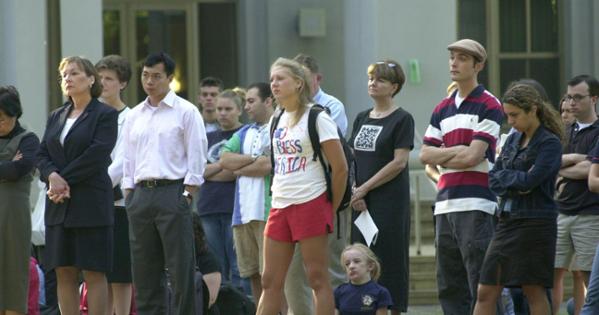
For Lisa Arakaki, special assistant in the president’s office, September 11, 2001, lives in a series of vivid images.
She was grabbing coffee on the first floor of Mary Graydon Student Center that morning when she noticed a small group gathered around the television, watching the TODAY Show after the first plane struck the World Trade Center.
“Unfortunately, we were watching as the broadcast aired the second plane hitting the South Tower,” Arakaki recalls. “Everyone was in a daze. There were so many rumors swirling around about different targets.”
Twenty-five years later, Arakaki still remembers those moments with striking clarity. But her memories of September 11 extend far beyond that morning. They include the uncertainty that followed, the ways the American University community cared for one another, and her own role in helping the university remember the five AU alumni lost.
In the immediate aftermath of the attacks, classes were cancelled, and university leaders knew the community needed a place to gather. Former University Chaplain Joe Eldridge worked with leadership to organize a vigil on the Quad that afternoon.
Two days later, the fear intensified.
On September 13, AU received a bomb threat. The campus was evacuated, and students and employees gathered in the parking lot where East Campus stands today.
“It was a really stressful day and one that sticks out to me almost as much as September 11,” Arakaki says.
She remembers students emerging from their rooms without shoes and still wearing pajamas and robes. But amid uncertainty, she also witnessed something that would become a defining part of her memories of that time: people stepping up to help.
Staff members moved into the street to stop traffic on Nebraska Avenue. Dining Services and the Campus Store mobilized to provide food, water, and extra clothing.
In the weeks that followed, campus remained “very somber.” Many members of the AU community had connections to New York, New Jersey, and Pennsylvania. Some had lost loved ones. Others were still waiting for news.
The university also worked to ensure that grief and fear did not become prejudice. Professors held discussions about stereotyping and emphasized that Middle Eastern community members should not be blamed for the attacks or made to feel unwelcome.
Those experiences shaped Arakaki’s understanding of what it meant to belong to AU.
“September 11 brought everyone together,” Arakaki says, remembering the support she saw from university leadership and across the community.
That sense of community became especially important as the university approached the first anniversary of the attacks.
The university wanted to honor the five alumni who had been killed on September 11: Peter C. Alderman, Kogod/BS ’99, Linda K. Gronlund, WCL/JD ’83, John P. O’Neill, SPA/BS ’74, Mark E. Schurmeier, Kogod/MBA ’88, and Ernest M. Willcher, WCL/JD ’68.
Staff, faculty, students, and alumni came together to plan a day of remembrance on September 11, 2002, including a candlelight vigil, panel discussions, and a ceremony honoring the five alumni. Arakaki played a leading role in planning the commemoration ceremony and the dedication of AU’s Memorial Plaza.
The ceremony, held at the Woods-Brown Amphitheater, brought the community together for presidential remarks, musical performances, a student reflection, and a flag ceremony honoring the five alumni. It culminated in the dedication of the Memorial Plaza plaque.
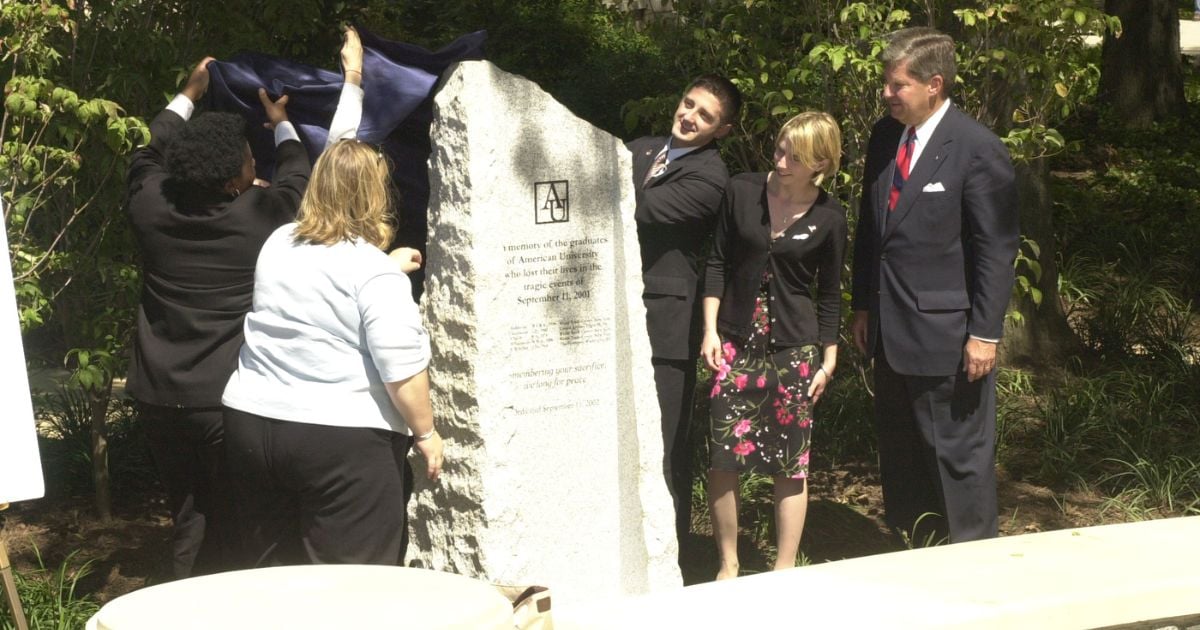
The flag ceremony remains the most vivid memory in Arakaki’s mind.
As the names of the five alumni were read and a bell tolled, members of the AU community processed into the amphitheater carrying an AU flag for each person lost. Students and staff representing each alum’s school carried the flags.
Arakaki remembers that there had been some discussion about whether AU should wait to hold the ceremony, particularly because none of the victims’ family members could attend.
But, she says, “many of us felt it was important that we do something for the AU community that day.”
Arakaki recalls being excited to see the plaza completed in time for the anniversary, particularly as members of the Class of 2002 returned to campus after helping raise funds for the commemorative monument near the Kogod School of Business.
The ceremony represented something larger than a single day of remembrance. It was AU choosing to reflect, pay tribute, and carry forth the memory of those lost.
Arakaki has continued to choose AU, too.
She joined the university in 1995 and has spent more than 25 years watching generations of students grow, graduate, and become alumni. Over time, AU has become more than the place where she works. It has become a community she trusts and a place to which she has continued to give her time and care.
That connection has taken on an especially personal meaning as her son, Miles, now attends AU’s Washington College of Law.
“My son spent a lot of time on campus growing up,” she says. “Having him attend WCL and having that additional connection to AU is so special to me and is a bond that we share.”
For Arakaki, September 11 is part of a much larger story: one of people showing up for one another, remembering those they lost, and carrying that sense of community forward.
Twenty-five years later, the five alumni honored at AU’s Memorial Plaza remain part of the university’s story.
And so does Lisa Arakaki, who witnessed one of the darkest days in the nation’s history from campus, helped AU navigate its aftermath, and played a part in ensuring that its community would have a place to remember.