Finding Her Place in Policy: An Internship Helped Morgan K Turn Passion into Impact
"I know that in December when I walk I am leaving with tangible skills, something that I can confidently say 'I can do that.'"
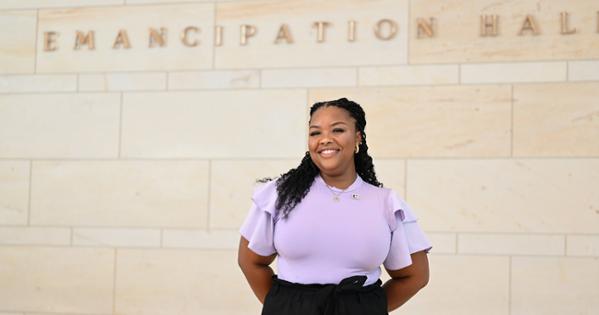
Morgan K, MEd '26, in Emancipation Hall
When Morgan K first applied for a prestigious public policy fellowship with Leaders for Educational Equity (LEE), she was turned down.
Disappointed, the Teach For America alum had spent years working directly with students. Knowing she wanted to continue making a difference in education, she did not give up–she turned to the Baker School of Education to help find her path into the policy world.
Today, she is a Public Policy Fellow with LEE, earning her Master of Education (MEd) in Education Policy and Leadership at American University's Baker School of Education this December. Her experience is proof that the right academic preparation, mentorship, and professional connections can help students transform career aspirations into tangible opportunities.
The summer before I started at Baker, I applied and didn't get it. Then I applied again about halfway through my degree program, and everything was different.
That difference, she says, came largely from the skills and confidence she developed at the Baker School of Education. LEE prepares leaders to drive change in education through policy, advocacy, and public leadership. Through partnerships with organizations across the country, fellows gain hands-on experience working on issues that shape educational outcomes for students and communities.
For Morgan, the fellowship represented a chance to explore education policy as a career while staying connected to the equity-focused values that first drew her to teaching. "LEE really helped me understand what education policy was," she says. "But Baker helped me develop the skills to actually work in that space."
Morgan credits her coursework at AU with providing the technical knowledge she needed to stand out as a candidate. Through the MEd program, she learned qualitative and quantitative research methods, data analysis, policy evaluation, and policy writing skills that became key selling points during the fellowship application process.
"I was able to say, 'I have quantitative and qualitative research skills that a lot of people entering this program might not have,'" she says, because of her MEd work. "I became much more marketable." Those skills not only strengthened her application but also gave her confidence during interviews.
Beyond classroom learning, Morgan points to one of the Baker School's greatest strengths: faculty mentorship. She describes professors who were deeply invested in students' success, reviewing resumes, recommending opportunities, and helping students connect coursework to professional goals.
"For me, I've never been in a program where there was so much personal investment in students' futures," Morgan says. Faculty members Dr. Jessica Sutter and Dr. Jennifer Steele played important roles in helping her prepare for opportunities in the policy arena. Morgan credits them with challenging her thinking, helping her refine her professional story, and teaching practical strategies for navigating the hiring process.
"Jessica literally gave us a class on how to conquer multiple rounds of interviews," Morgan says. The professors' real-world experience in education policy also helped Morgan better understand the breadth of the field and the many career pathways available.
Today, Morgan’s fellowship placement is in the Office of Strategy and Impact within Atlanta Public Schools’ district governance department, supporting compliance and governance efforts across Atlanta's charter system. Beyond her first experience in a charter system, the work has exposed her to aspects of education policy and governance that she had never encountered in the classroom.
The experience has also reinforced concepts she studied at Baker, including education finance, policy implementation, and stakeholder engagement. One particularly memorable moment came while observing real school board negotiations. Earlier in the MEd program, Morgan had participated in simulation exercises focused on policymaking and governance. Seeing similar conversations unfold in the real world highlighted the complexity of educational decision-making and the importance of evidence-based policy. "It's been fascinating to watch those conversations happen in real time," she says.
Perhaps most importantly, the fellowship and coursework has helped Morgan identify her own strengths and interests within the policy field. "This semester I realized that research is my forte," she says. "That's the power of the MEd and the power of Baker. We get the full scope of what policy work is."
As she prepares to graduate in December 2026, Morgan says she feels equipped with practical, transferable skills that will serve her throughout her career.
I know that when I walk across the stage, I'm leaving with tangible skills. I can write a policy memo. I can write a policy brief. I can confidently say, 'I can do that.'
Looking back, Morgan sees a direct connection between the opportunities she has today and the support she received at American University. From the partnership between Teach For America and AU that resulted in a significant scholarship to the mentorship of faculty and the career-ready skills embedded throughout the curriculum, she believes the Baker School helped open doors that once felt out of reach.
Her advice to students seeking internships is simple: leverage the relationships around you and believe in what you bring to the table. "Go to your professors. Baker professors are super connected," she says. "Listen to alumni. Pay attention to opportunities. And believe in yourself. There is something in you that somebody can use in their program."