You are here: American University Baker School of Education News & Events From Radio Booth to Dean’s Office: Getting to Know Aroutis Foster
Education

From Radio Booth to Dean’s Office: Getting to Know Aroutis Foster

Meet Dean Aroutis Foster, who has led the Baker School of Education since August of 2026.

By  | 

In a high school physics class in Kingston, Jamaica, a teacher gestured with his fingers about how electromagnetism moves along the Z-axis as he used the chalkboard (a two-dimensional surface to demonstrate a three-dimensional movement). Aroutis Foster, then a student, spent more mental energy trying to picture the invisible force and the movement than understanding why it mattered.

“There’s got to be a better way to teach these things,” he remembers thinking.

That question has shaped his career. Foster, who began in August as dean of the Baker School of Education, has spent two decades working where technology, learning, and human development meet. Before joining Baker, he was at Drexel University.

From the Radio Booth to the Classroom

Foster’s path to education started with radio. Straight out of high school, he worked as a disc jockey in Jamaica and studied at the Caribbean Institute of Mass Communication for a short time before he moved to the US to pursue a degree in broadcast journalism at Brooklyn College in New York.

There, he found he was drawn to computer graphics and design. He added a second major in art (where digital media and design lived), minored in computer science, and began connecting those interests to what he had felt in that physics classroom. A mentor in the Honors Academy, administrator Robert Scott saw his potential and encouraged him to pursue a doctorate, something Foster had never previously considered.

Foster went on to study educational psychology and educational technology, exploring how people learn and how games and digital technologies can be designed to support that learning. He didn’t learn that the field had a name until close to graduation: the 'learning sciences.' The learning sciences is an interdisciplinary field that studies how people learn and how to design environments that support learning. It examines learning in classrooms, workplaces, homes, communities, and digital spaces.

Outside the Office

Ask Foster how he unwinds, and the answer is movies. “Any movie, from the very good to the very garbage,” he says. He’s not picky, because it’s a chance to rest his brain.

Weekends belong to his children: His son plays baseball, and his daughter plays travel soccer. Foster has coached her, having played soccer most of his life. When his wife wants a date, it’s usually dinner and a movie.

And the detail that surprises people most? He’s still a DJ! “I was a DJ in college and I still play music,” he says. “I listen to any and every kind of music.”
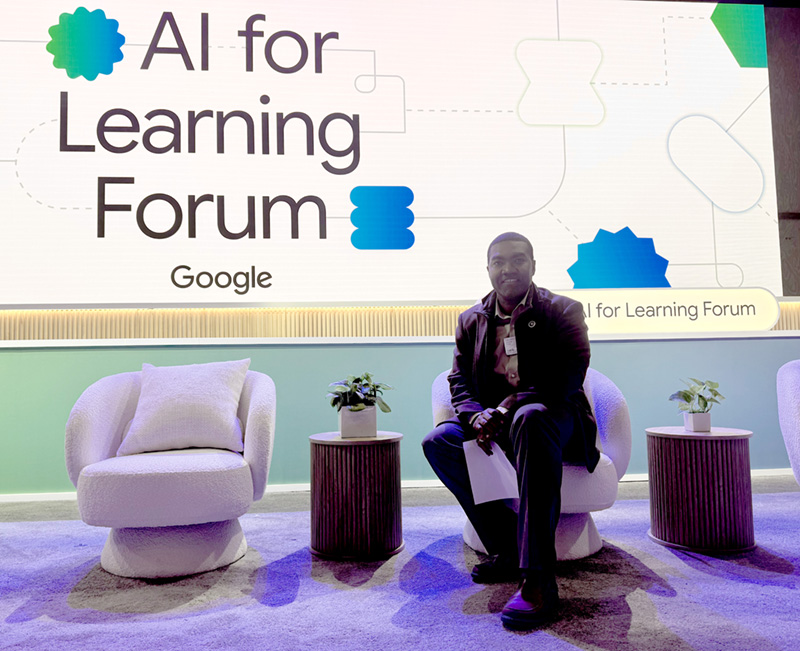
Dean Foster at the Google headquarters in New York City.

Leading with Hearts and Minds

Foster describes himself as a collaborative leader, and he points to a weekly standing meeting as proof. Program directors, faculty council, and staff council all sit at the same virtual table.

“I am not the expert of everything,” he says. He calls on people for their expertise and expects information to travel through his leadership team, not only from him.

His guiding principle came from a colleague at a previous institution: leadership is about hearts and minds. “Minds are fickle. Hearts feel everything,” Foster says. “You have to get to people’s hearts before you even get to their minds.”

A Vision Built Around Experience

When Foster designs something–from a course to a leadership approach–he says “I don’t start with technology first; I start with what I want someone to experience.” Next, he considers how to create that experience, and only then does he think about what technology may help facilitate the experience.

That approach shapes how he sees artificial intelligence in teacher and leader preparation. AI, he says, will touch every part of life, and no one knows exactly where it will be in 10 years. What history has shown with earlier technologies, from the printing press to Wi-Fi, is that people adapt.

For Baker’s bachelor's, master of arts in teaching, master of education, and doctor of education programs, that means teaching future educators to teach with technology, using it to check and evaluate answers and to think critically. Foster says courses should model the practices graduates will bring to their own classrooms and schools.

Responsible AI, to him, is human-centered. “I put people first,” he says. These technologies are designed by people, he notes, so people can shape how they’re used. “Schools are not natural. These are all design spaces, so we can reshape schools.”

His priorities for Baker include:

  • advancing equity and justice
  • justice-oriented and responsible AI
  • preparing graduates for the workforce
  • responding to teacher shortages
  • supporting trauma-informed education and mental health
  • using data well

Over the next three to five years, he wants to put Baker on an even stronger footing, with better systems to support students, faculty, and staff. This includes enrollment, professional development, and clusters of faculty scholarship. He is also clear that the school can’t be everything to everyone–it will do what aligns with its values and resources.

His hope for the school is simple to state and ambitious to carry out. “My hope for the Baker School of Education is that we will be a school that is transformative in how we think about education and human development,” he says, one with “public impact and public value.”

An Open Door

Foster wants to hear from alumni, students, and partners. “I’m a learner,” he says. “I want to talk with people.” He encourages students, potential students, alumni, along with faculty and staff, to reach out to him directly.

“I didn’t take this job to maintain the status quo of what a school of education is,” Foster says. “We want to reshape what it means to be a school of education at a time like this.”