
PERIL-Antisemitism-AI-Prebunking
Washington, D.C. (September 8, 2026) — New research from the Polarization & Extremism Research & Innovation Lab (PERIL) at American University, shows that people can be taught to recognize the manipulation tactics behind antisemitic content before those narratives take hold, making them less likely to buy into antisemitic conspiracies.
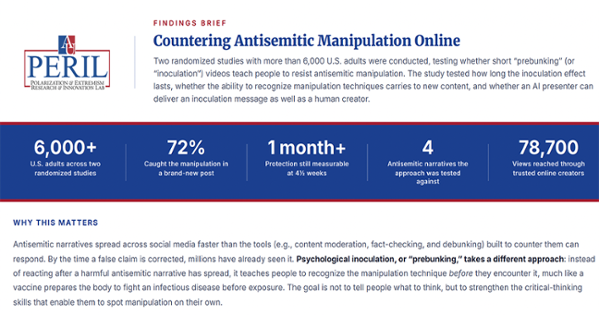
PERIL's randomized tests with more than 6,000 U.S. adults show that a short video – even if AI-generated – can help viewers recognize antisemitic manipulation in unfamiliar content, reducing the likelihood that they agree with an antisemitic conspiracy. The results are promising and likely applicable to other forms of online hate.
In addition, two of the videos used to test this hypothesis were AI-generated, which means that anti-hate efforts may be less reliant on unpredictable and expensive relationships with human influencers. This is a cutting-edge way of addressing antisemitism – and likely other forms of hate – at scale.
Across two waves of randomized testing, PERIL found that brief “pre-bunking” videos improved participants’ ability to identify manipulation in antisemitic content. After watching one short video, 72 percent of participants correctly recognized the manipulation tactic in a brand-new post unrelated to antisemitism. Protective effects remained measurable four and a half weeks later.
The findings point toward a potentially scalable way to combat online hate: rather than waiting for a false or hateful narrative to spread and then trying to debunk it, pre-bunking teaches people how common manipulation techniques work before they encounter them, strengthening critical thinking skills that enable them to spot manipulation on their own. AI-generated videos also expedite this process by not having to wait for – or pay for – a human influencer to pre-bunk any escalating hateful narratives.
“Most responses to harmful online content begin after the damage has already been done,” said Michael Jensen, research director at PERIL. “These results show we can intervene earlier. People learned to recognize the manipulation in content they had never seen before, that protection was still measurable weeks later, and this was done using AI. That gives us a scalable method with a strong empirical foundation, moving antisemitism and broader anti-hate research forward significantly.”
The approach focuses on how people are manipulated rather than telling them what to believe. Because the approach targets manipulation tactics rather than specific political or ideological positions, the underlying skill can transfer across narratives and potentially build resilience to other forms of hate and misinformation. Typically, an influencer offering to “pre-bunk” an escalating harmful narrative needs to be discovered by an anti-hate practitioner and then often hired through an advertising contract that takes time and expenditure by what is typically a resource-scarce nonprofit.
“This research gives us evidence that prevention of online harm can work, and AI may allow us to put that evidence into practice at the speed and scale of the online environment.” said Bill Braniff, executive director of PERIL. “For years, the internet has given those spreading hate an enormous advantage: they can move quickly, experiment constantly and reach millions of people at almost no cost. While we must manage risk, we also now have an opportunity to close the gap and ensure speed and scale throughout efforts to address online hate.”
The research is part of PERIL’s antisemitism prevention work combining real-time monitoring, behavioral science, education, and AI tools. PERIL’s researchers have mapped 72 antisemitic tropes and are continuously monitoring narratives across 48 mainstream and fringe online platforms. PERIL’s model is designed to ensure that speed does not come at the expense of evidence: pre-bunking videos are evaluated through randomized experiments and screened for possible backfire effects before release. Videos that do not demonstrate effectiveness are revised rather than deployed.
Additional Resources:
-
A two-page summary of the study and findings
-
A five-page guide to common manipulation tactics used in online content
-
Links to the tested pre-bunking videos are available here (short video) and here (long video)
About PERIL
The Polarization & Extremism Research and Innovation Lab (PERIL) at American University is an applied research lab studying the risk factors and protective factors that increase or mitigate ideologically motivated violence and related harms. See more: https://perilresearch.com/
MEDIA CONTACT: AU Communications, 202-885-5950, [email protected]