
Bon Voyage: Two Eagles Selected for Obama-Chesky Voyager Scholarship
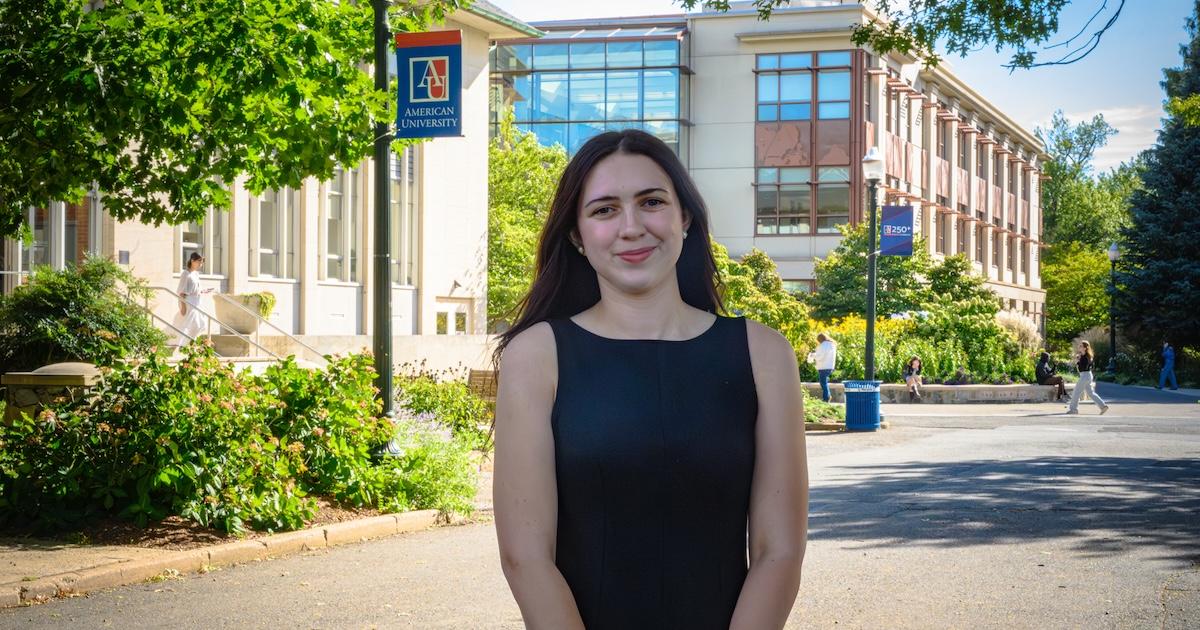 Cathrine Volk, SIS/BA ’28, might not have become an Obama-Chesky Voyager for Public Service if she hadn’t first been a Girl Scout.
Through the organization, the international studies major was introduced to the foundations of civic engagement—and how decisions are made through shared governance.
“Girl Scouts has a very good youth engagement structure,” said Volk, a Lincoln Scholar, vice president and political director of the AU College Democrats, and vice president of the School of International Service Undergraduate Council. “I got to start participating in decision-making and understanding how our governance works in sixth grade. That allowed me to see how important it is that we have youth voices in the conversation.”
Volk, a Jackson, New Jersey, native, is one of two AU students—along with Ashley Conlon, Kogod/BSBA ’28—selected for the 2026–28 cohort, the fifth in the leadership development program’s history. Fittingly, she found out she'd earned the prestigious opportunity while working at Camp Sacagawea, a Girl Scouts destination in Farmingdale, New Jersey, where she's spent her last 15 summers as a camper and staffer.
Selected as part of a 100-student cohort of college juniors from across the United States, the two Eagles will each receive up to $50,000 in financial aid to help complete their degrees. In addition, the scholarship—created through a $100 million gift from Airbnb CEO Brian Chesky to The Obama Foundation—provides a $10,000 stipend for a summer experiential learning project anywhere in the world.
“Every year, this scholarship reminds Michelle, Brian, and me that there is no shortage of young people ready to take on hard problems,” former president Barack Obama said in a release. “This year’s Voyagers come from small towns and big cities. . . . They are working on housing, health care, clean water, and public safety, and most of them started that work long before anyone offered to pay for it. We’re proud to help them keep going.”
During the two-year program, the Obama Foundation supports Voyagers in designing and executing their summer travels. The foundation also connects recipients with a global leadership network, offers mentorship to refine their public service goals, and provides leadership and bridge-building training. After graduation, Voyagers receive a $2,000 annual Airbnb travel credits for 10 years.
Chris Swanson, associate director in the Office of Merit Awards, said Volk—who he supported through the Voyager process—has a vision for serving her community. “Catherine's passion is youth civic participation, and while she has big ambitions, those are grounded in the idea of community impact,” he said.
Through the program, Volk plans to expand on work she began in high school with Energizing Youth Voters, an initiative of the nonpartisan League of Women Voters of New Jersey she connected with first through Girl Scouts that engages the nation’s newest voters at the ballot box and in their communities.
Research shows that citizens who begin voting as soon as they become eligible are more likely to remain voters throughout their lives. Voting can also serve as a gateway to other forms of civic involvement, including volunteering, community organizing, and running for office.
Last month, a national poll of young Americans conducted by AU’s Sine Institute for Policy and Politics found that only 53 percent of respondents ages 18 to 34 are certain or very likely to vote in the 2026 midterms. At the same time, 59 percent said they wish there were more ways to get involved in their communities, while only half reported feeling part of a community that cares about them.
For her Summer Voyage, Volk plans to examine youth civic engagement and education models in Europe, studying how communities inspire young people to take part. She hopes to bring home strategies for building broader youth coalitions across the US, including paths for young people across the political spectrum to tackle national challenges together.
“I'm especially looking forward to speaking to high school and college students and [hearing] their firsthand accounts of [civic] participation,” she said. “You can’t force anyone to vote. You have to motivate them to vote and get civically engaged.”