
From Campus Involvement to Career Impact: How AU Students Turn Experience into Opportunity
 At American University, an internship often begins long before a student sends in an application.
It can begin on the Quad, with a conversation at the Student Involvement Fair. It can take shape during a late-night student organization meeting, in a leadership role, through a mentoring relationship, or while learning to manage a team of peers. Those experiences may not appear under the word internship on a student's résumé, but they develop many of the skills employers ultimately seek: communication, judgment, collaboration, adaptability, organization, and leadership.
That connection between learning and doing is part of what distinguishes the AU experience. In the 2027 US News and World Report best colleges rankings, American University is ranked No. 19 nationally for co-ops and internships and No. 7 for study abroad. Eighty-seven percent of AU students complete at least one internship, and 91 percent of recent undergraduates are working, attending graduate school, or doing both within six months of graduation.
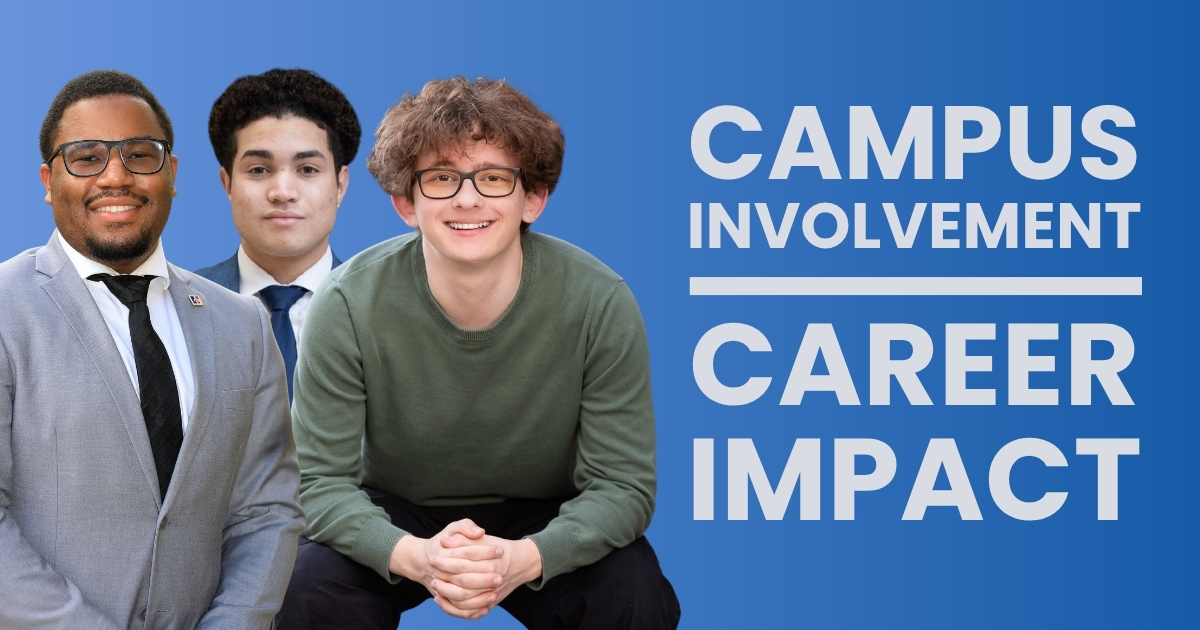
Those numbers tell one part of the story. Students like Sean Sampson, Maya Hyden, Braden Miller, and Demar Goodman tell the rest.
For Sean, It Started on the Quad
During his first year at AU, Sean Sampson did what thousands of new Eagles do: he wandered onto the Quad during a student involvement fair.
What could have been a brief walk between tables became the beginning of a much larger journey.
Sean met students and staff, learned about opportunities across campus, and began building relationships, including one with Vice Provost for Student Affairs Dayne Hutchinson, whom Sean describes as an important role model. He became an AU Ambassador, participated as a mentee in AU Catalyst, and ultimately became president of Brother Brother, a mentorship organization that connects students with positive male role models.
AU Catalyst is designed to connect students with faculty, staff, alumni, and one another while developing leadership, self-advocacy, resilience, and other skills important to life and career success. Brother Brother similarly creates opportunities for mentoring and connection among students.
For Sean, those relationships were particularly meaningful. He had not previously had consistent access to a network centered on positive male mentorship. At AU, he found mentors who could support him academically, professionally, and personally, and eventually found himself helping create that experience for others.
A political science and finance double major from Las Vegas, Sean later brought those campus experiences into a legislative internship in the office of a Nevada member of the U.S. Senate. His work included finance, trade, and tax issues as well as the development of a policy project.
When he looks back at what prepared him for that environment, he points not only to his coursework but also to campus involvement: representing AU strengthened his public speaking; leading Brother Brother sharpened his ability to manage competing demands; and mentorship taught him how to build relationships across differences.
“Being involved shaped who I am, not only as a person but as a leader,” Sean said.
His experience illustrates something central to AU's model: professional preparation does not happen in isolation from student life. The classroom, the organization meeting, the mentoring conversation, and the internship can become parts of the same developmental experience.
Maya Found a New Skill Set, and a Global Purpose
For Maya Hyden, involvement became a way to explore both her identity and her professional interests.
An international relations major, Maya began college by trying different organizations, including debate. As she met classmates and explored campus, a friend eventually recruited her to Eagle Communications, AU's student-run public relations firm.
There, Maya moved beyond theory and began doing the work. She gained experience with graphic design and communications tools, conducted outreach to sponsors and alumni, and learned how organizations shape messages for different audiences.
Eagle Communications provides students with hands-on professional communications experience and operates through AU's Public Relations Student Society of America chapter. The firm has also received national recognition for its student work.
Those skills traveled with Maya far beyond Washington.
During a summer experience in Paris, she worked with Prométhée Humanitaire, a French humanitarian organization that supports children experiencing extreme vulnerability in Haiti, Madagascar, and Senegal. Her work included qualitative research related to the experiences of children receiving financial support as well as assistance with events, fundraising, and social media.
Suddenly, the tools she had practiced in a student organization had a different audience and a different consequence.
“Not only was it fun, but I felt like I was able to substantially help the organization,” Maya said.
Her path demonstrates how involvement can become a laboratory for professional learning. Students have room to experiment, develop confidence, make mistakes, receive feedback, and then carry those skills into organizations confronting real-world challenges.
For Braden, the Skills Keep Moving Back and Forth
Braden Miller's story is less a straight line from campus to career than a continuous loop.
A public relations and strategic communications major with a minor in marketing, Braden joined AU's chapter of the Public Relations Student Society of America during his first year. He began developing practical skills, including public speaking, while gaining greater clarity about the communications profession.
He then expanded his involvement: becoming business manager of The Eagle, joining Phi Sigma Pi, and finding additional ways to connect professional development, service, and community.
His professional experiences grew alongside those campus roles. At IMP, Braden worked in communications around events at The Anthem, gaining experience with on-site press responsibilities and managing small teams. He later joined The Brand Guild, a Washington-based communications and marketing agency, where an internship grew into a fellowship.
The Brand Guild describes its internship program as a hands-on experience in which students work directly alongside teams in public relations, marketing, events, and creative services.
For Braden, the important part is that the learning does not move in only one direction.
Skills developed at AU strengthened his performance in internships. Lessons learned in those professional settings then came back to campus and informed the way he approached student leadership.
“I think it helped me fit in on this campus,” he said. “Yes, you have your friends, but you are making connections that will last a lifetime. Being involved on campus confirmed what I want to do with my career and allowed me to meet people I would not have met.”
That cycle, campus to internship and internship back to campus, is experiential learning at its strongest. Each environment makes the other richer.
Demar Planned to Sit Back; AU Had Other Plans
When Demar Goodman arrived at AU, he had a plan: concentrate on academics and resist the temptation to become involved in too many things.
The plan did not last very long.
He began attending interest meetings, lots of them - and discovered that involvement gave him another way to learn. Over time, he moved from exploring organizations to leading them.
Now a senior majoring in Communications, Legal Institutions, Economics, and Government (CLEG) with a minor in Education Studies, Demar has held leadership roles across the university, including representing the School of Education in AU Student Government.
His experience has also extended back to his hometown of Atlanta. Demar reports that he was recently promoted to Senior Advisor to Atlanta City Councilmember Antonio Lewis, for whom he has been working as an intern. Lewis currently represents Atlanta's District 12 on the City Council.
For Demar, working in a large and complex city requires many of the same skills he has practiced through student leadership: listening to different constituencies, managing multiple priorities, understanding competing needs, and remaining dependable when the work becomes complicated.
“Atlanta is a big and complex city, but being involved in all of the different organizations I've been in on campus prepared me for being able to service the different needs of different subsets of the constituency, much like being able to juggle the many different missions of the organizations I have been a part of at AU,” he said.
But Demar also sees involvement as something larger than preparation for a job.
“Being involved on campus has boosted my pride in AU to unimaginable levels,” he said. Through student leadership, “we have the power to shape what it means to have an AU experience.”
The Internship Starts Before the Internship
Sean, Maya, Braden, and Demar followed very different paths. One found mentorship and then became a mentor. Another translated communications skills into international humanitarian work. Another moves continually between student leadership and professional communications. Another discovered that managing the complexity of campus organizations could prepare him to navigate the complexity of local government.
What connects them is not a single major, organization, or career aspiration.
It is the opportunity to practice.
AU's annual Student Involvement Fair introduces students to a campus ecosystem that includes more than 150 student clubs, Student Government, student media, fraternity and sorority life, service opportunities, leadership programs, and thousands of events each year. At the same time, the Career Center hosts fall and spring Job & Internship Fairs, industry-specific programs, networking receptions, employer meetings, and one-on-one advising that help students translate their developing skills into professional opportunities.
Students do not become internship-ready simply by finding an opening on Handshake. They become ready by learning how to lead a meeting, communicate an idea, recover when something does not go according to plan, manage a budget, work with people who think differently, advocate for others, meet a deadline, and recognize when they need help.
Then they take those skills into Washington, across the country, and around the world. But perhaps the more compelling measure is what happens when students return from those experiences: more confident in what they can contribute, clearer about the work they want to pursue, and prepared to use what they have learned to strengthen the communities around them.
At American University, the internship may happen off campus. The preparation for it happens everywhere.