
Moving Beyond Cynicism: 2026 Solutions Summit Centers Gen Z in Democracy’s Next Chapter
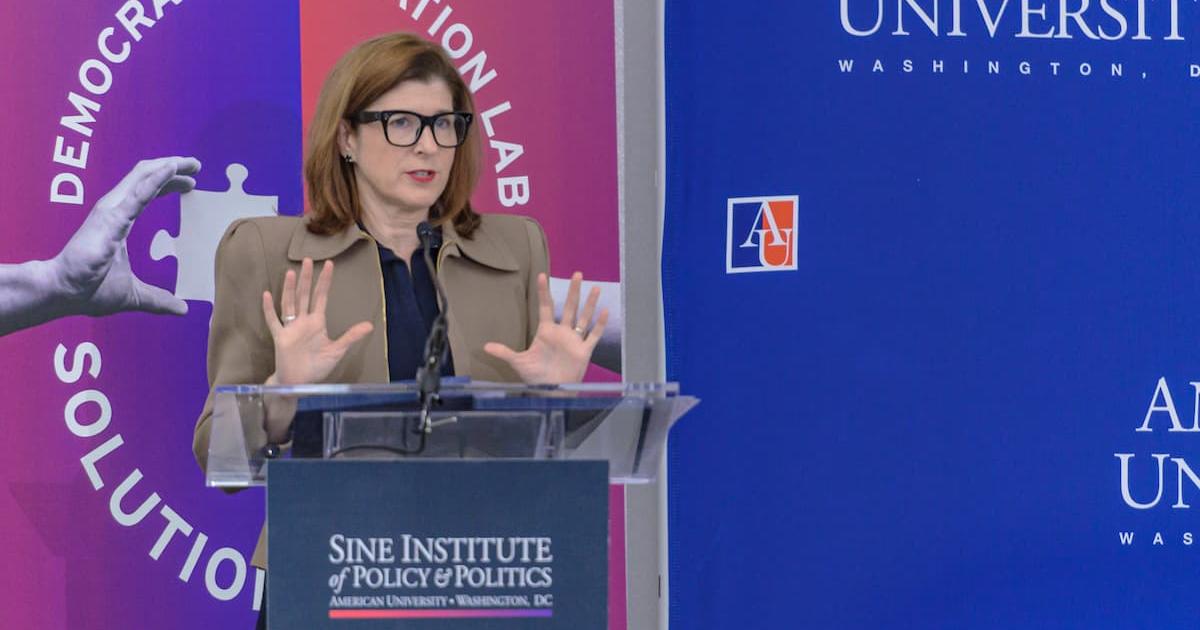 Across the Washington College of Law’s Grossman Hall, the 2026 Solutions Summit did not attempt to paper over the fractures in American democracy with comfortable platitudes.
Instead, the daylong gathering hosted by the Democracy Innovation Lab at the Sine Institute of Policy and Politics operated under a stark organizing principle: American governance cannot be renewed by clinging to old scripts.
“You cannot solve a democracy problem with one discipline,” executive director Amy K. Dacey, SPA/MA ’95, said in her opening remarks.
Framing the summit as an active testing ground rather than a ceremonial conference, Dacey cautioned against superficial disruptions: “When we use the word innovation, we don’t simply mean technology. We don’t mean disruption for disruption’s sake. Innovation means finding better ways to solve public problems. . . . Democracy at its best is always an ongoing experiment.”
Interim President David Marchick amplified that message, observing that while every pillar of civic life is currently in flux, disruption demands purposeful redesign rather than passive retreat.
“If AI wrote this speech, it would say our country is at an inflection point,” Marchick said, charging the audience to “reimagine our institutions—not in the way they were, but in the way they should be.”
The Burden of Disillusionment and the Demand for Equity
That need for reinvention emerged vividly from public opinion data, which revealed a generation entering public life with little patience for inherited nostalgia.
Presenting findings from research conducted during her semester as a Sine Institute 250+ at American Fellow, pollster Kristen Soltis Anderson dismantled the conventional myth of youthful romanticism.
“There’s this stereotype that when you’re young, you’re optimistic, and then slowly but surely reality grinds down your optimism,” she said. “Young people aren’t starting optimistic and then finding things are harder. Instead, they’re entering the conversation like, ‘Well, this is already terrible.’”
The data detailed why: 56 percent of young Americans believe there is less opportunity to get ahead today than there was 50 years ago, squeezed by soaring housing costs, inflation, and institutional gridlock.
Compounding this is a digital information diet that Anderson said “selects for negative,” creating an environment where “the more you’re getting news from digital spaces, the more you’re adding in that anxiety.”
Yet this skepticism is anchored in deep civic expectation rather than fatalism. Sine Institute senior advisor Molly O’Rourke supplemented Soltis’s data with findings from the fifth annual Sine Institute survey of young Americans, released on September 1.
According to the survey, 60 percent of respondents, ages 18 to 34, view treating people equally and fairly, regardless of background, as fundamental to national identity.
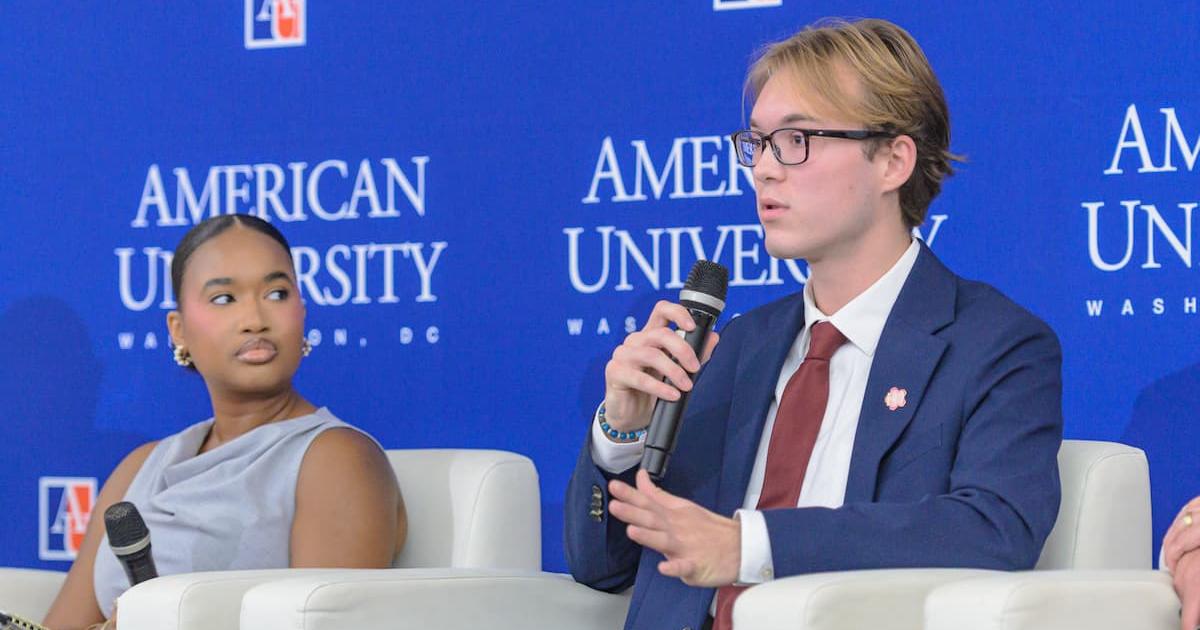 Student polling advisor Judith VanBoven, SPA/MA ’27, challenged older generations to stop treating youth as a future prospect: “We are stakeholders in the present now. If we do not have the ability to make our voices heard in these spaces, in this room, then how can we go forward to find solutions?”
Fellow student advisor Jackson Kreiner, SIS/BA ’27, pointed to a survey word cloud dominated by terms like broken, divided, and chaotic.
“Only 46 percent [of young Americans] think the road ahead is better, but we also think we’re going to be the ones to make it better,” Kreiner said. “We don’t like ideological divides, but we can hold a conversation with someone who is diametrically opposed to us based on our love for soccer, love for whatever it may be. It doesn’t have to all be about politics.”
Human Vulnerability Against the Allure of the Algorithm
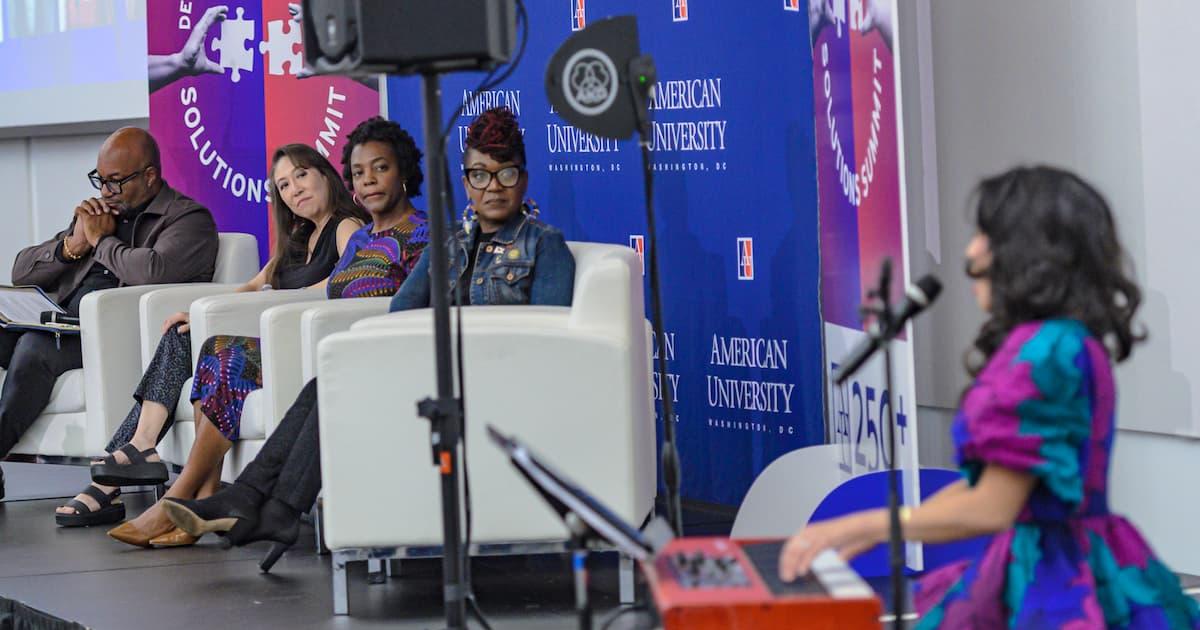 The counterweight to algorithmic polarization and institutional paralysis was explored through cultural narrative, where panelists insisted that empathy cannot be outsourced. Accompanied by live musical performances from jazz vocalist and pianist Sara Jones, the conversation wove together melody, personal history, and creative resistance.
Moderating the session on storytelling, poet and Emmy-winning producer Kwame Alexander, a Sine Institute 250+ at American Fellow, challenged technocratic shortcuts by reading original verses that confronted generative artificial intelligence directly:
“AI is not the writer or the hand, is not the singer or the band, is not even the drum keeping time while you find your rhythm word by word by word. . . . But will it ever be able to imagine the soundtrack playing between the lines? Will it ever be able to be the wonder being born right now?”
Stand-up comedian Meschelle argued that civic change requires confronting raw reality, drawing a sharp line between digital virality and genuine comedy.
“Real art and stand-up comes from life and living and failing and taking it in the face,” she said. “You can’t do that in 30 seconds online. You can get a false idea of what you think stand-up is. . . . If we can laugh about it, we can talk about it. And if we can talk about it, we can make change systemically.”
Novelist Angie Kim echoed the necessity of discomfort, describing how her method-acting training informs her fiction by forcing her into characters whose worldviews are fundamentally alien to her own.
“Each couple of months I would try to become a different person, even a person whose ideology was anathema to me,” Kim said. “It helps you understand how they could think such things. . . . It is about the struggle. It’s about falling and getting up. The point of art-making and of reading is not about having it be easy. It is the struggle. That is the end.”
Substantive Stewardship in an Age of Spectacle
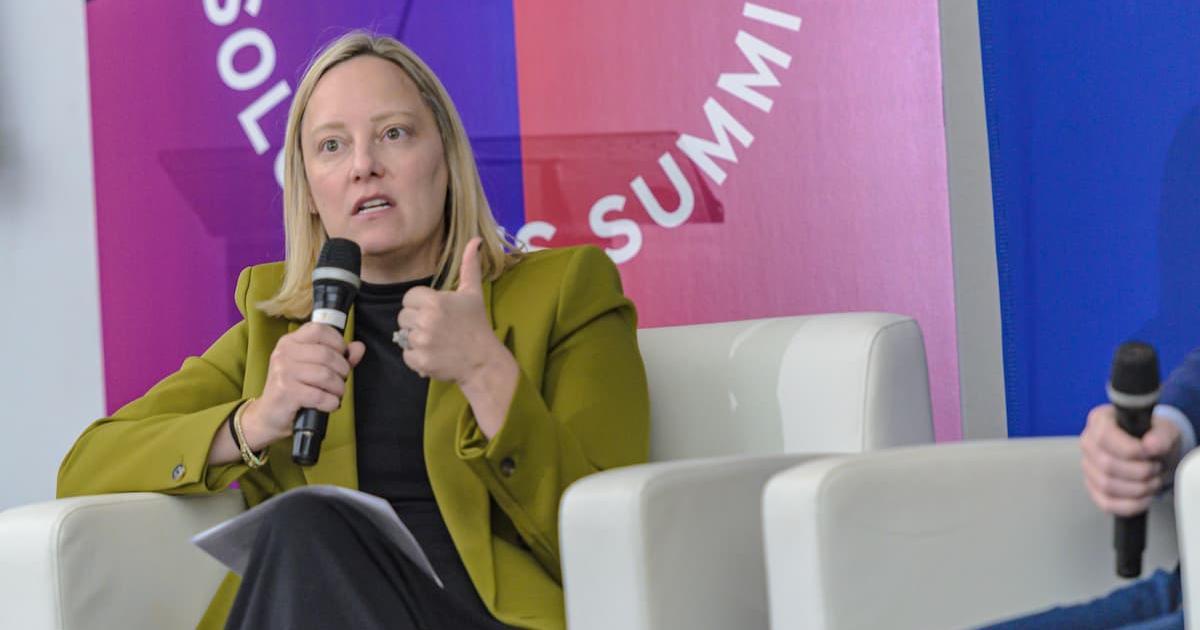 That same tension between surface-level performance and demanding, behind-the-scenes labor carried into Capitol Hill mechanics.
During a discussion moderated by Punchbowl News CEO Anna Palmer, a Sine Institute 250+ at American Fellow, top congressional aides pulled back the curtain on how power is negotiated in a hyper-mediated capital.
Strategist Mike Shields noted that politics has tilted sharply toward exhibitionism: “Politics, especially in Congress, has become performative. . . . There are people that run for office that are performers and entertainers as much as they are policy people.”
The antidotes to spectacle, panelists agreed, are relationship-building and old-fashioned competence. Kathleen Connery Dawe, chief of staff to Senator Angus King (I-ME), stressed that long-term legislative effectiveness rests on basics.
“What still matters, what still goes a long way, is that personal touch and those personal relationships that members and staff formulate over the years, and just being normal,” Dawe said with a laugh. She described her role as serving as “the chief diplomat to a very small, very insignificant country,” where durable coalitions cross party lines out of the glare of the camera.
Emily Crerand, chief of staff to Representative Andrea Salinas (D-OR), emphasized that modern influence requires defending substantive work from the daily news cycle: “Showing up for your staff and supporting them . . . you are really the first shield of defense.”
When advising young people aspiring to work in public service, Shields dismissed the chase for polished credentials. “If the other campaign has a bunch of Ivy League kids and I have a bunch of C-students from state schools that want to bust their tail, I’m going to whip them in an election every time,” Shields said, noting that real policy impact comes from “flight hours” in the trenches—sitting through grueling committee markups and mastering the details.
Demographic Shifts, the Executive, and Student Voices
The afternoon sessions expanded the summit’s scope to an evolving electorate and the future of the executive branch.
Maria Teresa Kumar, Sine Institute 250+ at American Fellow and president of Voto Latino, joined Christine Chen of APIAVote and Patrice Willoughby of the NAACP to explore how growing multiracial and immigrant populations are transforming political power.
National political correspondent Julia Manchester then led a panel evaluating the presidency, featuring Stewart McLaurin, president of the White House Historical Association, alongside former First Lady chiefs of staff Tina Tchen and Anita McBride, executive in residence at AU’s Center for Congressional and Presidential Studies. Together, McLaurin, Tchen, and McBride—all Sine Institute 250+ at American Distinguished Lecturers—examined strategies for modernizing the executive branch and restoring public trust.
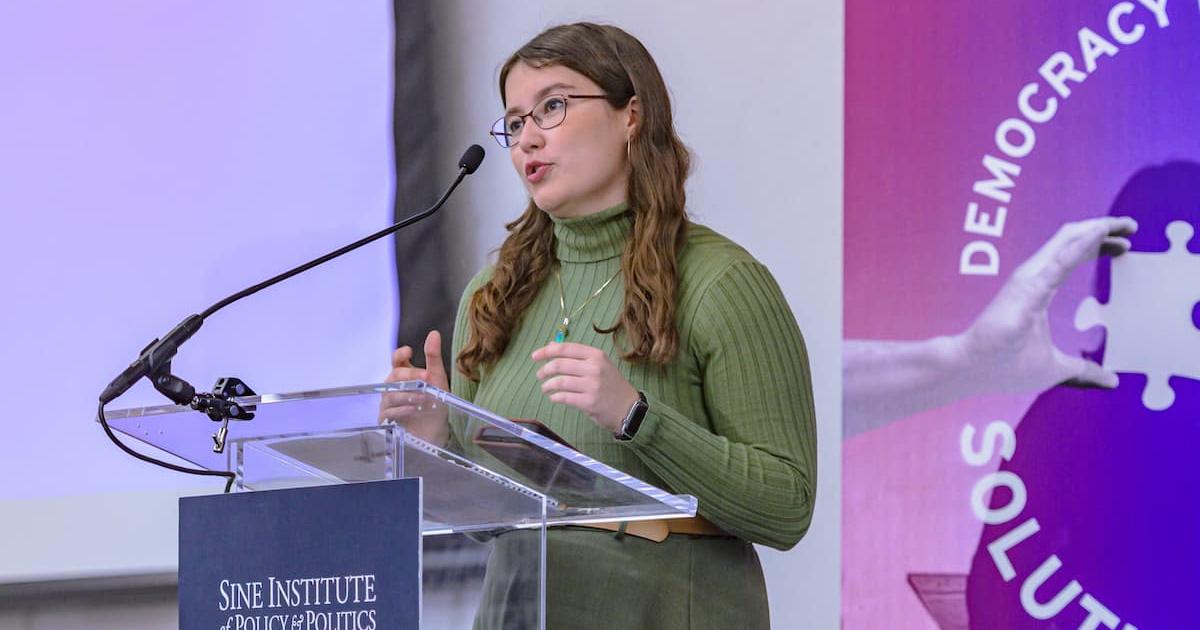 The summit concluded by spotlighting next-generation leadership during AU Student Voices Shaping the Future, which led into an evening networking reception featuring Ken Biberaj, SPA/BA ’02, Sine Institute senior advisor, Savills North America managing director, and host of Coffee with Ken, alongside CNN’s Phil Mattingly.
Across every session, the central takeaway remained consistent: Democratic renewal requires looking beyond performative outrage and actively constructing systems capable of bridging deep divides.
“Democracy asks us to believe that we can build something better, together, even when we don’t agree on everything,” Dacey said, closing the day with a call to collective purpose. “Our goal today [was] not to agree on everything. Our goal is to leave better equipped to build something together.”