
Demystifying the Universe
Dr. Johannes U. Lange, astrophysicist and Assistant Professor of Physics at American University’s College of Arts and Sciences, is working to answer some of the biggest, most pressing questions about our universe. According to our current best models, dark energy and dark matter comprise 95% of the universe. Yet, the physical nature of dark matter and dark energy remains a mystery.
Science’s standard model of the universe is built upon Einstein’s theory of gravity together with dark matter and dark energy. While this model describes the available data well, in recent years, scientists started to find possible inconsistencies when comparing multiple data sets. Therein lies the excitement, Dr. Lange explains: “If these tensions persist with better data, we may have to completely revise how we think about fundamental aspects of our universe.”
Dr. Lange and his colleagues are using large data sets from leading observatories including the Dark Energy Spectroscope Instrument (DESI), which is building the largest 3D map of the universe, and the Roman Space Telescope, described as a ‘wide-eyed Hubble Space Telescope,’ able to cover a field 100 times larger than its predecessor.
Dr. Lange has been part of DESI since 2019, holding leadership roles since 2021. Among other important insights, the DESI collaboration recently found evidence that dark energy weakens with time. Dr. Lange joined the Nancy Grace Roman Space Telescope collaboration in 2025, where he is currently leading a group focused on the joint analysis of Roman Space Telescope data with other data sets. He is also a co-chair of NASA's Cosmic Structure Science Interest Group, which is focused on understanding the nature of dark energy, dark matter, neutrinos, tests of inflation, as well as astrophysical galaxy evolution, among other important topics.
Thanks to these and other efforts, we are now in an era of precision cosmology, where scientists can measure the properties of the dark universe to percent accuracy. This gives experts in the field the ability to debate and understand data to multiple decimal points, ushering in an era of unprecedented accuracy.
“We are entering a very exciting era in cosmology,” explained Dr. Lange. “With new telescopes such as the Vera C. Rubin Observatory and the Nancy Grace Roman Space Telescope, we will have maps of hundreds of millions to billions of galaxies. We can measure the properties of dark matter and energy with unprecedented precision, giving us deeper insight into the most pressing questions about the universe.”
Dr. Lange’s work is on the cutting-edge of cosmology, leveraging machine learning, AI and advanced data science to interpret very large data sets about the universe. He hopes to one day help answer whether these new observations are consistent with Einstein’s theory of gravity.
For the Greater Good
Dr. Lange is active in scientific computing and contributes to open-source software projects that support research in astronomy and cosmology. For example, in cosmology, scientists use statistical inference to fit models of the universe to the available data, a complex and time consuming process. Dr. Lange developed nautilus, a code that uses AI to make statistical analyses easier and faster, sometimes shaving days off of complex analyses. Dr. Lange has shared his code publicly. Thus far, nautilus has been used in more than 100 scientific topics such as extrasolar planets, black holes, and gravitational waves, dramatically increasing the reach of his work.
“Astronomy and Cosmology are very collaborative fields that promote open science,” Dr. Lange explained. “Major data sets from observatories and simulations are made public for all scientists to explore. We also share many of our software tools publicly, making it easy for newcomers to reproduce important results.”
The Gravitational Pull of Physics at AU
Before coming to American University in 2024, Dr. Lange has traveled the world in pursuit of answers to these important questions about the universe, having studied and worked in Europe, Asia, the west coast, and Michigan. At AU, he is embodying the university’s dedication to cutting-edge research, teaching, and providing unique opportunities to students.
As Dr. Lange explains, “The Physics Department at AU has great relationships with our students. We know them personally, we work closely with them, and are deeply invested in their studies and future careers.”
As an assistant professor, one class he is teaching is “Changing Views of the Universe”, which studies the history of cosmology from the Ancient Babylonians to Newton to the present day. Students learn about recent developments in cosmology and how that compares to earlier discussions about the field. This class is part of the AU Core Curriculum, meaning any undergraduate at AU can take the class. Dr. Lange’s dedication to teaching and developing scientific literacy is empowering any student—whether they have an intellectual curiosity or want to develop deep expertise—to be part of this discourse.
A Rare Opportunity
In addition to teaching, Dr. Lange is passionate about exposing students to cutting-edge cosmology research. As he shared, “Working with undergraduates can help influence their career trajectory. Not every student will pursue a career in academia, but all will gain valuable skills they can use in other fields.”
Dr. Lange offers a personalized mentorship approach, aligning projects that fit with his research agenda with what the students want to learn from the project. Dr. Lange’s mentees are researching topics as varied as gravitational lensing, testing how we can measure dark energy, and advanced applications of machine learning to study galaxy formations.
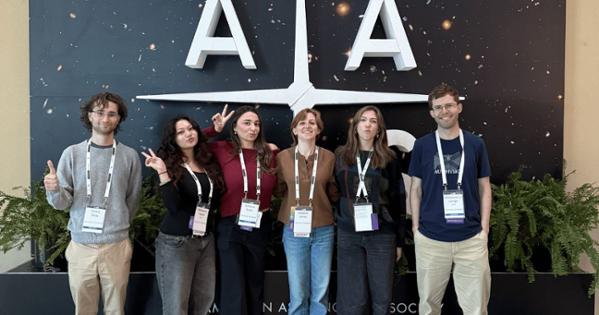
The experiences his students are receiving have real impact. Students collaborating with Dr. Lange have the opportunity to work with large computer simulations of the universe such as IllustrisTNG and FLAMINGO, which run on some of the most powerful supercomputers in the world. Dr. Lange’s students are also benefiting from his membership in the DESI collaboration, participating directly in meetings, presenting their research, and being involved in key projects. At the recent meeting of the American Astronomical Society, three of his students had the opportunity to present before an expert audience. Dr. Lange has positioned his undergraduate students at the forefront of research about the cosmos, an opportunity that would be hard to find anywhere else.
“I love to involve students in rigorous research that not only answers some of the most pressing questions about our universe, but also helps acquire broadly-applicable skills that will help them in any career they pursue,” said Dr. Lange. “Students in my research group work with very large data sets, using modern machine learning and AI methods. It’s not often that undergraduate students have this opportunity at an R1 institution.”
As Dr. Lange reflects on his hopes for his students and his field, he shares, “It’s very interesting to see what we find as we continue to explore the universe. We are discovering the unexpected all of the time. I hope we can continue to enable students to gain this great experience alongside of us as we probe these big questions.”
As for what lies ahead as Dr. Lange, his students, and colleagues travel through this exciting era in cosmology: “If the current hints of cracks in our standard model are real, we have a good chance of confirming them within the next ten years. Students at AU are involved in this work and are directly continuing to push these important questions.”