
The Quiet Wars: William Akoto on the Cyber Battles We Never See
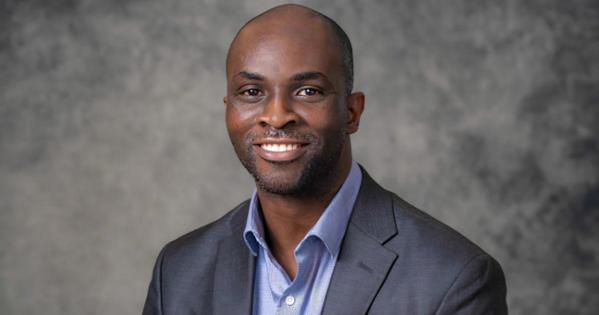
William Akoto has spent his career following unanswered questions wherever they lead-- from the psychology of coup plotters to the economics of stolen trade secrets to the hidden architecture of a cyberattack. It's a unique path that has taken him from Ghana to South Africa to America, and it has left him with a professional toolkit very few in his field can claim: formal training in computer science, economics, and political science, fused into a single, sharp lens for understanding how nations wage war against each other when no shots are fired.
Today, he brings his distinguished perspective to American University, making an impact in the classroom in the School of International Service and by serving as director of graduate studies for the foreign policy & global security department and co-director at the CSINT.
“My mission is to prepare students for careers in both academia and applied fields,” he explains. “I am drawn to being a professor and conducting useful research because I deeply believe that academia should have practical applications. Otherwise, what is the point?”
Dr. Akoto’s perspective—and expertise-- are more critical than ever before. Our news cycles teem with sensational stories about AI, cyberattacks, and new levels of international one upmanship that harken to the Cold War Era. Only today, the attacks have a fantastic range, and it’s not far-fetched to imagine scenarios where situations Dr. Akoto is educating us on could happen.
The Road Less Traveled
It was during his doctoral studies that Akoto's interests crystallized around an unlikely subject: military coups. An economics advisor redirected him toward political science, and a single open office door — belonging to a professor willing to talk through the unanswered questions in the field — led him to pursuing a Ph.D. in political science.
By the time Akoto had worked through the puzzles of coup timing and tactics, he found himself drawn to a different kind of conflict altogether: the intersection of cybersecurity and international trade. His computer science training, it turned out, had never really left him. "Cyberattacks are everywhere, but their use to achieve economic ends was relatively new to the field," he says. "The people who study cybersecurity aren't typically interested in economics or international relations. That intersection is where I live."
That intersection now defines his research program: how states use cyber capabilities, and other emerging technologies like artificial intelligence and drones, to gain competitive advantage and wage a kind of economic warfare that never makes it to a formal declaration.
A Small Band of Rivals
One question has anchored much of Akoto's published research: if any state can hack any other state, why do the same few countries — Russia, China, North Korea — keep showing up as the culprits? Why isn't a country such as Sweden doing it too?
The answer, Akoto's work shows, is that cyber capability is not evenly distributed just because the internet is. Running a sustained, effective cyber operation requires massive investment in infrastructure and in the training of skilled operators, resources that poorer states simply don't have. "It turns out the states that already have money and existing cyber capabilities are the ones who benefit most," he explains. Add to that the near-impossibility of reliably attributing an attack, and the deterrent effect of retaliation all but disappears for cyberattacks against high value targets — it isn't fear that keeps most nations out of the game, it's cost.
The practical implication, Akoto argues, is a reframing of how the United States should think about cyber defense. Rather than treating every nation as an equally plausible threat, policymakers should focus resources on the small set of states that have both the means and the motive to sustain an attack — a version of the "means and motive" logic long used in law enforcement. "We may get hit from left field occasionally," he says, "but most threats come from the core."
Broadening Understanding
Like many academics, Akoto's primary audience is the community of scholars who read his peer-reviewed work in journals. But he has made a deliberate effort of translating that research for the public through ongoing thought leadership pieces in the media where he links his academic findings to breaking news to help people understand important issues.
His recent piece on Iranian-backed hacks of municipal water systems across the United States is a case study in that method. Drawing on his research into how authoritarian states outsource cyber operations to proxy hackers, Akoto examined why decentralized, locally-run water utilities make such an attractive and vulnerable target, and what safeguards could make a real difference. It is exactly the kind of translation he hopes to keep doing: taking a technical, often abstract threat and making it legible to the people who ultimately have to respond to it.
Turning Down the Volume on Hype and Fear
Akoto is humble in describing the link between his thought leadership and its impact. "I want to help the public understand these issues better with facts, not fear,” he explains. “I hope something I write is read by someone who can move the ball forward to protect our country and communities." Part of that mission, for him, means actively working against the media's appetite for spectacle. Splashy ransomware attacks dominate headlines, Akoto notes, but they are often episodic disruptions the public can absorb and move past.
What worries him far more are the quiet, unglamorous intrusions that never make the news, such as a state patiently siphoning off the intellectual property behind advanced chips or solar panels, attack after attack, year after year. "Those don't make headlines," he says, "but they have a much longer-term impact than the big ransomware attacks we hear about." He sees the same dynamic emerging around artificial intelligence, where public fear of dramatic, world-ending scenarios can obscure the slower, more consequential risks worth actually preparing for.
As director of research at CSINT, Akoto now helps steer a broader institutional effort. He is working alongside colleagues studying emerging technology and AI to understand how states wield these tools. But his own north star hasn't changed since his days chasing down unanswered questions about coups: shift the public conversation away from knee-jerk reactions toward sustainable systems that guard against the threats that actually endure. "So long as we don't fall asleep at the wheel," he says, "we can keep pace. Falling behind would be a failure on our part. Not a victory on theirs."
_______________________________________________
William Akoto is Assistant Professor of Global Security and director of graduate studies in the Department of Foreign Policy & Global Security at American University's School of International Service, and Director of Research at the Center for Security, Innovation, and New Technology (CSINT). His research on cyber conflict, economic espionage, and state-sponsored hacking has appeared in leading academic journals including the Journal of Peace Research, the Journal of Strategic Studies, and the Journal of Global Security Studies, as well as public venues including The Conversation.