Stay up-to-date
Be the first to hear our new episodes by subscribing on your favorite podcast platform.
Like what you hear? Be sure to leave us a review!

School of International Service on a map
4400 Massachusetts Avenue NW Washington, DC 20016 United StatesAs ceasefire negotiations continue to shape conflicts in the Middle East and beyond, understanding how these agreements are built—and why they unravel—remains critically important. School of International Service professor Anthony Wanis-St. John joins Big World to shed light on what a career in peacebuilding actually looks like. He reflects on his personal career journey as a conflict resolution professional, detailing his experiences facilitating talks during the Darfur War and the Syrian Civil War. He also breaks down what makes ceasefire agreements succeed or fail, why experienced negotiators and inclusive talks matter when working to achieve peace, and how students can build careers in peacebuilding through mediation, diplomacy, and conflict resolution skills.
0:07 Madi Minges: From the School of International Service at American University in Washington, this is Big World, where we talk about something in the world that truly matters.
0:16 Anthony Wanis-St.John: It takes really high-level people to negotiate a ceasefire. You need presidents, prime ministers, and envoys that are very connected to those people to negotiate the ceasefire. And then they've got to get high-level military people to comply with it. So, huge lift to get one going, but anyone can break one.
0:34 Madi Minges: I'm Madi Minges, and that was SIS professor Anthony Wanis-St. John. Anthony is a conflict resolution professional who specializes in ceasefires and peace processes. He joins us today to talk about his personal career trajectory as a peace practitioner and provide expert insight into the elements that make for a successful ceasefire. Anthony Wanis-St. John, thank you for joining Big World, and welcome to the show.
1:03 Anthony Wanis-St.John: My pleasure. Thank you for having me.
1:06 Madi Minges: So we want to spend some time today talking about careers in peace and conflict resolution. You are a practitioner in this space with years of experience. So I would love if you could start by telling us about how you decided you wanted to work in peace and conflict resolution.
1:25 Anthony Wanis-St.John: I guess there are two parts to the origin story of why I got interested. I have a very vivid memory of the Israeli invasion of Lebanon in 1980, '82, I believe it was, and the Time Magazine cover generating this huge amount of buzz in my household because we had emigrated from Egypt to Lebanon and then from Lebanon to the United States. It was the first time I ever heard my parents talk about politics in the house because this was part of the heritage. And although we were part of the generation of people trying to become Americans, suddenly the past was at the dinner table and the images were on the television and war. War was coming into my young adult, well, young teen mind very vividly. So it got my attention and my concern because there were a lot of voices of concern about what was happening.
2:18 Anthony Wanis-St.John: That led me some years later to focus on Central America and US interventions there. So we went from the Lebanon Civil War, which had its tragic proportions, and even a US presence that touched my high school since some of my classmates were among the Marine contingent deployed as peacekeepers there in 1983 and '4, to a war that was closer geographically and for whom there were a lot of community members in New York City where I was growing up. The Central America wars were a combination of revolutions and counter-revolutions and civil wars that I got very, very interested in. I got interested because the United States was taking a side in those wars. At the time, I felt strongly as a young teen that we were on the wrong side. We were helping dictatorships, we were opposing revolutionaries. And then I came across some stuff about social justice and peace. I guess I decided at some point later on I didn't just want one side to win. I wanted there to be peace and justice rather than a continuation of cycles of war since wars often lead to another war.
3:40 Anthony Wanis-St.John: The second part of the story came much later when I was stuck in a job after college that wasn't going anywhere and read an article about a UN diplomat who went around making deals to get American hostages released by Hezbollah. That account of his work caught my imagination because he didn't have money, he didn't have arms, didn't have fancy planes flying him around. He just crafted a really interesting deal and got people released from harm, out of harm's way. So I thought, this is calling me. I need to learn more about this. How do I become somebody like that?
4:23 Madi Minges: Yeah, absolutely. So you kind of came to this career from a very personal place and you're talking about this sense of calling. I would love if you could describe what your career path from there looked like and maybe touch on some of the highlights of working in this space.
4:42 Anthony Wanis-St.John: Sure. There's a lot of accidental twists and turns on this path. It was by no means a linear voyage as I imagined it would be at the outset. So after reading about UN diplomats doing their thing, I had in mind a sort of false image of what it would be like to turn myself into a professional in this field. I very much imagined that I was going to go to Star Fleet Academy and graduate in the Federation of Planets and be sent out on some missions to do cool things where no one has gone before.
5:17 Madi Minges: Right.
5:17 Anthony Wanis-St.John: That's not quite how it works out. But I was driven by this idea that there was some ideal that I could be part of and play a role in. I picked my graduate schools for applications, went to the open houses, decided on a graduate school. I went to the Fletcher School of Law and Diplomacy up at Tufts University. At that time, my main preoccupation was to become a foreign service officer or somehow join the federal government or the UN Secretariat and do some cool diplomatic work.
5:53 Anthony Wanis-St.John: So those were my original ideas. Of course, as often happens in my life, I have some interesting ideas that inspire me to go forward. And then I find all the avenues forward blocked for one reason or another. I couldn't pass the foreign service officer exam. Twice I took it. I never really learned what it was that... They don't really give you any feedback. I couldn't get a presidential management fellowship. There were so many other really cool paths up into careers that were mysteriously closed to me, even though I was going to a good school, getting excellent grades, learning a lot, and had this zeal and this passion. I didn't understand why the doors were closed, but I also didn't understand that other doors were going to open if I just kept rowing. I kept growing, and eventually doors opened up.
6:46 Anthony Wanis-St.John: I found a way to be involved in the world of conflict resolution that was centered around Tufts University, Harvard, and MIT. They had a consortium called the Program on Negotiation that I got involved in. And that started to lead to practical work in the field, conducting trainings that kind of complemented my scholarly interest in negotiation and conflict resolution. I also had a really interesting mentor. He died while I was a student in a hiking accident, which was very tragic. His name was Jeffrey Rubin, but he was a conflict resolution scholar, a social psychologist who really loved a paper I wrote for his negotiation class that was about back channel diplomacy. And that led to a whole stream of thinking that I've published since then on secret negotiations for peace in the midst of war. So those are some of the things that started me out.
7:50 Madi Minges: Yeah. I mean, I think you talking about this path that wasn't linear or these doors that closed is such a relatable thing. It's such a hard thing to walk through, but I think it is really relatable and I think honestly inspiring that you continue to find a path forward despite those doors being closed. Could you talk about some of the organizations that you ended up working with and maybe some of the negotiations that you were involved with?
8:21 Anthony Wanis-St.John: Sure. There's a couple of steps to get to that, but this was a whole series of unexpected journeys. I wanted to be a practitioner. I wanted to be a diplomat at a high level or something like that. I did not want to be a professor at that point in my career in the early stages. But I found myself drawn to organizations that were doing conflict resolution stuff based on research. And I had a track of research that was pretty interesting that led to my doctoral dissertation and my first book and things like that. So there was an organization
9:00 Anthony Wanis-St.John: ... called the Conflict Management Group founded by a Harvard professor named Roger Fisher. And they had some people that were entrepreneurially looking to bring projects into CMG. And the people that were doing that stuff were sharing an office with me. So while I was doing research on Palestine and Israel, these people wanted to do Palestine and Israel practical projects. So I combined my contacts, gave them my, what we called then a Rolodex, and they started building up track two diplomacy type projects between the PLO and the Israelis at a fairly junior level. Later on, I found myself working on those projects, and that was my first involvement in a real international conflict. This was not studying about it, this was meeting with the people who were protagonists in the conflict or in its attempts to mitigate the conflict, and sitting down with them and trying to help them forge a way ahead. So the weird thing is, as I said, I didn't want to be an academic, I wanted to get a full-time job in these kind of organizations. I did get one. And by that time, I'd had my second child and we were thinking maybe about a possible third child. And being on the road in a consulting organization didn't fit well with a young family. But I was doing cool work. I was mediating between unions and management. I was touching some international stuff here and there. And then somebody asked me, "Are you interested in an academic job?" Because I heard about an opening, and I was like, "No. I've already entered practice and I hear that they closed the doors behind you and they never let you back into academia." That was the old sort of axiom. And that was not what happened at all. I applied for this job that a friend of mine told me about, and I got it. And it was my first full-time teaching job. And that led me down the path of becoming a professor.
10:58 Madi Minges: You mentioned being involved in some peace negotiation processes. I'm curious if you could talk about what the most challenging part of your career was as a practitioner.
11:12 Anthony Wanis-St.John: There were three or four touchpoints in my career where I was working on a real conflict, and every one of them was super challenging. Some had more success, some had less success. I was able, as I mentioned earlier, to work on the PLO Israel track two stuff that seemed like it was moving in the right direction 26 years ago. And of course, it turned out that it didn't move in the right direction. They got back to full scale reoccupation of the West Bank in Gaza, the wars that we've had in the last 25 years.
11:45 Anthony Wanis-St.John: Later on though, through my work with the United States Institute of Peace, which I started doing once I took the SIS job, I was invited by former students of mine who were now working at the State Department to just chat casually about how you would deal with the Darfur War in Sudan. At the time, I was really interested in the fragmentation of rebel groups. What happens when you have tons of rebel groups? And Darfur, you had over 25 at a certain point, all factionalized. And so they were being played by the government of Sudan, one against the other. And the student said, "Well, would you like to be part of an effort to try to unify them?" And I was like, "Hell yeah, absolutely. When do we go?" And he's like, "There's no we, you're going."
12:34 Madi Minges: Wow.
12:35 Anthony Wanis-St.John: So they sent me to Chad with another USIP colleague, and we put together a consultation with these commanders of the military organization of the Darfuri factions. Not the highest level people by any means, but they were super interested in the advantages that would come to them if they could get their leaders to unify and negotiate as a block rather than one by one. And later, we did see that they successfully got to an agreement with the government of Sudan and a ceasefire. Now, all that's fallen apart again because of the way Sudan's wars operate. It's just a state of perpetual wars, it's independence. But that was hard work. And yet these were beautiful people fighting a war for their survival who had originally been school teachers, government bureaucrats, farmers, people with no political aspirations. And they were not students of international affairs, they were like, "Tell us about El Salvador. Tell us about Northern Ireland. We don't know about that war, and we don't know how it was resolved."
13:39 Anthony Wanis-St.John: So that was, I guess, the second one I got involved in, and that led to the third, which was the Syrian Civil War. Just five or six years later, once the civil war was in full swing, again, former students of mine were now working for State Department-funded initiatives to support the Democratic opposition to Hafez al-Assad's son's government in Syria. So once again, my diagnostic was the opposition is extremely fragmented. What can we do to bring them together? And they said, "Well, there's an opportunity. Would you like to be part of an effort to unify them and help them have a shared platform, a shared negotiation template, and a common position since the United Nations was sponsoring talks between the rebels and the government?" That was very difficult work. I think I was ready for it, but I think the parties themselves had so much distrust of each other, I was kind of shocked that they almost... I mean, they literally torpedoed their chances of getting a deal with the government because they, one, didn't know how to negotiate, and two, mistrusted by each other to such a great extent.
14:53 Madi Minges: Yeah. I mean, I think hearing about your experience negotiating kind of brings me to a broader question about what the process for negotiating a ceasefire looks like. Obviously, it's complicated, there's many steps, and I'm sure it's different for every situation, but I guess can you treat me and the audience like we're some of your students and talk about what are the main steps of negotiating a ceasefire, and how do you even start to build trust between parties that might be enemies or have faced decades of bloodshed? Where do you even begin?
15:33 Anthony Wanis-St.John: Great question. Summer of 2008, I was getting ready to come do what we called then fireside chats at SIS for the newly admitted students. And they said, "You need to come and have a topic." And I was like, "I don't know what to talk about." I've been shuttling my kids to summer activities all summer long. I've totally been tuned out of the international affairs landscape because of the age of my children and things like that. And then the Russians invaded Georgia that week, just before the grad open houses. So I was kind of enthralled with the fact that France and other EU countries were trying to negotiate a ceasefire, and yet the fighting continued. So this was a huge head scratcher for me. They're saying there's a ceasefire, there's a signed document, The New York Times published it, but the fighting's going on. So for an academic, that's like a puzzle, the kind of puzzle that should inspire us to ask tougher questions and find out how does this really work and how should it work?
16:37 Anthony Wanis-St.John: So a ceasefire should absolutely pause the fighting and create space for whatever comes next. Now, in my mind at the time, what comes next should be substantive talks to resolve the political dispute so that you don't get back to fighting again. What I learned was that real life parties sometimes use the ceasefire as an excuse to re-arm, to get ready for the next phase of fighting, or to ask for humanitarian sort of relief for the civilians that are caught in the fighting. But not every party is really interested in stopping the fight.
17:16 Anthony Wanis-St.John: And some ceasefires get frozen in place. The Arab-Israeli ones from 1949 still stand for the most part. They've been violated here and there punctuated by different wars, but the parties generally go back to those 1949 ceasefires. The Korean War resulted in a ceasefire and a partition of the Korean peninsula, but there hasn't been a resumption of full-scale warfare. Fast-forward to 2008, and that started me on this whole research project about ceasefires, which I've been publishing about all summer long. This summer, I was on track, not focused on little children's summer camp activities, but
18:00 Anthony Wanis-St.John: ... on these two twin wars, the US-Iran war and the Hezbollah-Israel war in Lebanon. So once the parties agreed to stop the fighting, there should be a mechanism to monitor that they have pulled back from the point of contact. There should be agreed distances, there should be agreements on what weapons are going to be decommissioned or moved out of range of each other, where troops will go. There should be dates and times. It should be very specific. All the things that were not present in that 2008 Russia-Georgia one, which was extraordinarily vague and clearly drafted by the Russians to kind of excuse their aggression against Georgia. So there should be some specificity as well as a plan for what happens next.
18:51 Madi Minges: Right. I wanted to ask you a bit about some of these conflicts and these peace negotiations that we're seeing in the headlines, and you've mentioned them already. The ceasefires between Israel and various parts of the Middle East, and of course the United States ongoing negotiations with Iran. Those are examples that come to mind for me most recently, but it feels like it's almost been constant in the news these past several months. But like you were mentioning, it almost seems like they're almost always fragile or about to fall apart. Can you help us understand why these are not holding up?
19:30 Anthony Wanis-St.John: That's a great question. I think there's two sort of sets of causes of their fragility, to borrow your word, because they are super fragile. And one is that it takes really high-level people to negotiate a ceasefire. You need presidents, prime ministers, and envoys that are very connected to those people to negotiate the ceasefire. And then they've got to get high-level military people to comply with it. So huge lift to get one going, but anyone can break one. So the lowest level combatant can roll a grenade over to the other side or somebody can plant a bomb or an airstrike can happen. And the parties are sometimes looking for ways to violate the ceasefire terms deliberately. Sometimes it could be accidental, sometimes it could be on purpose. So they are fragile in part because of that dynamic of high-level resources required to get them and just anybody being able to mess them up.
20:28 Anthony Wanis-St.John: At the same time, who you send to negotiate matters. Their skill level and their understanding of the dynamics of armed conflict matters. So if you send a bunch of people who are real estate tycoons to do ceasefire negotiations at a high level in parts of the world that have had more than six decades of conflict, you are not sending the A-team. You need to send people who know the patterns, who know the dynamics, and can forestall them in the design of the ceasefire. So currently right now we have this ceasefire in place in theory between Israel and Lebanon, the state of Lebanon and the state of Israel have entered an agreement brokered by the United States. The state of Lebanon is not a combatant. They have no actual armed conflict with the state of Israel. It's Hezbollah who is Iranian supported but Lebanese militia that is involved in conflict with Israel and Israel with them. And they are not at the table.
21:32 Anthony Wanis-St.John: So the idea here is that American diplomats thought they could get the Lebanese government to be responsible for Hezbollah and answer for them. And that is highly doubtful. During the Clinton administration when there was a ceasefire negotiated in one of the prior phases of conflict with Hezbollah and Israel, Hezbollah was represented by the Syrian government and the United States, Syria, Israel, the Lebanese, and the UN, and maybe a couple of European countries would meet periodically to take stock of any small violations or large violations of their deal at the time. This is the 1996 ceasefire. Right now, nobody's talking for Hezbollah, and Hezbollah is likely to say, "We're not part of this deal."
22:16 Anthony Wanis-St.John: So your point about fragility is extraordinarily important here.
22:20 Madi Minges: Yeah. Yeah. I think what I'm hearing you say is it's very important, one, experience is important, having experienced negotiators, but two, having the people who are involved in the conflict at the table is also extremely important. I'm wondering if you could spell out for us, when you're looking at peace negotiations, ceasefire negotiations, what are the telltale signs of a strong negotiation versus a more tenuous negotiation?
22:54 Anthony Wanis-St.John: A pattern of past ceasefires being broken is a red flag. A pattern of reluctance to sit down and talk directly with the adversary is a red flag. Contrary-wise, if the parties are amenable to talking face-to-face, even though they acknowledge that they are adversaries, there's a better chance that they will find the common ground and rehumanize each other and be able to say, "Let's make a more lasting agreement rather than one that is probably going to lead to the next phase of fighting." A third factor might be exhaustion with the fighting and a sense of understanding either at the elite level or at the population's level that these kinds of wars are not getting us the political outcomes that we want. So if war is not the way forward, then diplomacy must be because that's the alternative. So exhaustion with the war and a realization that diplomacy is the means to the end.
23:53 Anthony Wanis-St.John: Now, people who want war and want to be seen as wartime leaders, they tend to underplay the right moment and they want the war to continue. And you could tell that when the war continues, when it restarts. The ceasefire with Iran broke down very quickly. The Iranians did not play fair in the Strait of Hormuz, and the United States never really consolidated the deal. We made a sort of poorly structured deal with the Iranians, and it's not a surprise that it has fallen apart.
24:24 Madi Minges: I'm curious from your perspective, when you think about there's always the chance that the peace doesn't last or that the negotiation falls apart, but what would you say makes the work of negotiating for peace worthwhile still even when a deal falls apart or peace can't be reached immediately?
24:48 Anthony Wanis-St.John: Well, a mentor of mine, an Israeli scholar named Saadia Touval wrote once that, well, I'm going to paraphrase him here, that you can get justice tomorrow if you can't get it today if you stop the fighting and start talking, but you can't get a life back because you decided to continue the fighting until you got to the perfect outcome that you were aiming for. So death is not negotiable. If we can save a life today from a fruitless armed conflict, let's take the early ceasefire, as imperfect as it is, but let's get really professional negotiators to do what they're supposed to do to follow it up, strengthen it, and shore it up. That's what should happen. That's how it should happen. Whether it does or not, depends on the political will of the people involved and what the populations underneath them say.
25:34 Madi Minges: Anthony, I want to turn now to talking about some career path wisdom advice for people who are interested in working in negotiation, working in peace, working in conflict resolution. I feel like to put this in context, we've seen the recent dismantling of some government organizations and programs dedicated to peace. I'm thinking about USIP, I'm thinking about USAID's peace programs. Can you talk about some of the pathways though that are still available in this area for people who want to do this work?
26:10 Anthony Wanis-St.John: That's really important here. The architecture for conflict prevention, for atrocities prevention, for mitigating civilian harm has been dismantled entirely by the current administration, at least on the US side. A lot of that architecture is going to have to be rebuilt in the future. It will have to come back because it is the arm of America's soft power. Right now we have a lot of hard power and we are not seeing the results that the president and the administration say will come about as a result of hard power. That's because we're not buttressing it with the soft power, the diplomatic, the development, the peace-building stuff. We used to have an organization within the state department called the Conflict Stabilization Operations Bureau, CSO. It went away in this Trump administration. I helped
27:00 Anthony Wanis-St.John: ... helped stand up the predecessor to CSO, called the State Coordinator for Reconstruction and Stabilization. And when it was created, the idea was to develop a civilian capability for the United States government to analyze, identify, and take action that is preventive of armed conflict around the world by bringing together people from all over our civilian agencies, not just state or AID or the Department of Defense. This was going to be civilians working together. As you probably know, our military branches have had to work together for some decades after important legislation was passed to create joint commands and things like that. We don't have a similar legislation on the civilian side. So civilian agencies work in silos and they tend to go in after armed conflict rather than preventively. CSO was America's effort to do the opposite, to be preventive, to be anticipative, and to be civilian forward rather than military forward. We have to bring that back. And a lot of SIS graduates have worked at CSO. Now, if they are still in the State Department, they found a way to survive somewhere else in the bureaucracy in anticipation that it'll come back or that it will be replaced by something even more responsive to whatever we find in the next few years.
28:27 Anthony Wanis-St.John: It's interesting that a lot of the money that funded AID and CSO and USIP didn't disappear. Congress appropriated that money for particular bilateral and multilateral efforts. It's still there, some of it. And it has to be spent. And to some extent, the government is scrambling, looking for people to do that work. So there is work for our graduates. They just have to work much harder than they did a few years ago to get the jobs that are doing the work.
29:02 Anthony Wanis-St.John: But from my personal experience, Madi, it's not a linear path. And so many doors were closed to me professionally early on that opened up at much better level later in my career by continuously knocking on doors that seemed closed, by fostering good relationships with people in the field, by having a reputation, and by starting with little projects, hopefully doing the best I could with them, and then trying to leverage small things into bigger things. And those are going to continue to be important skills for students in the current environment and for whatever's coming.
29:45 Madi Minges: Absolutely. I'm curious, outside of the government, what do pathways look like?
29:53 Anthony Wanis-St.John: There is going to be, there is already, I think, some entrepreneurial activity in the development side of things that looks for funding outside of the US government. So I just did a small project for the Norwegian Refugee Council. The Norwegians are not lacking in money. They sit on phenomenal sovereign wealth derived from oil and they spend it wisely and don't have corruption problems. So they fund their humanitarian work quite well.
30:23 Anthony Wanis-St.John: Somebody I know from the Syrian Civil War stuff work called me up and said, "I have this project funded by the Norwegians. Would you like to work on it?" And once again, I'm like, "Absolutely. Let's go. Let's go now." So finding who else is doing the work and how is it being funded outside of the normal pathways, that's always been an important skill, but now it's critical since US funding is harder.
30:55 Madi Minges: Right. Right. Anthony, my last question for you, for people who want to work in conflict resolution, in negotiation, and in peace, what would be your biggest piece of advice to them?
31:11 Anthony Wanis-St.John: Here's something that I didn't see going into the field that I look back now and say, "Oh, that worked." I did a social work degree as an undergraduate. So as part of that, as part of my bachelor's in human services, we had to learn about things like active listening and communication and mediation at the interpersonal level. In an international affairs degree, such as what I did 30 years ago, it wasn't an explicit part of the curriculum, but I realized, oh, the skillset is critical here. You can't just go and create an international dialogue process unless you are a good communicator or can create a space for good communication between parties in conflict with each other.
32:06 Anthony Wanis-St.John: So as I alluded earlier, I worked on union management issues and did some mediation. I worked on conflicts within corporations. A very large, important financial institution had a conflict at their top levels that I mediated. Another agency of the federal government had a personnel conflict that I mediated. Those people problems require the same set of skills or some of the same set of skills as the international ones.
32:37 Anthony Wanis-St.John: So students today, if they are going to get some exposure, I encourage them to find some of the domestic and social problems that face our society today that could use good facilitation, communication, mediation, get experience on those. It's translatable to other contexts and conflicts, as long as you also then learn the dynamics of the other problems that you're going to go apply them to. So that's an important part of how we adapt for a changing employment and professional environment.
33:15 Madi Minges: Anthony Wanis-St. John, thank you so much for joining Big World to share your experience and expertise working in peace and conflict resolution. It was a pleasure to speak with you.
33:25 Anthony Wanis-St.John: Thank you so much for having me. A huge pleasure.
33:28 Madi Minges: Big World is a production of the School of International Service at American University. This episode was produced by me, with assistance from Morgan Desfosses. Our podcast is available on our website, Apple Podcast, Spotify, or wherever else you listen. If you liked this episode, please leave us a rating and review. Our theme music is It Was Just Cold by Andrew Codeman. Until next time.
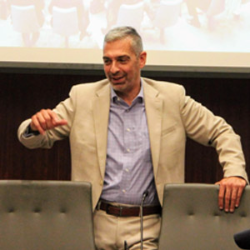
Anthony Wanis-St. John,
SIS professor
Be the first to hear our new episodes by subscribing on your favorite podcast platform.
Like what you hear? Be sure to leave us a review!