
Amplifying Your Scholarly Voice: Essential Strategies for Academic Success
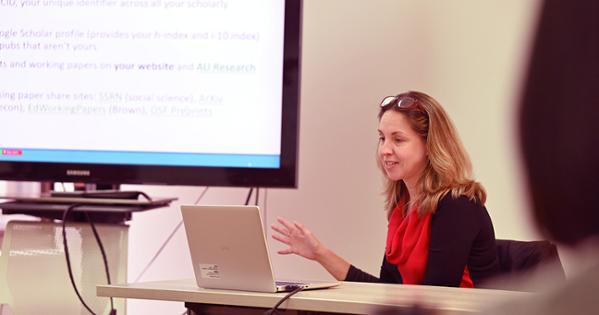
“If I had thought about these things a lot earlier,” Steele said, “I would have had the reach that I was trying to have.” Her session focused on practical strategies for faculty to amplify their work and build meaningful professional networks. Some key takeaways are below. You may watch the full recorded session here, or download the PowerPoint deck here.
Establish Your Digital Foundation
Steele emphasized three fundamental steps every scholar should take. First, set up an ORCID iD—a unique identifier that connects you to all your published work across academic platforms. Education Librarian Hannah Park pointed out that ORC iD integrates with AU’s Elements faculty evaluation software. Second, claim your Google Scholar profile, where colleagues and tenure committees look for your H-index and citation metrics. Third, publish preprints and working papers in open-access repositories like the AU Research Archive, making your research discoverable earlier due to sometimes lengthy journal publication timelines.
“In economics, it takes years for an article to get published,” Steele noted. “I’ve had articles take five years.” By sharing preprints in places like the open research platforms SSRN or OSF, scholars can establish their contributions to ongoing conversations while continuing to navigate the traditional publication process.
Be Your Best Self-Advocate
Perhaps Steele’s most counterintuitive advice addressed the common academic discomfort with self-promotion.
You have to be your own press agent, because if you think the work is worth doing, then I think it’s worth it for people to know about it.
Practical tactics include creating accessible summaries of new research for LinkedIn and other social platforms, emailing key scholars you cited to let them know your work builds on theirs, and maintaining contact lists of journalists who have interviewed you. One colleague strategically includes recent publications in his email signature—a simple way to ensure every professional interaction showcases current work.
University communications offices can help. AU’s Faculty Experts Guide connects scholars with journalists seeking sources, but academics must proactively signal their availability and areas of expertise. Contact University Marketing and Communications (or Jason Pier if you’re in Baker) to learn how to be added to the list of experts.
Build an Independent Academic Website
 While many scholars rely solely on institutional webpages, Steele strongly advocates for personal academic websites independent of any employer, as you do not want promotion to be dependent on working at one place. “You should have something that follows you and doesn’t just follow your institution.”
Whether using GitHub Pages, WordPress, or Google Sites, an effective academic website should include links to publications, working papers, media appearances, teaching resources, and a downloadable CV. Steele compared it to a Wikipedia page—more archive than news site—that requires updating only a couple times yearly but provides a comprehensive professional presence.
Be Intentional with How You Spend Your Time
Using a metaphor of pouring water from a pitcher into cups each day, Steele challenged participants to consider whether they direct energy toward the right professional activities. Are you focusing on data collection, writing, conference participation, journal service, or community engagement? “This is a process of a day, but it becomes a process of a year, a decade, a lifetime, and it becomes your legacy,” she observed.
While writing accountability is a common challenge, she encouraged the formation of a regular writing group—scheduled time for silent, collective work that creates external accountability without requiring extensive conversation.
Finding Mentorship at Any Stage
Drawing on comments from faculty participants Dr. Antonio Ellis and Dr. Jisun Jeong, among others, the session dismantled the idea that mentors must be senior scholars. “A person doesn’t have to be older than you, or at a more advanced stage in their career in order to be a mentor,” she noted. Peers offer different expertise and can provide mutual accountability.
Steele challenged participants to use the remaining weeks of 2025 to accomplish “one thing that fills the right glass”—one contribution that advances the scholarly impact you genuinely want to have.
For academics feeling isolated in navigating professional visibility, Steele’s message was clear: these conversations matter to uphold each other, strategic self-promotion serves the work itself, and building your scholarly presence is both learnable and essential.
Links: