
Certificate Requirements
Browse our certificate requirements, courses, and electives

Kerwin Hall, Room 306 on a map
SPA: Graduate Admissions 4400 Massachusetts Avenue NW Washington, DC 20016 United StatesOpen to students with a bachelor's degree or higher from an accredited institution, participants who are currently enrolled in an SPA master's program may apply 12 relevant credits to this program. For those not currently enrolled in an SPA master's program, if they choose to continue their studies toward a degree, they may transfer up to 12 credit hours as long as they indicate their plans before the 12-credit threshold in the certificate program. Students also may apply up to 3 hours earned at an acccredited college or university as transfer credit toward a certificate.
Learn more about admissions and apply.
Browse the Cyber Certificate Info Sheet.

 Dr. Suleyman Ozeren, Professorial Lecturer and Director of the SPA's Cyber Policy and Management Graduate Certificate Program, recently published an article titled “North Korea’s Cryptocurrency Theft and Strategic Logic of Its Cyber Operations” with the Orion Policy Institute.
The opinion piece analyzes North Korea-linked Advanced Persistent Threat (APT) actors' malign activities in cyberspace, cryptocurrency theft cyberattacks, and the strategic logic behind these operations.
Read More
 Matt Saglam is a seasoned cyber threat intelligence expert with a passion for proactive cyber attack prevention. As the driving force behind a team of over 40 threat intelligence analysts at SOCRadar, he led the charge in providing Attack Surface Management, Digital Risk Protection, and Cyber Threat Intelligence services to a diverse clientele of more than 14,000 companies globally. With a strong focus on analyzing cyber risks, Matt currently dedicates his expertise to supporting National Computer Emergency Response Teams (CERTs), Information Sharing and Analysis Centers (ISACs), and enterprises in addressing their evolving threat intelligence needs. He holds certifications as a Threat Intelligence Analyst, Ethical Hacker, and Red Team Professional, complemented by a Master's degree in Computer Science from Virginia Tech. Beyond his professional accomplishments, Matt is a community-driven individual who initiated the Security for Community nonprofit cybersecurity advisor. This noble endeavor empowers both organizations and individuals with actionable threat intelligence to proactively thwart cyberattacks. Additionally, Matt serves as a professional Ransomware Negotiator and offers his expert insights as a threat intelligence advisor to DefendMe.AI, the pioneering GenAI-based personal security advisor.

Stewart Garrick, Special Projects Manager at The Shadowserver Foundation and former Senior Investigating Officer at the UK’s National Crime Agency, will join Adjunct Professor Matt Saglam’s Cyber Risk and Threat Intelligence class on November 3, 2026. The course is offered through SPA’s Cyber Policy and Management Graduate Certificate Program.
Garrick brings 30 years of UK law enforcement experience, including work on the international investigations behind the Gameover Zeus and Dridex botnet takedowns. At Shadowserver, he contributes to a nonprofit organization that supports efforts to disrupt cybercriminal infrastructure through technical analysis, sinkholing, and victim notification.
The conversation will explore a central challenge in cybersecurity: turning threat intelligence into evidence and coordinated action across borders, jurisdictions, and institutions. Students will examine how law enforcement, nonprofit organizations, and private industry work together to disrupt cybercrime and help protect affected communities.
For the class’s 28 students, whose backgrounds include international relations, public policy, law, and counterterrorism, the session will connect cyber policy and risk management with the practical realities of international investigations.
Looking for more? Browse our full list of recent news and events.
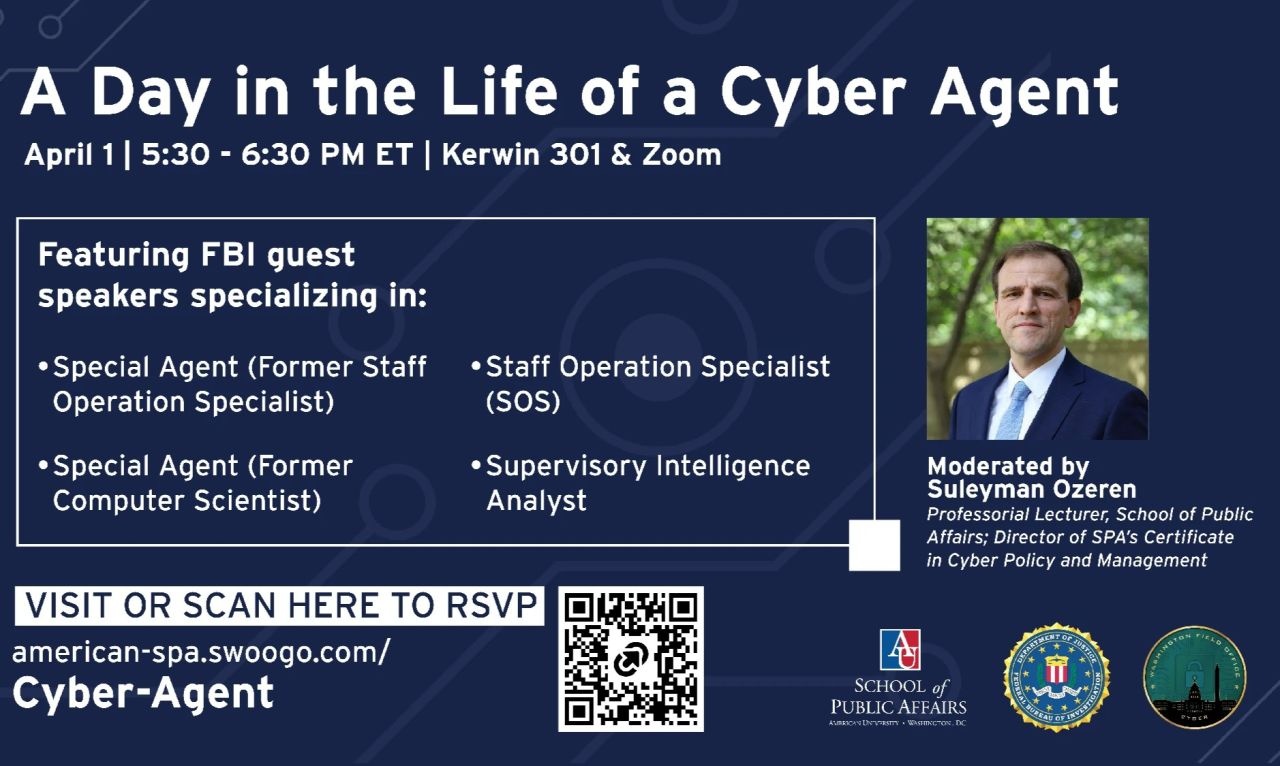
Join SPA Prof. Suleyman Ozeren for "A Day in the Life of a Cyber Agent" on April 1 at 5:30 PM in Kerwin 301 or via Zoom. Hear from FBI guest speakers about careers in cyber opertations, intelligence analysis, and national security.
RSVP

The Cyber Policy and Management graduate certificate program is tailored for individuals who seek leadership roles in cybersecurity, focusing on policy and management. The Cyber P&M Cert equips students with essential skills to navigate and influence U.S. cyber policy and address management challenges. Cyber Cert students will be able to understand and synthesize “cyber” in the context of both U.S. cyber policy and internal cyber management challenges and opportunities.
Students will gain deeper perspectives about the current and emerging dynamics of the policy processes related to U.S. cyber policy, such as critical infrastructure, artificial intelligence, regulatory harmonization, public-private partnership, software liability, and civil cyber defense, and how we approach cybersecurity governance.
The Cyber CERT program will enable students to master the tools they need to enter the cyber workforce and apply them to real-world scenarios impacting cyber policy and management domestically and internationally.
We will help students contextualize relevant cybersecurity legislation, regulations, and international developments, and how they incorporate these advancements within U.S. policies.
Students will learn to build a resource toolkit that allows them to quickly diagnose problems and propose clear, action-driven solutions to tackle cyber management issues within the public and private sectors.