

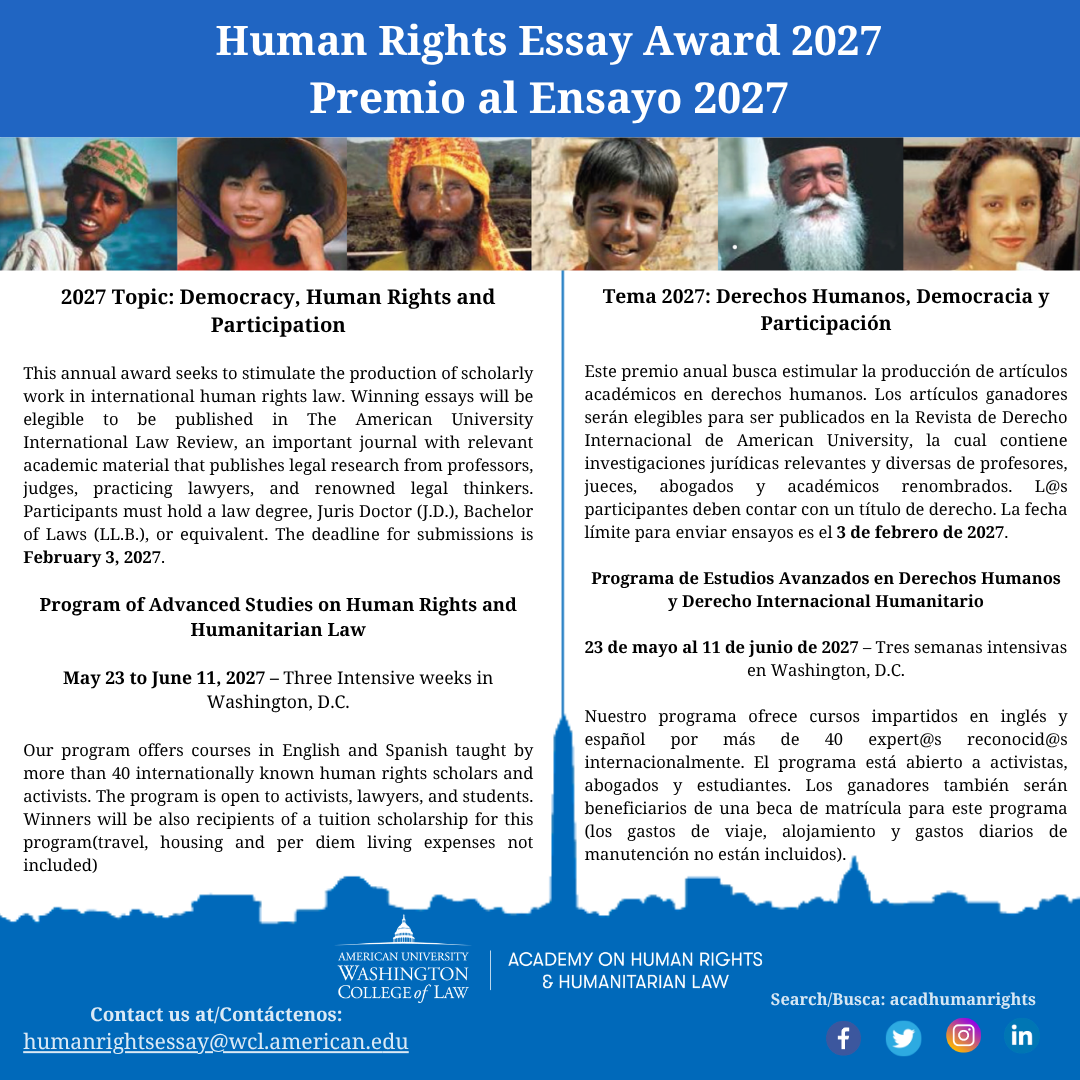
2027 Human Rights Essay Award
The call for submissions for the 2027 Human Rights Essay Award is now open!
2027 Topic:
Democracy, Human Rights and Participation
The Human Rights Essay Award is an annual award sponsored by the Academy aimed at encouraging the production of academic articles in the field of international human rights law. The topic for the 2027 will be: Democracy, Human Rights and Participation
Participants have the flexibility to choose any subject related to this topic. However, the scope of the essay must directly correspond to the 2027 theme, or it will be disqualified. Additionally, we would like to note that we believe international human rights law includes international humanitarian law and international criminal law.
ABOUT THE TOPIC
The Academy has chosen for the 2027 Human Rights Essay Award the theme of “Democracy, Human Rights and Participation.”
The topic of democracy has increasingly occupied a central role in academic and professional legal discussions concerning the effective protection and guarantee of human rights. As political dynamics evolve across countries and regions, and as the structure and functioning of institutions change, important questions arise regarding how new political proposals, forms of governance, and transformations in the exercise of public authority affect the way in which States, their institutions, and even non-State actors ensure the protection of fundamental rights.
During the 1990s, there appeared to be a broad consensus within much of the international community not only that democracy was the most suitable system for protecting individuals and promoting stable and prosperous societies, but also regarding many of its fundamental components. Today, however, democracy itself and the institutions traditionally associated with democratic governance are once again the subject of significant legal and political debate. Several well-recognized organizations have raised concerns about changes in democratic institutions and political rights around the world. Human Rights Watch, for example, noted in its World Report 2026 that, according to some metrics, democracy has returned to levels last seen in 1985 and that approximately 72 percent of the world’s population currently lives under autocratic rule.
These developments are also occurring at a time when the international institutions and human rights mechanisms established and progressively strengthened in the decades following the Second World War face important questions regarding their effectiveness, resources, mandates, and capacity to respond to contemporary challenges. At the same time, scholars and practitioners continue to debate broader transformations in globalization and multilateralism, including the emergence of approaches to international relations that are increasingly described as transactional. These transformations in political and international systems inevitably have implications for democracy, including how democratic institutions are built, structured, understood, and preserved.
The relationship between democracy, human rights, and participation therefore opens the door to a wide range of contemporary legal questions. Among many possible areas of discussion are the separation and independence of branches of government; judicial independence and impartiality; the protection and political participation of minorities and historically marginalized groups; political pluralism and the role of political parties; equality and nondiscrimination; transparency and public participation in the adoption of legislation and policies affecting communities; labor rights and democratic participation; freedom of expression and freedom of the press; the role of civil society; and the protection of civic space.
Other questions concern the profound impact of technology on democratic societies, including the role of social media in political participation and public discourse, the challenges created by misinformation, and the rapid development of artificial intelligence (AI) and its impact on individuals, institutions, elections, employment, and the exercise of fundamental rights. Candidates may also consider questions related to election integrity and political participation; public security and crime-prevention policies and their compatibility with human rights; accountability for gross human rights violations; the weakening or capture of democratic institutions; and the legal and institutional challenges involved in restoring democracy and the rule of law following periods of authoritarianism.
These questions are neither entirely new nor limited to any particular region. Democracy has faced profound challenges at different moments in history and across virtually every region of the world. Contemporary developments, however, provide an opportunity to reconsider these questions through the evolving framework of international human rights law and to examine how established principles should respond to new political, institutional, social, and technological realities.
Recognizing the breadth of this topic, the Academy encourages candidates to think creatively and critically about the many legal questions it raises. Essays may approach the subject from different regional, international, comparative, institutional, or thematic perspectives. Candidates should nevertheless ensure that their analysis maintains a clear connection among the three central components of the 2027 topic: democracy, human rights, and participation.
It is noteworthy that this same topic will be addressed during our 32nd Inter-American Human Rights Moot Court Competition, which will take place from May 16 to May 21, 2027.
This year, we have partnered with the GQUAL Campaign, and the Center for Justice and International Law (CEJIL), in the development of the hypothetical case., to create a complex and cutting-edge case. Participants in the Essay Award are eligible to be judges in the Moot Court Competition. Check more here.
Learn more about the work of the GQUAL Campaign here: https://gqualcampaign.org/
Learn more about the work of CEJIL here: https://cejil.org/
Our commitment to fostering human rights education and encouraging the production of academic articles aims to enhance the analysis of this pressing topic and to contribute to more effective legal frameworks and stronger protections for all individuals seeking to exercise their right to protest, as is necessary and expected in democratic societies governed by the rule of law.
ABOUT THE AWARD
The Academy will grant two Awards: one for the best article in English and one for the best article in Spanish, each of which will consist of a full tuition scholarship to the Program of Advanced Studies on Human Rights and Humanitarian Law for either the Diploma or Certificate of Attendance options (travel, housing and per diem living expenses are not included).
Additionally, the two best articles and the four honorable mentions may also be published in the American University International Law Review, which contains relevant and diverse academic material. This prestigious journal receives approximately 1,500 submissions each year and publishes legal research from professors, judges, lawyers, and renowned scholars.
*The Academy reserves the right to determine whether the 2027 Program or any of its classes will be held virtually if exceptional circumstances so require.
Participants Eligibility Requirements:
-
Must hold a law degree, Juris Doctor, (J.D.), Bachelor of Laws (LL.B.), or equivalent.
-
Shall have a demonstrated experience or interest in international human rights law.
-
Have the flexibility to choose any subject related to the 2027 topic: Democracy, Human Rights and Participation
-
Must keep in mind the essay must be a legal article citation sources.
-
The submitted essay must be an academic legal article with proper citations and source references.
Important dates:
-
Deadline for submissions: February 3rd, 2027
-
Winners Announcement: April 1st, 2027
Difference between the award and our LL.M Program
We would like to remind you that the Human Rights Essay Award is a project offered by the Academy of Human Rights and International Law. The project is not related to the application process for our LL.M. programs, for which you need to follow all the steps outlined on our website at this link, which we encourage you to consult if you are interested.
Want to know more?
Click on the right menu to learn more about the Award regulations.
Contact us!
For more information, please contact us at [email protected]. Allow 48 to 72 business hours for responses
We invite you all to keep visiting this page for more details on the 2027 Human Rights Essay Award!