
The Culture of Eastern Orthodoxy June 2026
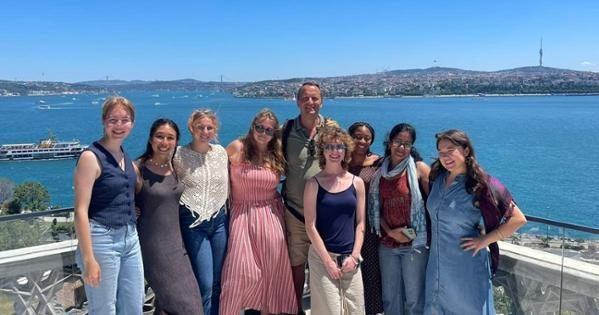
In June of 2026, the Carmel Institute sponsored a class-trip to Istanbul, Türkiye, for a group of students from AU, Trinity, Harvard, and Miami University of Ohio. It explored the legacy of the Eastern Roman Empire and Byzantine Orthodoxy.
Before arriving in Istanbul, the students read Thomas Madden’s Istanbul: City of Majesty at the Crossroads of the World (2016) and selections from Geffert & Stavrou’s Eastern Orthodox Christianity: The Essential Texts (2016). The course combined discussions of the books with visits to churches, museums, mosques, and archaeological sites in Istanbul and beyond. In the process, the students explored the history of the Byzantine Empire, the evolution of Eastern Orthodoxy, and the interconfessional relations throughout the late classical, medieval, and modern eras. Dr. Onur İşçi of Bogazici University in Istanbul also joined the group on select museum visits, guided some of the tours, participated in discussions, and gladly answered multiple questions about Istanbul.
Carmel Institute director and associate professor of history Anton Fedyashin guided the students through museums and urban explorations, and led daily discussions based on the readings. In the process, the students learned to contextualize written texts through museum exhibitions, artistic representations, religious symbolism, and archaeological interpretations. The urban tours related architectural styles to religious, philosophical, and artistic trends. The class also introduced the students to the impact of deep cultural structures on spiritual and visual expressions of medieval and early modern societies. Moreover, the students discussed the similarities and differences between Byzantine Christianity and Russian Orthodoxy, Catholicism, Protestantism, and Islam.
On the first full day of the trip, Dr. Fedyashin gave the students a tour of the Istanbul Archaeological Museum as an introduction to eastern Mediterranean geopolitics and the history of Achaean civilization and the classical city-states of Greece, one of which, Megara, established the colony of Byzantion and influenced its evolution into Constantinople. Exploring the artistic styles that dominated the Eastern Mediterranean region from the Archaic Period to the Roman Empire, the group discussed the literary, philosophical, and geopolitical trends leading up to the split between the Western and Eastern Roman Empires. The students also reflected on the intellectual and spiritual legacy of the classical era that the Christian world would inherit, coopt and, in some cases, suppress. The group then proceeded to explore the remnants of the ancient Hippodrome with its three remaining historic columns. After ushering the group through the unique private hippodrome museum in a Byzantine cistern, Dr. Fedyashin led the students into the Church of Sts. Sergius and Bacchus, which is known as the Küçük (Little) Aya Sofia. Built by Justinian and Thedora in the 520s, it is a remarkable monument to Byzantine architecture on the cusp of its golden age. The group closed out the day on the Sea of Marmara exploring the ancient sea walls, Boukoleon Palace, and the remnants of the imperial palace. On the way back to the hotel, the group walked through Gulhane Garden to see the oldest Roman-era monument in the city—the Column of the Goths. Touring the museums and the city, the group pounded out 30,000 steps on the first day.
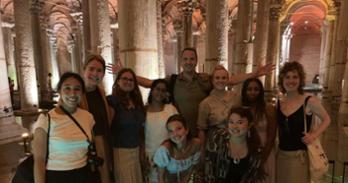
The group started the second day with a tour of the brand new audio-visual Hagia Sophia Museum in Sultanahmet Square. Opened in August 2024, the museum ushers visitors through multiple rooms depicting the history of the cathedral with rich visual and audio arrangements. Dr. Fedyashin then took the students on a tour of the medieval world’s largest Christian cathedral, the Hagia Sophia. Turned back into a functioning mosque recently, it remains open to tourists between prayer times. However, only the second-floor galleries are accessible. Nevertheless, they contain some of the most impressive Byzantine mosaics in Istanbul and even some unique Varangian graffiti. Even though it is 1,500 years old, Hagia Sophia’s sheer size and beauty continue to stun. No wonder that the Rus envoys who entered it famously remarked that they “knew not whether they were in heaven or on earth.” The group then visited a marvel of early Byzantine engineering, the 6th-century Basilica Cistern, and discussed the important contribution of Roman engineering to the development of Mediterranean and Eurasian civilizations. The group then toured the Hagia Eirene Cathedral. Its inclusion within the boundaries of the Topkapi Palace complex saved the church, which was never turned into a mosque. It was the site of the Second Ecumenical Council of Constantinople in 381, which confirmed the Nicene Creed. After lunch, the group walked across Sultanahmet Park to visit the Sultanahmet Mosque, often called the Blue Mosque for the stunning white-and-blue tiles that adorn its interior. They listened to the famous dueling call to prayer between the muezzin of Ayasofia and the Sultanahmet mosques. The students then walked up the ancient Mese Road to the Column of Constantine. The discussions that day focused on the role of the Trojan War in Roman, Byzantine, and Christian Orthodox identity. Once it conquered the Macedonian and Greek territories and turned them into provinces, the Roman Republic began to emphasize Aeneas’s role as the city’s founder. Eastern Roman Emperor Constantine the Great emphasized the same connection with his new capital by encasing the Palladium statue that Aeneas carried with him from Troy inside the base of the famous Constantine Column, which still stands close to Istanbul’s Grand Bazaar. The students closed out the second day with a visit to the Grand Bazaar.
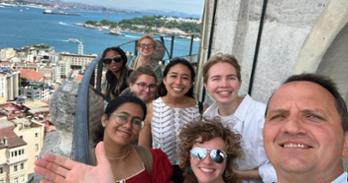
The third day began with the steepest climb of the week up to the Tekfur Museum, which was part of the Blachernae Palace that stood along the Theodosian Wall of Constantinople. The wall marked Constantinople’s last line of defense in 1453, when the Ottoman army attacked the Byzantine capital. Dr. Fedyashin gave the students a tour of the site where the last Byzantine Emperor Constantine XI took leave of his family and imperial court to join the capital’s defensive forces. Restored and reopened in 2017, the Tekfur Palace offers spectacular views from its rooftops upon the extent of the city as it was in the fifteenth century. The group walked along the remaining section of the wall with a stop to see one of the best monuments of Byzantine architecture, the Chora Church. Reopened just a few months before the trip after years of renovation, the Chora Church is also the functioning Kariye Mosque. People interested in 14th-century Byzantine frescoes and mosaics will find a rare treasure here. Preserved by the Ottomans because they plastered over the original decorations, the art in Chora is stunning. Off the beaten tourist track, it is a visual record of late Byzantine interpretations of three Christian stories. The frescoes depict Judgment Day. The two sets of extensive mosaics depict the lives of the Virgin Mary and Christ. After lunch, the group continued their three-hour walk back to the historic district. It passed under the Valentinian Aqueduct, a marvel of Byzantine engineering, and visited Shekhzade and Suleimaniye mosques designed by the renowned Ottoman architect Mimar Sinan. The group then mounted to the top of the 14th-century Galata Tower to take in the magnificent views of the seven hills of Constantinople. And it ended the day at a lamp workshop called Highlights of Istanbul where the students made traditional lamps for themselves as souvenirs.
The group started the fourth day with a boat tour of the Bosporus, which included sailing past the Rumeli Fortress, which Mehmet the Conqueror constructed on his way to conquer Constantinople. In an unprecedented development, dolphins appeared twice during this outing. Dr. Fedyashin then took the group on the subway to Yedikule Fortress, which constituted the southern end of the Theodosian Wall of Constantinople. Overlooking the Sea of Maramara, the fortress contained the famous Golden Gate of Constantinople, which is bricked up today. Yedikule offers great panoramas of the surrounding countryside, the sea, and the Mese Road, which led from the Egnatian Way to the royal palace. The group then walked along half of the Theodosian Wall as Dr. Fedyashin showed the students its three levels and explained to them that the land section withstood every invasion until Mehmet the Conqueror took the city in 1453. It therefore remains human history’s largest and most successful urban defense wall, which fulfilled its function successfully for 1,000 years. The group closed the day by visiting the Panorama 1453 Museum to reflect on the legacy of Constantinople’s fall.
The group started day five by taking a ferry to Büyükada, also known as Prinkipo Island—the largest in the chain of the Princes’ Islands where Byzantine royals were often exiled. The students enjoyed a swim in the Sea of Marmara called the Propontis. The group toured the island and saw the house where Leon Trotsky spent four years of his exile (1929-1933) and wrote his famous history of the Bolshevik Revolution and his memoir My Life.
The group started its sixth day with Drs. Fedyashin and Isci touring the official residence of the Ottoman sultans, the Topkapi Palace Museum complex. They then took the city ferry to Istanbul’s Kadiköy District to explore the history and architecture of the Asian side with its Orthodox churches, synagogues, and mosques with Drs. Fedyashin and İşçi as guides.
On the last day of the trip, several students enjoyed a traditional Turkish bath (known as a hamam) in the historic Kilic Ali Pasha complex built by Mimar Sinan. They then finished packing and headed for the airport to return to the US and other destinations.