
The Cold War Georgetown Set
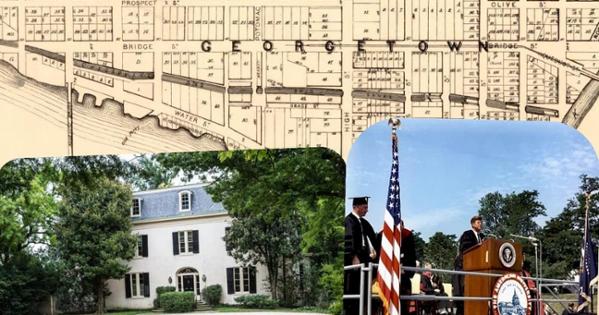
On Saturday, April 25, 2026, Dr. Fedyashin led a two-hour tour exploring the Cold War sites of Washington’s Georgetown neighborhood. The students investigated the lives of America’s Cold Warriors, known as the Georgetown Set, as well as the Cold War’s socio-economic and urban manifestations.
A political village when the Second World War thrust it into the ranks of global capitals, Washington had no metropolis status, few cultural amenities, and no native intelligentsia. The new American elite quickly coalesced in Georgetown and left its mark on the neighborhood. The people who created Henry Luce’s “American century” were not just present at the creation of a superpower but raised the curtain on the opening scene of the Cold War and brought it down at its end.
Their emergence came with a locational shift of political power in Washington from the Dupont-Kalorama area running along the Massachusetts Avenue axis—where Teddy Roosevelt, William Howard Taft, Woodrow Wilson, and Herbert Hoover lived—to “the tiny kingdom of Georgetown,” as Phil Graham put it, where the salonistas constituted a government by invitation.
President Lyndon Johnson noted that “every student of Washington’s political process ought to know that the business of government is often transacted during evening hours, sometimes over a drink and sometimes over a meal—but almost always in Georgetown.” Richard Nixon hated the “eastern elitists, knee-jerk liberals, Georgetown gossips, [and] Kennedy men” who made up the Georgetown Set. But his National Security Advisor Henry Kissinger famously noted that the “hand that mixes the Georgetown martini is time and again the hand that guides the destiny of the Western world.”
Dr. Fedyashin started the tour at Georgetown’s historic Oak Hill Cemetery, which is the resting place of Secretaries of State Dean Acheson and Madelein Albright as well as Washington Post owner Katherine Graham and its Executive Editor Ben Bradlee. The group then crossed the street to explore Kay Graham’s house, which she purchased from William “Wild Bill” Donovan, the founder of the Office of Strategic Services, which both spied on and cooperated with Soviet military intelligence under Pavel Fitin during the Second World War.
The group then explore Georgetown’s East Village stopping at the houses of Secretaries of State Cyrus Vance and Dean Acheson, whose memoir Present at the Creation won the Pulitzer Prize.
At the house of Chip Bohlen, Dr. Fedyashin told the group about the owner’s sojourns at the US embassy in Moscow from the 1930s to his ambassadorship in the 1950s. Just down the street, the group stopped at columnist Joe Alsop’s house where Chip Bohlen advised President Kennedy on how to deal with the Cuban Missile Crisis during a party on the evening of October 16, 1962.
At Averell Harriman’s house, the group discussed his tenure as US ambassador to Moscow during the Second World War when he also advised President Franklin Delano Roosevelt at the Teheran and Yalta conferences. After John F. Kennedy gave his breakthrough Commencement speech at American University in June 1963, he sent Harriman to Moscow to negotiate the Limited Test Ban Treaty with Nikita Khrushchev’s government.
The group also visited the house of Llewellyn Thompson who served as US ambassador to Moscow from 1957 to 1962 and again from 1967 to 1969. JFK called Chip
Bohlen and Thompson his “demonologists,” but their advice to embrace diplomacy in dealing with the Soviets averted multiple crises that could have gone horribly wrong.
The group also visited the homes of Frank Wisner, Mary Pinchot Meyer, Walter Lippmann, and the mid-nineteenth-century Russian ambassador Alexander de Bodisco who died in Georgetown and is buried at Oak Hill Cemetery. The group then walked by the homes of James Forrestal, Harry Hopkis, Ben Bradlee, and John F. Kennedy himself. And the tour ended with lunch at Georgetown’s famous Martin’s Tavern where Cold War practitioners met with their competitors as well as their allies to work out their plans and their differences. The likes of Donovan, Truman, LBJ, JFK (who is said to have proposed to Jackie in booth 3), Nixon, and Bill Clinton dined here, among many others.
Museum visits, concert attendance, and study trips have been part of the Carmel Institute’s programming since its inception. As Professor Fedyashin always reminds his students, although our knowledge about the past depends primarily on reading, history must also be walked and seen.