
From Hip-Hop to the White House: 20 Courses You Can Take at American University
What do Taylor Swift and professional baseball have in common?
At American University’s College of Arts and Sciences, both have provided unexpected ways to study economics. The student-designed Swiftonomics economics course attracted national media attention, while The Economics of Baseball brought America's pastime into the study of labor markets, wage inequality, and corporate decision-making.
In courses across the College, students have opportunities to design video games, examine the science behind their favorite foods, explore the stars, and discover what happens behind the scenes of a theater production. They can also take advantage of AU's Washington, DC, location, studying the history of the White House, or exploring the capital as a living city shaped by art, activism, and politics.
Take a look at just 20 of the unique courses offered across AU's College of Arts and Sciences.
Chemistry of Cooking (CHEM-150)
 Photo by Jeff Watts
There's a little chemistry in every kitchen. Explore fundamental concepts such as acids, bases, and chemical reactions through the science of food and cooking. Hands-on activities bring chemistry to life, using familiar ingredients and everyday processes to illustrate the principles behind chemical change.
Game Development I (GAME-415)
Have you wanted to create your own video game? Work with classmates to design and develop one while exploring programming, artificial intelligence, graphics, and interface design. You'll also discover the artistic and production decisions that bring a game from concept to completion.
Washington, DC: Life Inside a Monument (AMST-140)

Washington is more than monuments and museums. Explore the capital as a living city shaped by art, community activism, and politics. Discover how DC's identity as the nation's capital intersects with its role as a regional community and a city with global connections.
Street and Club Dance I (DNCE-117)
From breaking and hip-hop to house, locking, popping, and waacking, this course will get you moving. Learn foundational techniques while exploring the history and culture of the dance styles through movement, readings, videos, and discussion.
History of the White House (HIST-212)

There's more to the White House than the presidents. Explore the history of America's most famous residence, from its changing architecture and the people who lived and worked there to its evolution as a symbol of American democracy and diplomacy.
Do the Right Thing (PHIL-120)
What's the right thing to do when there's no easy answer? Put philosophical theories to work as you examine contemporary ethical and political dilemmas. Explore how moral reasoning can help us think critically about difficult questions and competing values.
Astronomy Lab (PHYS-160)

Look up! From the night sky to the expansion of the universe, explore astronomy through observation and experimentation. Hands-on laboratory activities introduce students to topics such as telescope optics, spectroscopy, solar observations, and the science behind our understanding of the cosmos.
Memory and Cognition (PSYC-300)
Why do we remember some things and forget others? How do attention, perception, and language shape the way we experience the world? Explore the science of thinking and memory through psychological research, behavioral studies, and theories of cognition.
Urban Gardening (ENSC-175)
 Photo by Jeff Watts
Get your hands dirty in AU's Community Garden. Learn how to grow and care for edible and medicinal plants in an urban environment, from planting and harvesting to food preservation. You'll also explore food security, agriculture, foraging, and community resilience.
The Fed Challenge (ECON-205)
Think you have what it takes to tackle the nation's economic challenges? Analyze macroeconomic data, develop policy recommendations, and learn to communicate complex ideas clearly. Working as a team, students prepare a presentation simulating a briefing to the Federal Reserve's Federal Open Market Committee.
Stagecraft (THTR-260)

Ever wondered what happens behind the curtain? Discover the technical artistry that makes live theater possible, from scenery and stage lighting to sound, makeup, and costumes. Mandatory laboratory sessions provide hands-on experience with scenic construction, basic electricity, and live-performance support.
Art and Science of Wellbeing (HLTH-200)
What does it really mean to be healthy? Explore the physical, psychological, and social dimensions of wellness through classroom discussions, fitness activities, and hands-on laboratory work. Learn how to measure aspects of health, including blood pressure, cardiovascular fitness, and the body's response to stress.
Class Piano Level I (MUSC-111)

Always wanted to learn piano? Here's your chance to start at the keyboard. Designed for beginning students, this course introduces the fundamentals of piano playing and helps build essential keyboard musicianship skills, laying the groundwork for private lessons or further musical study.
The What, Where, and Why of Art (RELG-225)
What makes something art? Who decides whether it's good? And why does art matter in the first place? Explore philosophical questions about creativity, meaning, and artistic value through forms that may include film, music, video games, comics, theater, and dance.

Cinema and the Twentieth Century (LIT-246)
Love movies? Discover how cinema evolved throughout the twentieth century, from major artistic developments to advances in filmmaking technology. Examine films as works of art and explore the historical and cultural forces that shaped what audiences saw on screen.
Art, Performance, and Politics (PERF-305)
Can art change minds—or change the world? Examine how artists, activists, and political figures use performance and creative expression to advance political ideas and promote social change. Explore the connections between artistic choices, cultural context, and political movements.
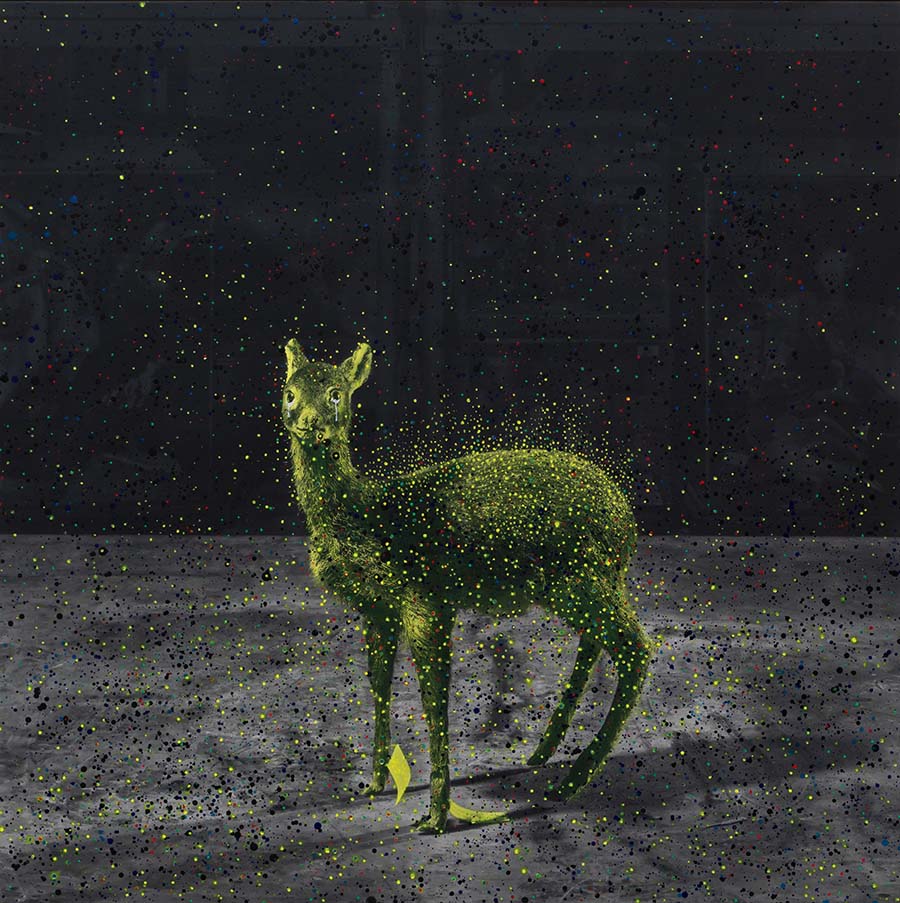
How Art Became Modern (ARTH-210)
How did art become modern? Trace the evolution of visual art from the late eighteenth century to today, exploring how political upheaval, social movements, industrialization, and global history transformed artistic expression. Discover how art both reflects and responds to a changing world.
Right: Ahn Chang-Hong, Sorrow 2025’10, 2025. Mixed media on photo panel, 51.2 x 51.2 inches. On display at the American University Museum, Spring 2026.
Washington, DC Architecture (ARTH-216)
Explore Washington, DC, through its architecture, from classical landmarks to modern designs. Through classroom discussions and visits to buildings across the city, discover how history, engineering, and design have shaped the nation's capital. Learn historical styles, the meaning of materials, architectural design, engineering innovations, and the complex relationship between form and function.
Jazz Orchestra (MUSC-146)

Love the sound of a big band? Join fellow musicians to prepare and perform jazz standards, traditional big-band arrangements, and more progressive international and fusion works. The ensemble explores both big-band and small-combo formats, offering opportunities to develop as a jazz performer. Audition required.
Intro to American Sign Language II (ASL-101)
Take your American Sign Language skills to the next level. Build on your knowledge of vocabulary, grammar, and sentence structure as you develop greater confidence in expressing yourself and understanding others. You'll also explore Deaf culture, history, and culturally appropriate communication.