You are here: American University College of Arts & Sciences News Meet CAS’s New Faculty

Contact Us

202-885-2446

Fax: 202-885-2429

[email protected]

Battelle-Tompkins, Room 200 on a map

CAS Dean's Office 4400 Massachusetts Avenue NW Washington, DC 20016 United States

Back to top

Meet CAS’s New Faculty—and Learn What They Can’t Wait to Share with Students
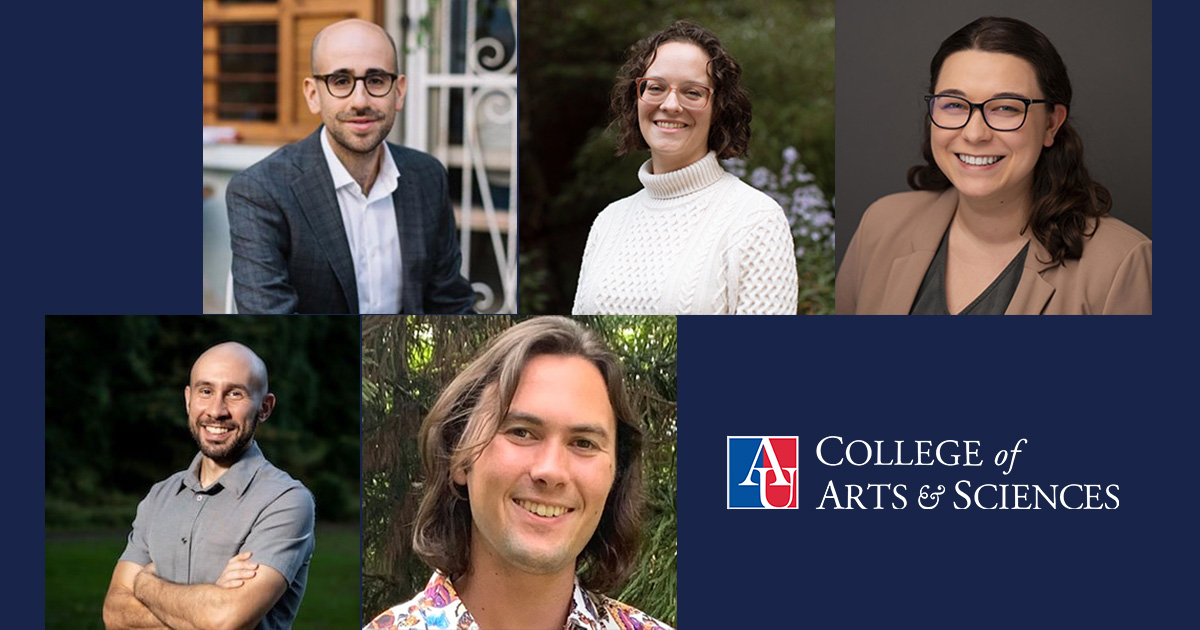
Five new professors bring expertise in AI, archaeology, mental health, philosophy, economics, and more to American University’s College of Arts and Sciences

By  | 

Jacob Abolafia, Lisa Velkoff, Lilly Springer, Zev Cossin, and Isaiah King

From an archaeologist excavating the past to an artificial intelligence researcher protecting critical infrastructure, the College of Arts and Sciences is welcoming a new group of faculty members whose work spans the humanities, social sciences, arts, and sciences. This fall, they'll bring new ideas, research opportunities, and real-world experience into AU classrooms and labs. 

“Our newest faculty bring an extraordinary range of expertise and ideas to CAS,” says Dean Linda Aldoory. “They are asking important questions, pushing their fields in new directions, and creating opportunities for students to ask big questions, engage in hands-on research, and build successful careers.” 

Meet the five newest faculty members in the CAS community—and find out what they can’t wait to share with students this fall. 
Isaiah KingAssistant Professor of Computer Science and Mathematics and Statistics

Isaiah King is helping computers recognize cyber threats before they become real-world attacks. His research uses artificial intelligence, machine learning, and graph-based algorithms to strengthen cybersecurity and protect critical infrastructure. Outside the lab, King is also an accomplished creative writer whose fiction and poetry have appeared in literary publications—bringing an uncommon blend of technical expertise and creativity to the classroom.

What He Can’t Wait to Share: The “Math-y” Side of Programming

“I’m excited to share the more math-y side of programming with CSC students who may not think of themselves as mathematicians,” says King, “and MATH students who may not think of themselves as computer scientists.” 

Teaching this fall: CSC-320 Algorithms and Data Structures


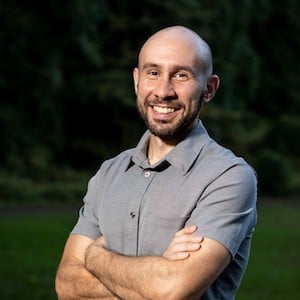
Zev Cossin Assistant Professor of Anthropology

Zev Cossin studies the past to better understand today's biggest global challenges. An historical archaeologist and environmental anthropologist, Cossin explores how European colonialism transformed communities and landscapes across the Americas, and how those changes continue to shape issues such as climate change, food insecurity, and environmental justice today. His research spans Ecuador and Minnesota and combines archaeology, archival records, oral histories, and ethnography. He is passionate about experiential education and involving students in field research and community-based projects.

What He Can’t Wait to Share: Let’s Build a Lab

“I can't wait to work with students to begin building a new Public Archaeology and Cultural Heritage Lab in Anthropology. I’m looking forward to building new spaces for community and hands-on training with students to spark creative reflection on the ways the past shapes our contemporary world.” 

Teaching this fall: ANTH-235 The Buried History of the U.S.


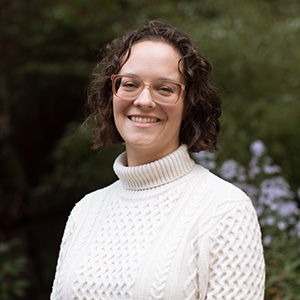
Lisa Velkoff Assistant Professor of Psychology

Lisa Velkoff is a clinical psychologist whose research focuses on understanding, treating, and preventing eating disorders and suicidality. In her research, Dr. Velkoff aims to identify momentary predictors that can tell us when someone is at risk for disordered eating behaviors or self-harming behaviors, with the ultimate goal to use this knowledge to develop better interventions for treatment. Lisa's research has been supported by the National Science Foundation, the Academy for Eating Disorders, and other private foundations, and reflects a commitment to using science to improve people's lives.

What She Can’t Wait to Share: The Science of Human Behavior

“This year, I look forward to sharing with AU students the many exciting ways that researchers use the scientific method to understand human behavior, and I'm glad to have the opportunity to do this both in the classroom and in the lab.”

Teaching this fall: PSYCH 215: Abnormal Psychology


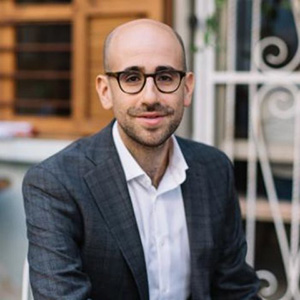
Jacob Abolafia Assistant Professor of Philosophy and Religion

What can prisons, ancient philosophy, and political myths teach us about today's world? Quite a lot, according to Jacob Abolafia. A political philosopher trained at Yale, Cambridge, and Harvard, Abolafia studies the history of political thought from classical antiquity to the present, exploring topics ranging from incarceration and democracy to ethics and political economy. His courses invite students to connect timeless philosophical questions with today's most pressing social and political debates.

What He Can’t Wait to Share: Democracy Is More Than a Word

“The thing I'm most excited to share with AU students this fall is that democracy is not only a word. It's a set of practices and a way of life that they, as students and citizens, are already involved in and can use to shape their own lives and the world around them.” 

Teaching this fall: The Philosophy of Democracy and Human Rights


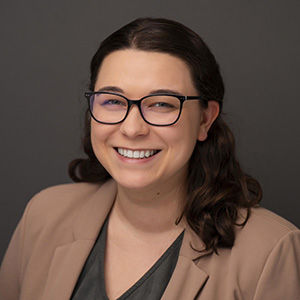
Lilly SpringerAssistant Professor of Economics and Health Studies

Lilly Springer studies questions that affect millions of families every day. Her research examines how health, family life, and work intersect, with a focus on reproductive health, social safety-net programs, and parents' participation in the workforce. Springer is also committed to mentoring students and broadening opportunities within the field of economics, bringing both rigorous research and a passion for teaching to AU's classrooms.

What She Can’t Wait to Share: The Economics of Our Health

“I am excited to share with AU students how policies and economic forces influence all aspects of our health,” says Springer, “from pregnancy and birth to palliative care.”

Teaching this fall: ECON 200: Principles of Microeconomics