
Robots Take the Shortest Path: Prof Nate Harshman’s Advice to the Class of 2030
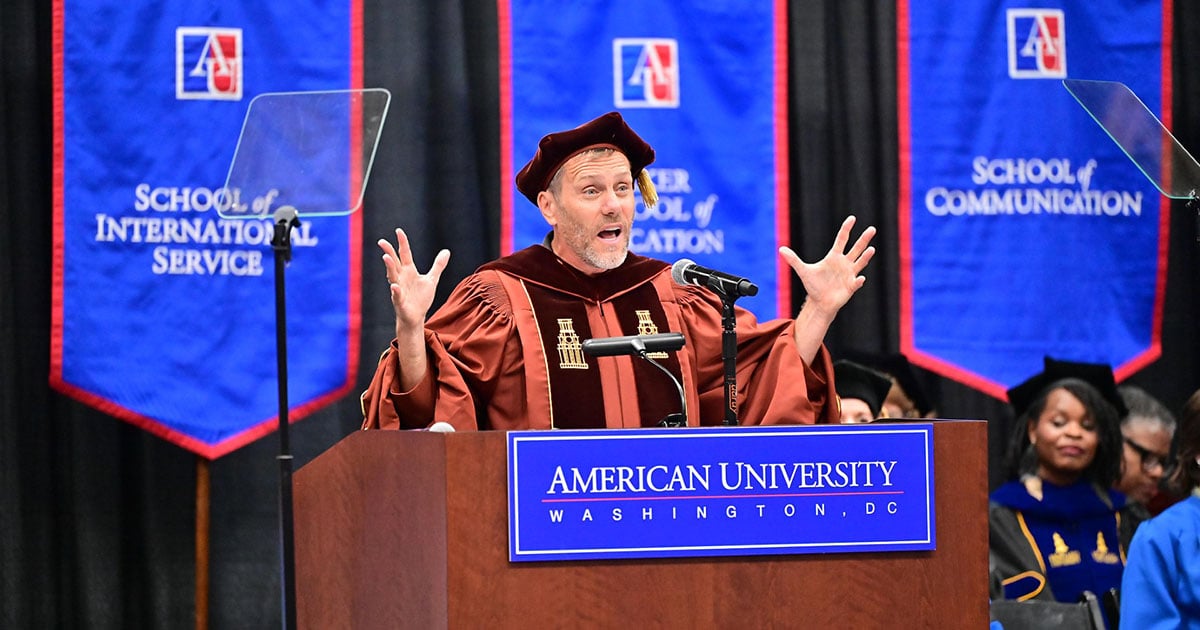 Photo by Jeff Watts
What can quantum physics teach students about how to spend the next four years at American University?
Quite a lot, according to Professor of Physics Nate Harshman.
Harshman, American University’s Scholar/Teacher of the Year, took the stage on August 28 at the New Student Convocation, a cherished AU tradition that marks the official beginning of the college journey for new Eagles. He welcomed the Class of 2030 with a story from his own first month of college. He and his roommate were walking back to campus from a comic bookstore when they disagreed about which way to go. Harshman argued for the most logical choice: the shortest route.
His roommate had a different idea. “Robots take the shortest path,” he said.
Decades later, Harshman, now a theoretical physicist who studies symmetry and topology in quantum systems, still remembers the lesson.
“Sure, there may be advantages for taking the shortest path back to the dorm,” he told the new Eagles. “But we can also choose to optimize something else, like beauty or joy. Or we don’t have to optimize at all. We can just take some random path because we’re humans and we’re curious.”
Nathan Harshman, PhD - 2026 Convocation Speech
Watch Nate Harshman's remarks to the Class of 2030
Don't College Max
Harshman is an expert on complex concepts. His research explores, among other things, what happens when mathematics, logic, and rationality run into the limits of complex physical systems.
The weather is a complex system, and so are the climate and the economy, he told the Class of 2030. And their lives are complex, too.
Complex systems are difficult to predict and control, and attempts to optimize them oversimplify messy reality, he added. So he offered the new Eagles some advice: “Don’t college max.” Instead of trying to engineer the perfectly efficient college experience, he encouraged students to leave room for curiosity, discovery, and the unexpected.
Some of the most worthwhile things humans do, he reminded them, aren’t particularly efficient. “Learning isn’t efficient. Creativity isn’t efficient. Research isn’t efficient. Protecting the environment isn’t efficient. Democracy isn’t efficient. Human dignity isn’t efficient.”
Be Wild, Be Free, Be Kind of Each Other, Be Human
“Don’t pressure yourself to optimize by Tuesday,” Harshman told the Class of 2030. “Explore DC. Read books that aren’t on the reading list. Seize opportunities to dance. Take risks. Heck, take an intro physics class. Become an expert in something obscure and delightful. Hang out in the commons room talking about how to build a just and caring society late into the night and how to prevent the robot apocalypse.”
It was fitting advice from a professor whose own career has ranged across particle physics, quantum information, and ultracold atomic systems, and whose more than two decades at AU have included teaching and mentoring students, leading the Department of Physics, directing the NASA DC Space Grant Consortium, and co-founding the university’s Initiative for STEM Education, Equity, and Ethics.
Most of all, Harshman does not want students to fear uncertainty but to embrace it. “Within the uncertainty of complexity is your freedom,” he said. He ended with four simple instructions: “Be wild, be free, be kind to each other, be human.”