
American University
International
Anti-Muslim Racism 25 Years after 9/11: What’s Changed, and What Hasn’t?
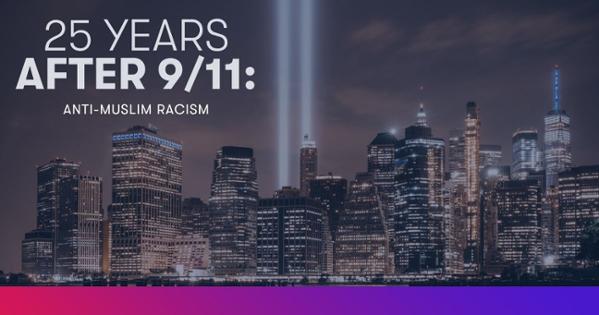
Twenty-five years ago, Mariam Durrani watched in horror as the September 11 attacks transformed both our country and the experiences of Muslim and immigrant communities across the United States. The tragic events of that day, as well as what played out in the days and weeks that followed, became central to her research and teaching today at the intersections of war, migration, racialization, higher education, and Muslim youth.
To better understand what has—and hasn’t—changed in the 25 years after 9/11, we spoke with Durrani about whether “Islamophobia” is comprehensive enough a word to capture anti-Muslim racism that exists today, what universities can better do to address, and what gives her hope.
- You were a college student yourself when 9/11 happened. What do you remember about that day, and how did it transform your own career path and research interests?
- I vividly remember the sense of panic as the events of September 11 unfolded before our eyes, but I also remember an immediate concern for brown immigrant communities and the backlash that would inevitably follow. At the time, I was a junior at the University of Arizona in Tucson. Many of our worst fears were realized only days later when a gunman murdered Balbir Singh Sodhi, a 52-year-old Sikh American businessman outside Phoenix, in what he described as "retaliation" for the attacks. In the weeks, months, and years that followed, my friends and communities took precautions to avoid becoming targets of hate crimes. In the months after 9/11, I felt a growing responsibility to speak out against the wave of anti-Muslim sentiment that swept the country. I began writing anti-war articles for the campus newspaper and sought ways to challenge the fear, misinformation, and harassment directed at Muslims and Islam.
- Years later, as a doctoral student, I encountered the consequences of the post-9/11 security state in my own research. During my fieldwork, I learned about the NYPD's surveillance of Muslim Student Associations, including those at my field site, Hunter College, and at my doctoral institution, the University of Pennsylvania. From the immediate aftermath of 9/11 through my fieldwork in 2014, I witnessed the normalization of institutional forms of discrimination affecting Muslim and Arab students. I later observed similar dynamics as a tenure-track professor of anthropology at Hamilton College.
- These experiences ultimately shaped my current book project, which examines the interconnected ways that U.S. wars reverberate across educational institutions both domestically and internationally. The project argues that the impact of U.S. military interventions cannot be understood solely through their effects abroad; They also reshape universities, students, and public discourse within the United States itself, while producing parallel consequences in other locations of the War on Terror, such as Pakistan.
- In your research and writing, you often use the phrase “anti-Muslim racism” instead of the more commonly phrased “Islamophobia.” What is the difference, and why does the distinction matter?
- The term Islamophobia first appeared as Islamophobie in 1910, when it was used to describe “a prejudice against Islam that is widespread among the peoples of Western and Christian civilization.” The concept gained broader prominence with the publication of the British think tank Runnymede Trust’s 1997 report, Islamophobia: A Challenge for Us All, which argued that “anti-Muslim prejudice has grown so considerably and so rapidly in recent years that a new item in the vocabulary is needed.” Following the attacks of September 11, 2001, Islamophobia became the dominant term used in public discourse, the media, and in scholarly analysis to describe harassment, discrimination, and violence directed toward Muslims and those perceived to be Muslim.
- In recent years, however, scholars and activists have increasingly questioned whether the term Islamophobia adequately captures the racialized nature of anti-Muslim discrimination. In 2017, a group of scholars launched the website Islamophobia is Racism to advance resources that show how anti-Muslim exclusion operates through processes of racialization and should be understood as a form of racism. That same year, the Runnymede Trust’s 20th-anniversary update explicitly redefined Islamophobia as a form of “anti-Muslim racism,” emphasizing that anti-Muslim discrimination functions in ways similar to other forms of racial oppression.
- The concept “anti-Muslim racism” highlights how Muslims are not only targeted on the basis of religious identity but are also racialized through social, political, and cultural processes that produce structural inequality and violence. Understanding anti-Muslim racism requires situating it within longer histories of U.S. and European empire-building and examining the interconnected systems of power that shape racial hierarchies. A focus on anti-Muslim racism thus directs attention to the historical and institutional forces that both exclude and selectively incorporate Muslims into broader structures of racial domination.
- We still actively see anti-Muslim attacks at play, including toward politicians such as New York City Mayor Zohran Mamdani and U.S. Senate candidate Abdul El-Sayed. What does this tell us about what has and hasn’t changed in the past 25 years?
- The anti-Muslim attacks leveled against politicians such as Zohran Mamdani and Abdul El-Sayed reveal a central paradox of contemporary American politics: Muslim Americans have become an integral part of democratic life, yet their participation continues to be shaped and constrained by the legacies of more than 25 years of U.S. military wars in Muslim-majority countries. Their experiences illustrate how the forever wars have transformed not only the regions in which they were fought but also the institutions, political cultures, and forms of citizenship within the United States itself.
- Even as Muslim Americans attain greater representation in electoral politics, they continue to confront racialized narratives that portray them as suspect, foreign, or insufficiently American. In Broken: The Failed Promise of Muslim Inclusion, Evelyn Al-Sultany argues that Muslim inclusion in the United States often operates through what she terms “crisis diversity,” in which moments of overt Islamophobia prompt symbolic gestures of inclusion and institutional recognition while leaving the deeper structures that produce anti-Muslim racism largely intact.
- The scrutiny directed at Muslim political candidates underscores how the racial and security logics forged during the post-9/11 era continue to shape public discourse, making Muslim political participation a site where questions of citizenship, loyalty, and national belonging remain contested. These recurring attacks highlight the deep connections between foreign policy and domestic racial formation, demonstrating how war abroad has helped produce enduring structures of anti-Muslim racism at home. The inclusion of Muslim Americans in the democratic project has therefore been neither straightforward nor complete; rather, it has unfolded alongside ongoing efforts to police the boundaries of national belonging.
- What do you see as the biggest thing that universities should be doing differently when teaching about 9/11 and anti-Muslim racism to a generation that was not yet alive during it?
- Universities can respond to anti-Muslim racism by pairing institutional commitments to sustainable, long-term inclusion alongside educational initiatives that examine the historical roots of anti-Muslim racism. Resources such as University of Pennsylvania’s Teaching Beyond September 11 provide educators with tools and lesson plans to explore the enduring consequences of 9/11 through critical inquiry and a social justice framework to help understand how anti-Muslim rhetoric and policies are embedded in broader histories of race, empire, war, and citizenship.
- Universities must also ensure that Muslim students are able to participate openly and freely in discussions about U.S. politics, foreign policy, and the ongoing consequences of the Global War on Terror without being subjected to heightened surveillance, suspicion, or criminalization. Protecting academic freedom, free speech, and fostering an environment in which Muslim students can express political views, engage in debate, and advocate for causes they care about on equal terms with their peers is essential to creating a genuinely inclusive campus. In doing so, universities can move beyond reactive responses to racism and cultivate deeper forms of understanding, accountability, and democratic engagement.
- Twenty-five years after 9/11, what gives you hope?
- In some ways, this is a difficult question because, over the last 25 years, I have watched the U.S. War on “Terror” expand dramatically. According to Brown University's Costs of War Project, the U.S. has conducted counterterrorism operations, airstrikes, and/or ground combat missions in at least 78 countries around the world. The consequences of this vast military infrastructure are global, but they also shape everyday life in the United States in countless ways.
- Over the years, I have been asked what it would take to bring an end to Islamophobia, or anti-Muslim racism. My answer is that as long as we continue to invest in and normalize forever wars, there are good reasons for concern. The narratives, policies, and security logics that justify military interventions abroad often reverberate at home, shaping how Muslim communities, and communities perceived to be Muslim, are treated.
- What gives me hope is that the past 25 years have produced a rich body of scholarship and activism that helps us better understand the connections between war, racism, surveillance, citizenship, and belonging. My own work reflects this shift. In December 2001, I published a college newspaper article titled “The Misrepresentation of Islam,” focused on challenging stereotypes about Muslims. My current book project develops what I call the “Imperial Optic,” a framework that moves beyond questions of representation to examine the infrastructures of empire and war-making that shape institutions and everyday life. My hope is that sharing these insights with students can help foster a more critical public and contribute to ending both anti-Muslim racism and the era of forever wars within our lifetimes.
- On that note, please join us for the panel conversation “Tracing the Impact of 9/11 Forever Wars: From 2001 to the Present” in Founder’s Room on Friday, September 11th from 4-6 p.m. The conversation will feature scholars and practitioners to examine the human, political, and social impacts of the Forever Wars, and the stories too often left out of official remembrance.