
Fostering a Culture of Cross-Campus Research Collaboration

Academic research typically doesn’t occur in a vacuum.
The process of getting published can often involve collaboration across teams of research associates, peer reviewers, and academic journals.
For Professor Derrick Cogburn, collaboration has been a throughline of his career. Since joining American University’s School of International Service (SIS) in 2009, Cogburn has fostered a culture of student-faculty collaboration on various projects, creating opportunities for students across AU’s campus to publish substantial research, present at major conferences, and engage with cutting-edge technology.
“[Including students in research] presents a tremendous opportunity for students to collaborate more closely with faculty on research than they normally would. This is especially true if the faculty member is not simply using the students to collect background research, but actively engaging them in the conceptualization, data collection, analysis, and writing processes,” Cogburn explained.
Getting Students Involved in Disability Research
Cogburn, whose research is situated at the intersections of information technology, global governance, and socio-economic development, serves as the founding executive director of AU’s Institute on Disability and Public Policy (IDPP), a research center that focuses on global, regional, and national disability policy, inclusive sustainable development, disaster risk reduction, and accessible global governance.
In its infancy, IDPP focused much of its work in the ASEAN region. Through a grant from The Nippon Foundation, the center established AU’s first fully online master’s degree—the master’s in Comparative and International Disability Policy—for students who were blind, visually impaired, deaf, hard of hearing, or mobility impaired in Southeast Asia. The program enrolled three cohorts of SIS master’s students before it was turned over to the ASEAN University Network, which is made up of universities across Southeast Asia.
Cogburn has involved students across AU’s campus in the work of IDPP since the beginning. For many years, he explained, AU students assisted in planning and organizing an annual IDPP meeting in the ASEAN region, which came with the opportunity to travel to Malaysia, Singapore, Thailand, and Cambodia—a chapter Cogburn says he’s “very proud of.”
For more than decade, Cogburn has also taken groups of AU students to the UN Conference of States Parties (COSP), where the 194 countries that ratified the 2006 Convention on the Rights of Persons with Disabilities (CRPD) gather in New York to discuss the implementation of the Convention.
Prior to the COVID-19 pandemic, AU students who attended COSP in past have had the opportunity to serve as official UN rapporteurs—a person appointed to help take notes of proceedings, summarize sessions, and track formal discussions.
“We were the only university in the world who had students come and serve as official rapporteurs for COSP,” Cogburn said.
Today, IDPP has expanded the scope of its work to a global scale, working with international institutions headquartered in Washington, DC, and New York City, and enabling students to contribute to academic research published across an array of journals.
From the Classroom to the United Nations
Most recently, Cogburn has involved students in the IDPP through his work of developing a dashboard that tracks international progress on the CRPD.
Cogburn’s dashboard, which launched in summer 2026, integrates Python-based text mining and natural language processing techniques to synthesize more than 1,900 documents on the AI-powered dashboard, allowing users to track 20 years of CRPD implementation progress in just a few clicks. Cogburn teaches students how to run this kind of text analysis using AI tools through his Advanced Text Analytics with AI and Machine Learning course for graduate students.
The dashboard was born out of a peer-reviewed paper Cogburn published with assistance from AU alumni Juliana Woods, SIS/MA ’26, and Theodore Ochienge, Kogod/MS ’22, in Data and Policy, a journal published by Cambridge University Press. Cogburn was invited to present the paper during the Global Forum on Law, Justice, and Development at the World Bank, and it was there that he showed the audience an initial prototype of the dashboard.
“I did a little demo of the dashboard that I ginned up in a couple of hours, and people loved it,” Cogburn recalled. “I was mobbed afterwards, and the students I brought to the event with me were amazed because they saw all these people coming up to me afterward, and we left saying, ‘We really need to do this.’”
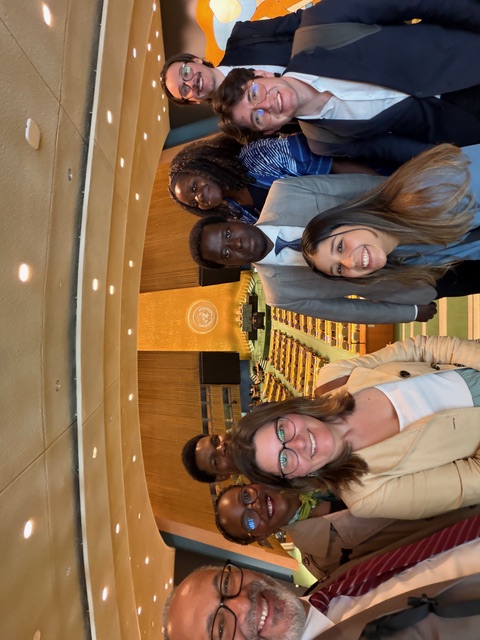
To bring the dashboard to fruition, Cogburn collaborated with five AU research associates, including SIS student John Dylan Bustillo, SIS/MA ’27. The team of research associates helped with the conceptual and technical development of the dashboard, conducted internal testing of the dashboard, led IRB-approved user-research, , and helped prepare materials for presentations of the dashboard.
“It has been amazing to work with Dr. Cogburn and the rest of the IDPP team on making the dashboard an instrument for knowledge translation,” Bustillo said in an interview this summer. “Through this project, I learned a great deal about how to filter technically dense information into something that is visual, searchable, and intuitive for analysis. It has been rewarding to see how this project has sought to marshal the immense amount of information generated by the treaty reporting cycle for use by the disability rights community.”
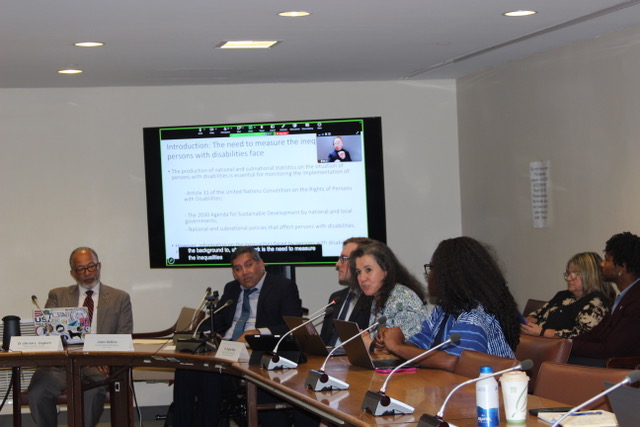
Bustillo was among a group of AU students that Cogburn and Professor Maria De Jesus took to COSP 19 in New York City, where the team hosted a side event to present the dashboard as part of UN celebrations marking the 20th anniversary of the CRPD.
Reflecting on presenting the dashboard at the UN side event, Bustillo said it was a “singular experience.”
“Over the course of the conference, I had the opportunity to showcase the data dashboard to a number of advocates,” Bustillo recalled. “It was these interactions that I found particularly meaningful. Coming from countries around the globe, everyone I spoke to brought a rich perspective to disability advocacy that broadened my understanding and provided countless learning experiences. I also profited from hearing the unique perspectives on how different segments of the disability community could incorporate the potential insights from the dashboard into action.”
Empowering Future Generations of Researchers
Cogburn is continuing to find ways to incorporate even more students into his research and the work of IDPP.
Cogburn said IDPP, the Internet Governance Lab (IGL), and the UNESCO Chair in Transnational Challenges and Development have been registered under the new AU Ready Internship Pledge—which provides undergraduate students with access to $4,500 in funding support while they are engaged in an unpaid or underpaid internship or research experience—and is hopeful this will open additional doors for students to get involved in the centers’ work.
For Cogburn, one of the main things he tries to do when mentoring research associates is guide them through every step of publishing research, from writing through to publication. He shepherds them through how to address feedback from peer reviewers and how to write memos in response—key skills anyone interested in publishing academic research needs to know.
“There are only so many hours in the day, so having students who are dedicated enough to bring the skills they have currently to the research process and dedicate themselves to learning more is a tremendous asset and resource,” Cogburn said. “When I dedicate my time to teaching students new skills and mentoring them, I’m doing it both for them and their own development, but to also contribute to our research activities as well.”
Author's Note: The CRPD Disability Rights Data Dashboard is funded, in part, by the National Science Foundation Accelerating Research Translation program under the Translating Research into Action Center (TRAC) award #2331399.