
SIS Voices: Community as a Non-Negotiable Throughline
Welcome to SIS Voices, an ongoing series in which SIS alumni from a range of experiences, including disadvantaged backgrounds, first-generation graduates, first in their families to enter the field of international affairs, and many others share their experiences working in international affairs. They offer some advice to current and future students who may also find themselves outside the majority in their classes and professional spaces. These alumni work in varied fields, and they share a belief that the surest way to realize the SIS vision of “waging peace” is to include all voices in the discussion.
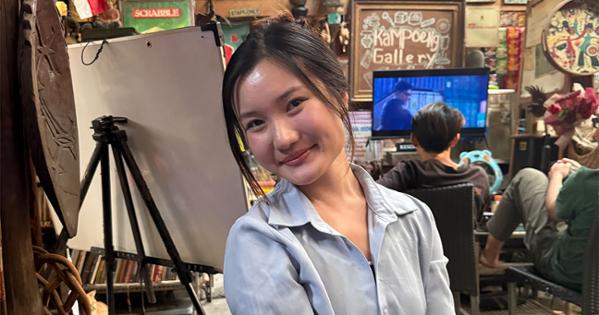
In this edition, we spoke with Samantha “Sammie” Chai, SIS/BA ’22. While much of her time at American University took place online due to the pandemic, she still found community at SIS. She led the efforts to reestablish the Southeast Asia Student Network, creating meaningful spaces for belonging and deconstructing stereotypes of the “Asian” or “Asian American” experience. She also made a deliberate effort to connect with faculty members, some of which she still stays in touch with even today, having most recently been invited to speak with incoming students at SIS’s New Student Welcome.
- What sparked your interest in international affairs?
- My cultural background sparked my interest in pursuing a career in international affairs and global development! As a proud daughter of Malaysian immigrants and granddaughter of smallholder farmers, I am privileged to be predisposed to a wealth of knowledge—even before I had the development jargon to describe my family’s livelihood—and to have had the opportunity to visit my large family in Malaysia throughout my childhood.
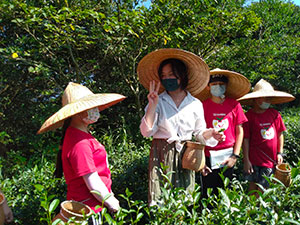 For example, the gender and rural-urban education disparities experienced by my family members paved the way for my interest in teaching culturally relevant classes. After graduating from American University in 2022, I embarked on a three-year journey as a Fulbright Taiwan grant recipient, instructing in rural elementary schools and Technical and Vocational Education and Training (TVET) university settings. Currently, I am enjoying a development finance consultancy that examines climate-resilient jobs, a sector I previously only had anecdotal and lived experience about via my family’s durian farming livelihood.
- What are some challenges and opportunities you have found as an Asian American woman in the field of international affairs?
- I actually have a hyperspecific example for this. When conducting fieldwork in the historic Chinatown of Glodok in Indonesia last summer, my unique researcher positionality as a Mandarin speaker of Southeast Asian heritage allowed me to build trust with the community members and explore my research topic with a depth and scale that was culturally robust while also being personally meaningful. Many of the “leads” I gained to expand my understanding of the development of the region’s public transportation infrastructure, heritage tourism sector, and education initiatives in Northern Jakarta came from long mornings spent chatting with elders at traditional coffee shops and even longer evenings at mahjong parlors.
- However, Indonesia has a difficult history with its ethnic Chinese populations, fraught with institutionalized cultural genocide and violent riots. While my identity as a Sino-Southeast Asian woman was key in contextualizing the research and fostering bona fide relationships (especially with the community’s elders), it also led to uncomfortable situations that were a direct result of this same intersectionality. While conducting fieldwork, I received my fair share of sudden proposals, catcalls mixed with racial epithets, and distrust from those who viewed the Chinese Indonesian communities I was working with as an insular outgroup.
- While at AU you were very involved in creating community and challenging stereotypes, which was realized in your work reestablishing the Southeast Asia Student Network and as an Intergroup Dialogue Facilitator. What skills, tools, or knowledge did you gain from SIS that have proven especially important in your career growth?
- My presidency of the Southeast Asia Student Network (SEANET) and my facilitation of Intergroup Dialogues shaped my understanding of communication across differences. These experiences also led to an epiphany: no matter what type of work I do in the future, community is a non-negotiable throughline for me! I attribute these experiences to my current fascination with community-led development schemes and the opportunities they inspire, especially in the post-USAID world.
- As an SIS student, the research I conducted in Professor Boesenecker’s qualitative methodology course provided me with the skills necessary to develop a rapid social baseline assessment on North Jakarta's development as a research intern for Georgetown School of Foreign Service Asia Pacific. I also want to highlight American University’s DC Community Impact Scholars certificate program, which has led to a network of lifelong friends, a strong foundation in mixed-methods research conducted in collaboration with the wider DC community, and a social-justice orientation that guides my praxis as a development practitioner today. I highlighted the importance of youth volunteerism and action-based research methodologies in a piece I recently wrote for UNICEF’s Generation Unlimited.
- What advice would you give current students from historically underrepresented communities about what they have to offer as a vital voice?
- For Americans like myself who are interested in pursuing careers in the international landscape: positive changemaking is also needed at home! Development issues are not just constrained to the Global South; They are happening in our own backyards. It’s easy to fall into nihilism when thinking about the irreparable damage to trust, both domestically and with other countries, but there’s so much that the world can benefit from your empathy and energy.
- Who are your professional mentors (formal or informal), and how did they come to be your mentors?
- Professor Pek Koon Heng, who taught SIS courses at the intersection of human rights and the Asia-Pacific region, is my role model! During the first week of my freshman year in SIS, I cold-emailed her to introduce myself as a fellow Malaysian-Chinese woman. Not only did I leave her office hours with weekend plans as her plus-one for a Malaysian Embassy/Malaysia-America Society event (where I still maintain a connection today), but I also gained a lifelong mentor and friend. She later served as the faculty mentor who encouraged my friend group to reestablish the Southeast Asia Student Network, a student organization that is still active on campus (go check them out!), has since expanded to George Washington University, and is in talks of launching at Georgetown University! Professor Heng is a close confidant and has provided countless letters of support that eventually led me to three consecutive Fulbright Taiwan grants and my current Georgetown master’s program in development economics. To this day, I enjoy grabbing brunch to catch up with her, as she continues to be my sounding board for major life decisions, both academic and personal. If you needed a sign to email a professor you admire or book office hours with a faculty member you have yet to take a class with, this is the sign to shoot your shot!