
Contact Us
Battelle-Tompkins, Room 200 on a map
CAS Dean's Office 4400 Massachusetts Avenue NW Washington, DC 20016 United StatesThe College of Arts and Sciences houses some of the nation’s leading experts in generative AI research and has become a leader in intersectional education and training in responsible AI scholarship. Faculty across the sciences, humanities, and arts are working at the forefront of AI, not only advancing its technological capabilities but also addressing the profound ethical questions it raises. The College offers students a range of AI-related courses, along with new certificates in ethics and generative AI. Seed grants and programs support training and research, and the new College AI Incubator will serve as a hub for faculty collaboration and student training in AI-related research.
NEW! Center for AI Research in the Sciences and Humanities
Led by Computer Science Professor Leah Ding, the Center for AI Research in the Sciences and Humanities (CARSH) advances interdisciplinary research and education by integrating Artificial Intelligence (AI) with scientific inquiry and humanistic insight. It brings together faculty and students across disciplines to collaborate on responsible, AI-driven discoveries that expand knowledge, promote ethical innovation, and generate meaningful public impact. Learn more about CARSH.
Grad & Undergrad Certificates — AI: Ethics & Society
Housed within the Philosophy and Religion Department, our newest certificates, "Artificial Intelligence: Ethics and Society," are available for both undergraduate and graduate students.
This certificate empowers students to take courses from different disciplines to enhance their knowledge of AI and navigate the complex ethical and societal implications of AI systems. Students will receive interdisciplinary training at the intersection of AI technology, ethical frameworks, and societal impact analysis.
In Action
- CAS rising sophomores and juniors: apply for the Hedayat & Google Student AI Research Award by July 30.
- Leah Ding received a $867,000 National Science Foundation grant to develop innovative AI and machine learning algorithms that can detect and forecast wildfires.
- Michael Robinson's paper, "Token embeddings violate the manifold hypothesis" was accepted to NeurIPS 2025, the worldwide top AI conference.
- Johannes U. Lange (Physics) and physics undergraduate Abby Fisher were part of the international team that released the most detailed 3D map of the cosmos, which will help scientists tackle questions from the evolution of galaxies and black holes to the nature of dark energy.
- Silvina Guidoni (Physics) was part of a team that published “Synthetic Remote-sensing and In-situ Observations of Fine-scale Structure in a Pseudostreamer Coronal Mass Ejection through the Solar Corona” in The Astrophysical Journal (March 2025), which develops methods in computational heliophysics that will help us understand the dynamics of our Sun.
- Leah Ding (Computer Science) eceived supplemental funding of $151,570 (new total: $300,000) from NASA for the project “Enhancing Ice Cloud Retrieval Through Multitask Machine Learning.” She also received supplemental funding of $257,557 (new total; $386,335) from NASA for“Integrating Explainable Machine Learning with Physics for Enhanced Wildfire Detection in Observation-Constrained Environments” and an $867,245 grant from the NSF for “Advanced AI Framework to Improve Understanding and Prediction of Wildland Fire.”
- Watch Michael Robinson discuss Hacking Large Language Models on the Unorthodox Views Podcast.
- Mark Nelson (Computer Science) received an SEK 253,880 international collaboration grant from Vinnova, the Swedish Agency for Innovation Systems, for the project “Foraging Games: Exploring Generative AI systems to tackle high-dimensional game design spaces."
- Nathalie Japkowicz and Zois Boukouvalas (Data Science) published Machine Learning Evaluation: Towards Reliable and Responsible AI (Cambridge University Press, 2024). It looks at ways to evaluate machine learning systems, including how to ensure fairness and avoid bias.
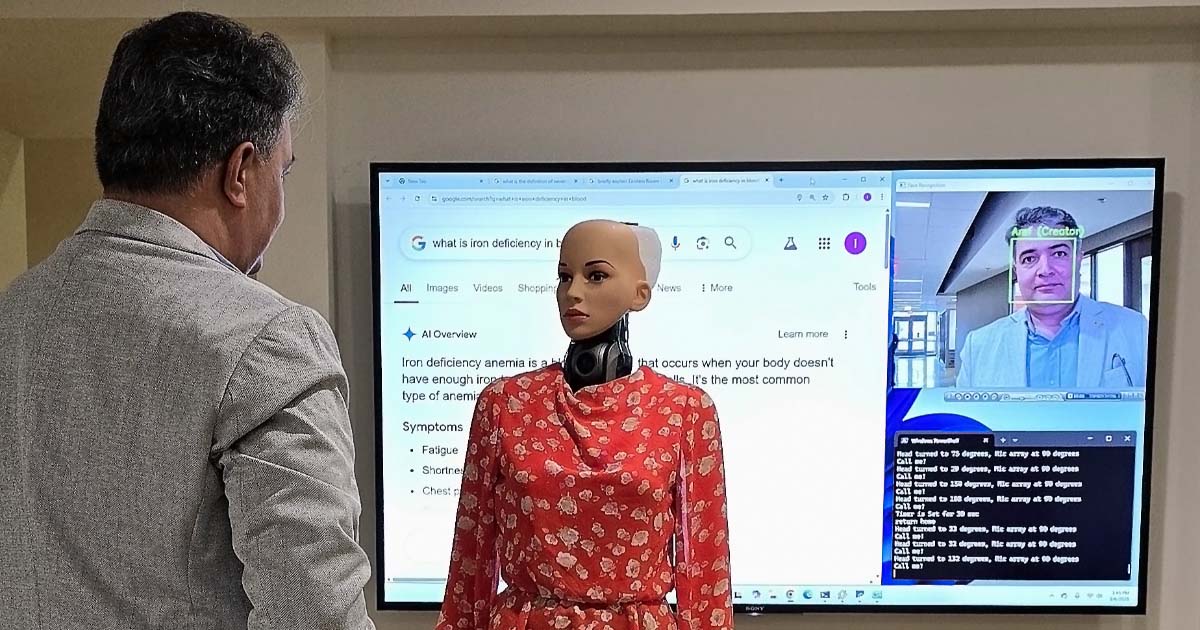 Iris, AU’s first artificial intelligence robot, recognizes faces, speaks in nine languages, and answers complex questions using ChatGPT and Google technology.
 Gift from Hamoon and Nancy Hedayat establishes Hedayat Fund for Generative Artificial Intelligence, which will spark interdisciplinary work in AI research and ethics.
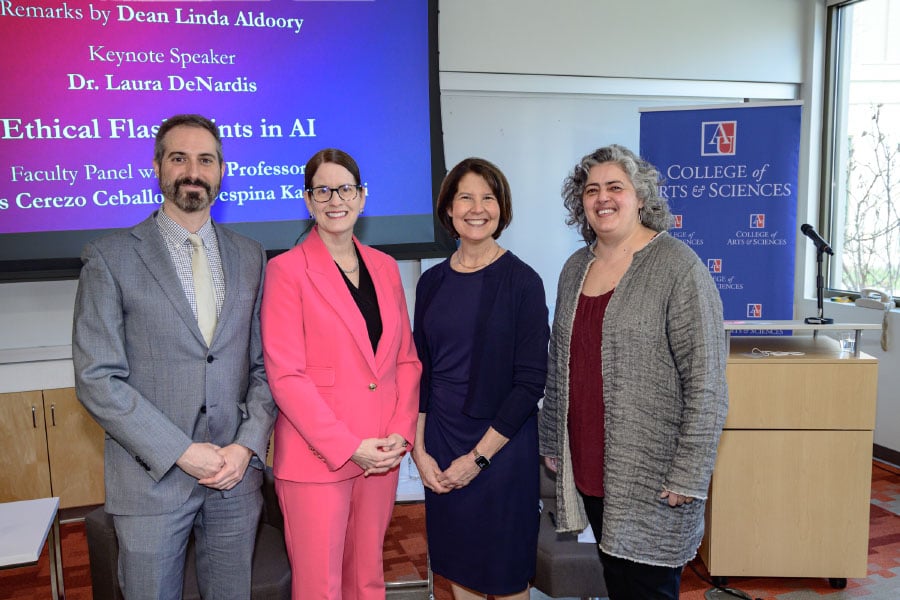 Dr. Laura DeNardis, Director of the Center for Digital Ethics, Professor, and Endowed Chair in Technology, Ethics, and Society at Georgetown University, spoke with CAS Professors Luis Cerezo Ceballos and Despina Kakoudaki during the 2025 Mathias Student Research Conference on Ethical Flashpoints in AI.
 AU physicists contributed to the largest and most detailed 3D map of the universe, capturing 18.7 million galaxies, quasars, and stars.
Curricula
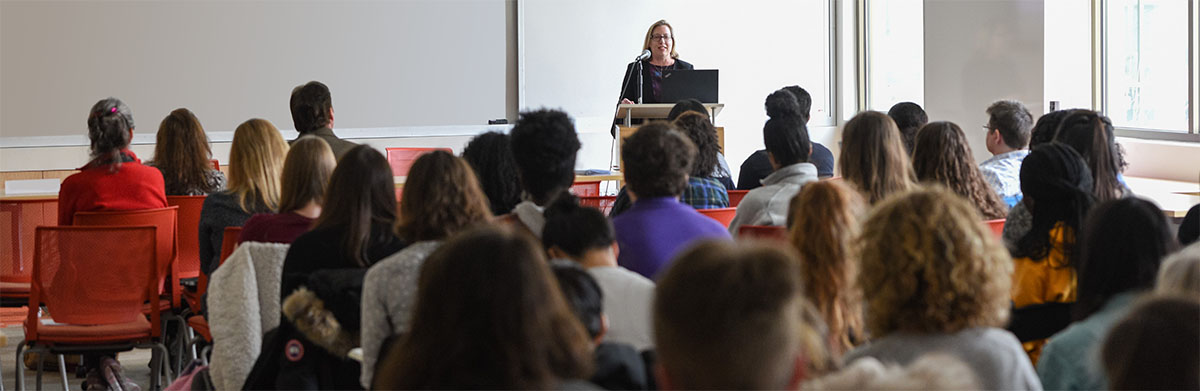
Below is a sampling of the AI-related undergraduate courses across the College. View the full AU course catalogue.
Computer Science
- CSC 124: Exploring AI & Programming
- CSC 432: Intro to Simulation and Modeling
- CSC 468: Artificial Intelligence
- CSC 476: Computer Vision
- CSC 480: Intro to Data Mining
- CSC 481: Machine Learning for Cybersecurity
- CSC 483: Big Data Computing and Machine Learning
- CSC 484: Ethical & Legal Issues in Computing
- CSC 486: Deep Learning for Vision
Data Science
- DATA 441: Natural Language Processing
- DATA 442: Advanced Machine Learning
- DATA-445/645: Neural Networks
- DATA-420/620: Exploring AI Using the Scientific Method
Economics
- ECON 450: Growing Artificial Societies
Environmental Science
- ENVS 430 Environmental Modeling
- ENVS 450 Environmental Data Analysis
Literature
- LIT 302: Ethics of Writing Creatively
Philosophy
- PHIL 435: Digital Ethics & Social Equity
Physics
- PHYS 396: Data Mining and Machine Learning for Natural Sciences
- PHYS 380: Mathematical and Computational Physics
- PHYS 460: Statistical Mechanics
- PHYS 490: Independent Study in Physics and AI
Psychology
- PSYC 455: Cyberpsychology
Statistics
- STAT 427: Statistical Machine Learning
Creative Writing
- WRT 210: Rhetoric of Digital Culture
Faculty Publications
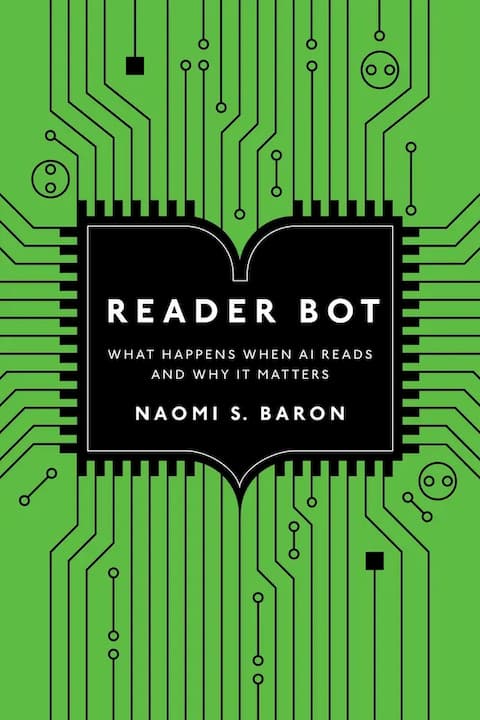
Reader Bot: What Happens When AI Reads and Why It Matters
(Stanford University Press, 2026)
Naomi S. Baron
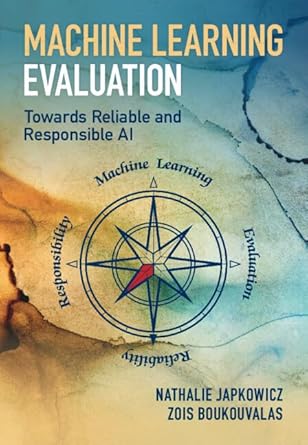
Machine Learning Evaluation:
Towards Reliable and Responsible AI
(Cambridge University Press, 2024)
Nathalie Japkowicz and Zois Boukouvalas

Technology-Mediated Language Teaching: From Social Justice to Artificial Intelligence (Multilingual Matters, 2025) co-edited by Luis Cerezo
For More Information
Stay tuned for more updates as we develop this exciting new hub for generative AI research and education at the College of Arts and Sciences! For more information about donating and becoming a partner in this exciting effort, please contact Giving to AU (202-885-2986).