
American University Releases CMF-CW, a New Tool for Chemical-Weapons Control List Screening
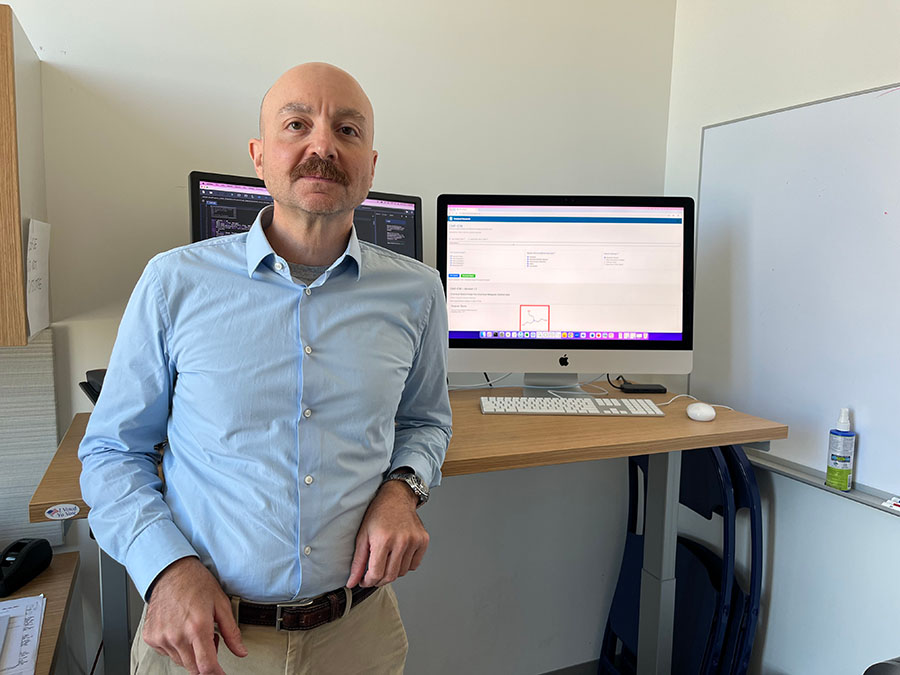
American University has released Chemical Match Finder for Chemical Weapons Control Lists, or CMF-CW, a free-to-use web application developed by Stefano Costanzi, Isbell Professor of Chemistry and Policy in the College of Arts and Sciences. CMF-CW is designed to help users determine whether a chemical is covered by chemical-weapons-related control lists.
The broader motivation is the dual-use nature of chemistry. Chemistry underpins modern society, but some chemicals can also be misused for harmful purposes, including in chemical weapons programs. Chemical weapons disarmament and nonproliferation frameworks address this challenge through mechanisms such as verification, licensing, export controls, and customs screening. Control lists are central to many of these activities, but they are useful only if stakeholders can apply them effectively.
Determining whether a given substance is covered by these lists can be challenging and time-consuming because of the complexity of chemical nomenclature and the vastness of chemical space. CMF-CW addresses this problem by automating key steps in the screening process. Starting from a chemical name or other chemical identifier, the tool checks whether the corresponding substance is covered by several major control lists, including the Chemical Weapons Convention Schedules, the Australia Group Chemical Weapons Precursors list, and the Wassenaar Arrangement Munitions List 7.
The key point is that CMF-CW does not simply search for exact text matches. Because the same chemical can be described in many different ways, the application also uses computer-based analysis of chemical structure. It translates chemical names and other identifiers into molecular structures and checks those structures against an integrated database of controlled chemicals and structurally defined chemical families. CMF-CW was conceived and built from the ground up by Costanzi as original software, combining an in-house cheminformatics engine with an integrated database of chemical-weapons-related control lists. The user experience is simple, but the underlying solution is chemically and technically nontrivial.
The CMF-CW website also includes help pages explaining what the application does, how to use it, and how it works, along with video presentations.
The project reflects Costanzi’s work at the intersection of chemistry, security, nonproliferation, and public policy. Prior work by Costanzi, in collaboration with the Stimson Center’s Partnership in Proliferation Prevention and George Mason University, with support from Global Affairs Canada, demonstrated that these challenges can be addressed through automated, structure-aware approaches based on cheminformatics, the use of computational methods to organize, analyze, and compare chemical information. With CMF-CW, Costanzi has translated this line of work into a new, free, web-based application designed for broader use by professionals and stakeholders.
CMF-CW was developed with support from funds associated with the Isbell Chair in Chemistry and Policy, held by Costanzi at American University. Ongoing translational work is supported by the Isbell Chair and by the National Science Foundation Accelerating Research Translation program through American University’s Translating Research Into Action Center (TRAC), under award #2331399.
CMF-CW is available at: https://cmf-cw.research.american.edu