
Only in DC: A Dream Internship at the Smithsonian
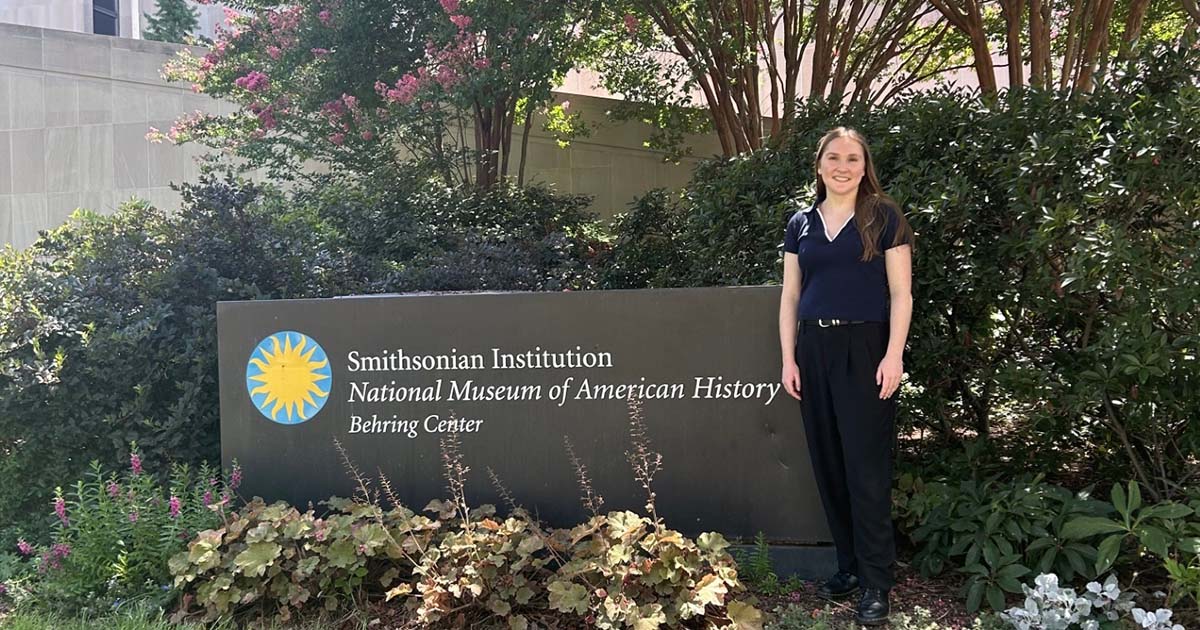 Catherine at the National Museum of American History
I wouldn’t have gotten an internship like this anywhere else in the country.
Catherine Wise came to American University with a dream: to work at the Smithsonian.
Last summer, she got her chance. Wise landed a 10-week internship at the National Museum of American History (NMAH), home to more than three million historical objects documenting the American experience, from the Star-Spangled Banner to Dorothy’s ruby slippers.
It was a coveted opportunity to experience the museum profession from the inside. Wise immersed herself in the collections, conducted independent research, learned from curators and collections managers, and saw firsthand how museums preserve the past and bring its stories to life.
As an MA student in AU’s Public History Program, it was exactly the kind of experience Wise came to Washington to find.
“I wouldn’t have gotten an internship like this anywhere else in the country,” she says.
For AU public history students like Wise, many of the nation’s leading museums and cultural institutions are just a Metro ride away—and university connections and a strong alumni network help open doors.
At the Smithsonian, those ties run especially deep. American University alumnus Lonnie G. Bunch III serves as the Smithsonian’s 14th Secretary and was founding director of the National Museum of African American History and Culture. History Professor Kate Haulman recently co-curated NMAH’s award-winning All Work, No Pay exhibition. And generations of AU students have interned and conducted research across the Smithsonian.
Finding Her Way In
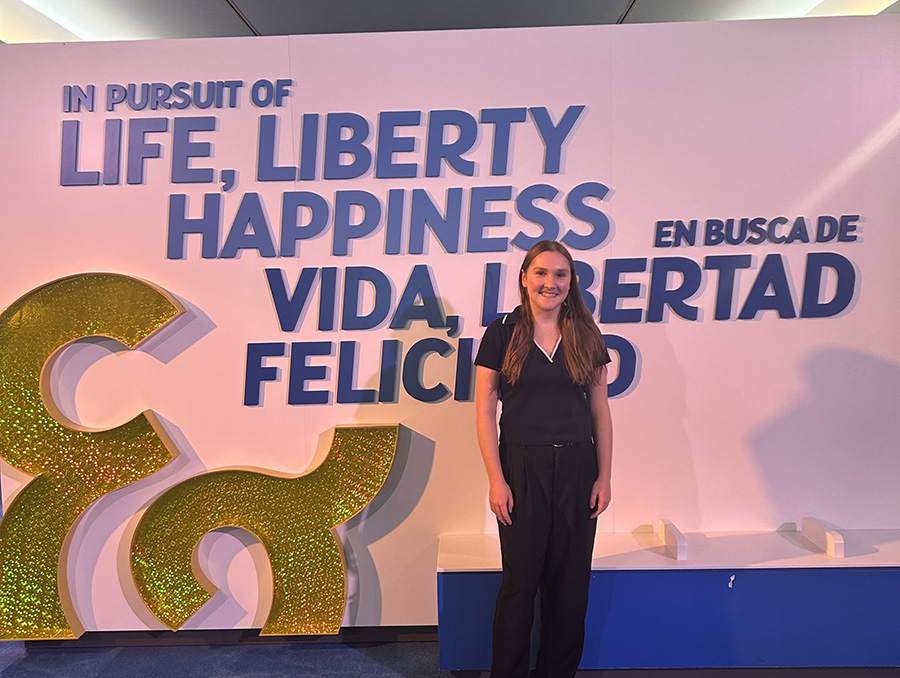 Catherine at NMAH In Pursuit of Life, Liberty, Happiness exhibition
Everyone has to get dressed every day. Fashion history is history.
Wise didn’t always know that history would become her career. She began college in a different degree program, but when she went looking for classes that sounded interesting, they kept turning out to be history courses.
So she changed her major. And along the way, another interest—fashion—gave her a new way to understand the past.
“Everyone has to get dressed every day,” Wise says. “Fashion history is history.”
Her love of history, fashion, and museums began to come together, and at AU, she found a unique connection to that world. She asked History Professor Kathy Franz, director of the Public History program, to introduce her to Laura Johnson, NMAH curator of costumes and textiles, whose work closely matched her interests.
The introduction led to an informational interview. Wise learned about Johnson’s work and the field—and when Smithsonian internship applications opened months later, she was prepared. She applied, asked to work with Johnson, and got the internship.
Wise came away convinced that sometimes you need to make the first move. “I think that finding professionals whose work you’re interested in and setting up an informational interview is really important,” she says. “That’s the only reason I got this internship. It was really anxiety-inducing, but it was completely worth it in the end.”
Wise also learned that the people on the other side of those emails often want to help. “The professionals I’ve talked to have been really encouraging,” she says. “They want to meet with students and people interested in going into their field.”
Every Object Is a Treasure
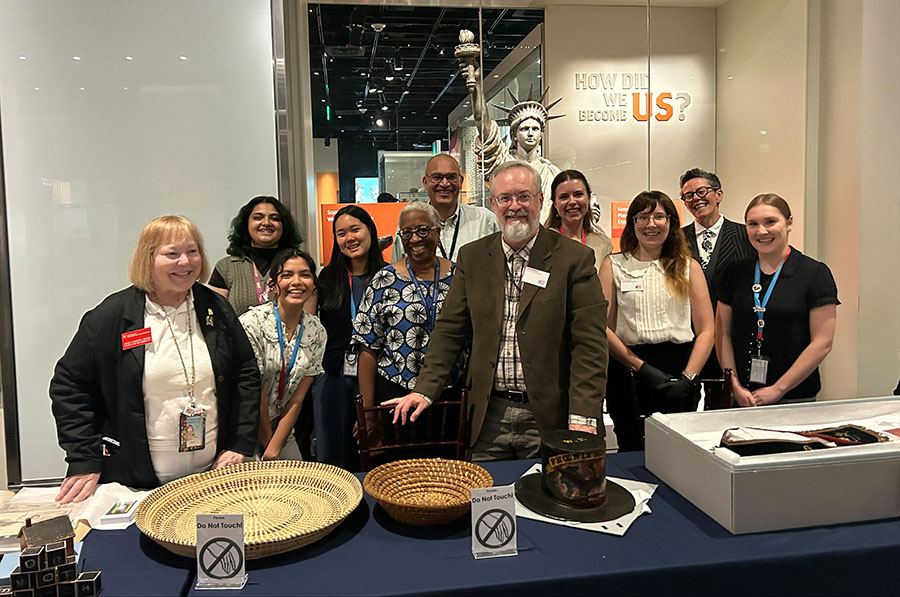 Catherine (far right) and Smithsonian colleagues, looking at historical objects out storage
I was so excited to go to work every day—to learn, be challenged, and work with the incredible collection at NMAH.
At NMAH, Wise spent much of her summer immersed in clothing—and the stories it can tell.
Some of the pieces Wise handled connected her to pivotal moments in American history. She worked with a dress worn by Minnijean Brown Trickey, one of nine Black students who helped integrate Little Rock Central High School in 1957, a landmark moment in the civil rights movement. She also got an up-close look at a bright pink 1890s gown by the House of Worth, the legendary Paris fashion house that dressed royalty, actresses, and wealthy American clients.
Working behind the scenes in the museum’s collection storage spaces also changed the way Wise thought about the objects themselves. Even at a museum famous for its iconic treasures, she learned, every object is worth caring for and understanding.
Her largest project took her through nearly 200 swimsuits dating from the 1880s to the 1990s, as she inventoried the collection. Among her favorites were designs by Rudi Gernreich, creator of the “monokini,” the famously topless swimsuit that caused a sensation in the 1960s.
“He was really interested in the idea that whatever a man could wear, a woman should be able to wear as well,” Wise says. “I really love his designs, just because they’re so shocking, even to us today.”
Wise also spent the summer researching a less visible chapter of Washington history. For NMAH’s Black Clothing Makers project, Wise combed through thousands of census records from the 1860s through the early 1900s, moving line by line through names and occupations—dressmaker, tailor, seamstress—to document the lives and livelihoods of Black clothing makers in post–Civil War Washington.
By summer’s end, Wise was more certain than ever that she had found the right field. “I was so excited to go to work every day—to learn, be challenged, and work with the incredible collection at NMAH,” she says. “I left deeply inspired by the curators, collections managers, and other interns—and excited about what comes next.”