
Where Numbers Meet Narrative
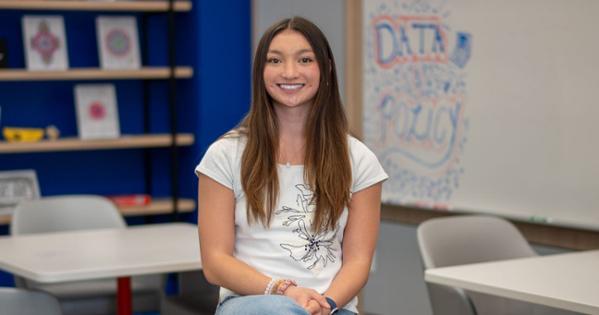
When Sonya Purcell, CAS-SPA/BA ’28, arrived at American University, she thought she would have to choose—math or politics, systems or stories. Instead, she found a way to weave them together.
Through a self-designed academic path, Sonya is learning how to translate numbers into narratives—and narratives into action.
“Dialectical” is the word she uses to describe her college experience so far, a concept she first encountered in a linguistic anthropology course.
“To think dialectically is to understand that a lot of things are interconnected,” she says. “I came in thinking I had to choose one path and leave everything else behind. But AU has shown me that things are more connected than they seem.”
A Seattle native, Sonya arrived in Washington, DC, drawn by the city’s energy and the university’s mission—but unsure how to reconcile her wide-ranging interests in math, government, and history.
“I always loved math, but with politics and history, I felt a different kind of curiosity,” she explains. “It made me nervous because I thought I had to pick one and let the others go.”
Instead, she didn’t let go of anything.
Sonya began as a political science major and added applied mathematics, eventually discovering AU’s data science for political science program—a relatively new offering that felt, to her, like everything clicking into place.
“With math, you get that structural, systematic thinking. With political science, you get philosophy and questions about human nature,” she says. “Being able to put a system or theory to something as complex as politics really intrigued me.”
Now, she’s using her expertise in both disciplines to make an impact.
“I’m using statistical modeling to target things I care about and make societal change.” And that philosophy isn’t abstract—it’s already shaping her work.
As a supplemental instructor for calculus, Sonya helps students navigate challenging material in a collaborative environment. But her commitment to connection—between people, ideas, and disciplines—extends beyond the classroom.
Sonya is an advisory board member for the Sine Institute of Policy and Politics, where she collaborates with students to foster meaningful dialogue and drive policy conversations. She’s also contributing to AU’s Repository for Open-Source Research & Analysis, authoring a “bottom line up front” report on the asylum crisis in Mexico using qualitative data and policy analysis.
In each experience, she’s testing the same idea: that data, when paired with intention, can do more than inform—it can influence.
That belief deepened through her research on local reparations policy, where she conducted archival work and led a Seattle-based case study.
“At times it felt repetitive,” she says. “But when I started writing and connecting everything, I could see a story emerge. That’s when it clicked—data isn’t just numbers. It’s a way of communicating something bigger.”
Sonya has a perspective rooted not just in curiosity, but in responsibility. And it’s one she might never have had the chance to develop without support from the Robert and Christine Johnson Scholarship.
“If it wasn’t for financial aid and scholarships, I probably wouldn’t have been able to come to AU,” Sonya says. “So just being here, having these experiences, is because of that support.”
For her, scholarships represent more than access to an education. They represent access to a purpose-driven future.
“Scholarships don’t just make education accessible,” Sonya says. “They allow people to find their purpose and then use that purpose to contribute, to inspire others, to create change. It’s impactful in both direct and indirect ways.”
Looking ahead, Sonya plans to continue exploring the intersection of data, policy, and social impact.
“I want to use data to promote change, potentially through policy,” she says. “I don’t know exactly what that looks like yet, but I know that’s the goal.”
It’s a goal shaped by curiosity, sharpened by discipline, and made possible through opportunity.
And in Sonya’s hands, numbers don’t just measure the world—they help reimagine it.