
What comes next for the Kurdistan Region’s security? Experts weigh in
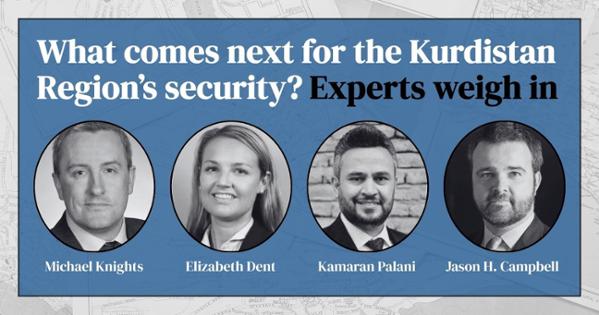
The planned withdrawal of US forces from Iraq on September 30, 2026, is forcing the Kurdistan Regional Government (KRG) to reassess how it protects the region and preserves its ties with Washington. As the United States and Iraq move toward bilateral defense cooperation, Erbil must secure a distinct role within arrangements negotiated with Baghdad.
The stakes extend from arms deliveries and air defenses to the balance of power in disputed territories. The departure of American troops also puts a long-standing source of political reassurance in doubt. In the responses below, experts assess Erbil’s options for securing outside support, strengthening its own forces, and preserving Kurdish autonomy while maintaining cooperation with the federal government.

Dr. Michael Knights
Head of Research, Horizon Engage
Q: As U.S.–Iraq security relations transition to standard bilateral defense cooperation, how can the Kurdistan Regional Government (KRG) ensure it retains a distinct role rather than having all military assistance funneled strictly through the central government in Baghdad?
A: End-User Certificates (EUCs) are a vital part of any international arms transfer, and (sadly for Kurdistan) only the nation state is usually allowed to be listed as the recipient on EUCs. This means that Iraq is always listed on the EUC, usually its Ministry of Defense. Iraqi law requires the imported materials to be inspected by MoD and they choose to do this in Baghdad, which often delays the process. As Iraq is a problematic EUC recipient (in terms of human rights and terrorism sanctions), having Iraq as the EUC is a disadvantage when Kurdistan wishes to import defense articles. Provision of training and basing of forces is also usually arranged with the sovereign power, so these aspects of security cooperation can also be delayed or blocked by Baghdad. Kurdistan's options include:
- Separation as a national state followed by international recognition as a state.
- Agreement with Iraq via a memorandum of understandings that the Kurdistan Region of Iraq be treated as a separate EUC recipient.
- Smuggling of defense imports into Kurdistan with the collusion of the supplier states.

Elizabeth Dent
Nathan and Esther K. Wagner Senior Fellow, Washington Institute for Near East Policy
Q: With the drawdown of U.S. air defense umbrella assets, what capabilities does Erbil possess, or need from alternative partners, to deter recurring missile and drone strikes from non-state armed actors and regional powers?
A: As U.S. and coalition air defense assets leave Iraq, Erbil is left with its ground-centric Peshmerga, a limited number of counter-UAS kits, and air defense around key sites. It will complicate the Kurdistan region's ability to prevent drone or missile attacks because many of the early warning and interception systems it has relied upon for many years will depart with the coalition, leaving an operational gap. Erbil will need to invest in layered, mobile short-range air defense to cover its most critical sites: Erbil, Sulaymaniyah, energy and civilian infrastructure, and military facilities. Its security partners, to include the U.S., European supplies, and regional states, can all help to fill that gap so long as Baghdad allows for military sales. It will also require clever political maneuvering to ensure the Iraqi Kurdistan Region is not inviting threats in (allowing militias to operate) and has partners who can provide credible deterrence.

Dr. Kamaran Palani
Head of the UK and EU Policy Unit at the Middle East Peace and Security Forum (MEPS)
Q: Is Erbil forced to seek structural security guarantees elsewhere (e.g., European partners, Gulf nations), or must it fundamentally re-engineer its grand strategy to accept deeper integration into Baghdad’s state apparatus?
A: First, the presence of American security forces on the ground in Erbil has long carried a deep psychological meaning for the Kurds, one that outweighs even their material support. Psychologically, this presence has signaled to the Kurds that they matter in American foreign policy in Iraq and the region, and it has served as a form of protection against aggression from within the region. It has also been seen as a safeguard in the balance of power with Baghdad and in the Kurds' disputes with the federal government. Now, with American forces leaving Erbil, this psychological sense of security is gradually eroding. In security terms, it is true that ISIS is unlikely to re-emerge as a major threat to Kurdistan, and there is no immediate danger. However, Erbil will increasingly be seen as falling outside US interests in the region and, therefore, as vulnerable to pressure from various actors both inside Iraq and across the region. The answer for the Kurdish leadership is long overdue: unite, institutionalize, and strengthen its own security forces, without being drawn into confrontation with the Iraqi federal government. There is room for the Kurdish forces to do this.
The Kurdistan Region does not have alternatives in the short term. In the absence of an American military presence, European actors can provide only limited support, as the US has served as a kind of framework for the presence of others as well.
What Erbil needs to avoid at this stage is losing coordination with the federal government. During this transition, security and political decisions will be intertwined and interconnected. Stability and institutionalization at home will allow Erbil to identify and explore security arrangements. This will also allow Erbil to negotiate a better deal with Washington, should it seek to sign a potential new defence memorandum of understanding.

Dr. Jason H. Campbell
Senior Fellow, Middle East Institute (MEI)
Q: Will the security vacuum in the "disputed areas" lead to an expanded footprint of Federal Iraqi Forces and Popular Mobilization Forces (PMF) near KRG margins, and how does this affect regional stability?
A: With US military forces set to depart Iraq at the conclusion of Operation Inherent Resolve (OIR) on September 30, there has been much focus placed on the next evolution of US-Iraqi bilateral relations. An optimistic view is that the removal of US forces will deprive Iranian militias of their justification to refuse disarmament efforts and potentially pave the way for the reintroduction of US businesses in Iraq. A pessimistic view, however, is that the recent extension of the disarmament timeline from September 30 (to coincide with the conclusion of OIR) to June 2027 signals to the militias that they can continue to make political demands and threaten the sovereignty of the Iraqi government. A potential flashpoint for a new Iraqi government needing to maintain a delicate balance between US and Iranian influence could be the KRG, where the loss of US situational awareness on the ground and potential drop in US support could prove an enticing target for the Federal Iraqi Forces and/or PMF to attempt to win political points in a scenario where they are reluctant or even unable to place sufficient pressure on militias. Going forward, it will be imperative that the US remain focused on these “disputed areas” and continue to exercise its diplomatic influence in Baghdad to ensure that the priority remains on the militias and their ability to create regional instability and that any disputes in the Kurdish region continue to be tackled diplomatically.