


Contact Us
Battelle Tompkins , Room T-23 on a map
Critical RGC Studies 4400 Massachusetts Avenue NW Washington, DC 20016-8144 United StatesThrough a minor or certificate in Disability Studies, you can direct your career to serve structurally-neglected communities and those who are multiply marginalized, build community power with fellow disabled/neurodivergent/chronically ill people, and learn more about the ways in which we can support and care for each other.
Completing a minor or certificate in Disability Studies offers you the opportunity to add depth to your major by focusing on the history, lives, and futures of disabled people. The program will introduce you to different ways to think about disability, neurodivergence, chronic illness, trauma, and access, give you a critical toolbox to investigate policy discussions, legal frameworks, cultural scripts, and representation, as well as prepare you for various professions, medical school, law school, and graduate study. Our alums have worked at the White House, the MoMA, the Smithsonian museums, and many other cultural institutions as well as for international and national organizations, local schools, in various health systems, and as artists and activists.
Disability Studies as a field is interdisciplinary, intersectional, and the way we teach it at American University is also decolonial, anti-racist, feminist, and rooted in disability justice. This way of approaching disability studies was developed by queer-of-color disabled activists, organizers, and community builders, and we honor that legacy through our curriculum, programming, and involvement in local communities. Disability Studies at AU is part of the larger Critical Race, Gender, and Culture Studies department, which offers students a way to connect their work on disability and access to systems of oppression and dispossession and allows them to discover forms of resistance, resurgence, and reclamation.
Alumni Spotlight: Katie Greenstein
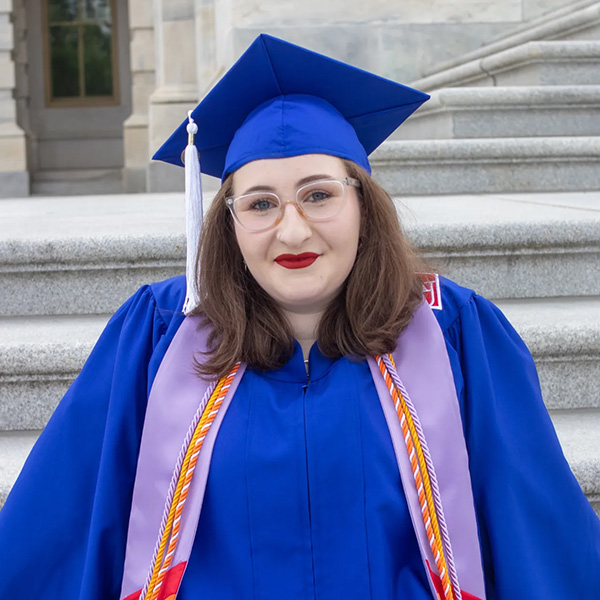
As a community-engaged scholar, 100% of my methods can be attributed to my original work as a community organizer and disability studies student as an undergraduate.
—Katie Greenstein (SPA BA/’24; CAS MA/’25)
Q&A with Katie
Why did you choose to minor in Disability Studies? What were some of your favorite courses? How did it complement your major?
I minored in disability studies because I got involved with the Disabled Student Union as a founding member; then, I got interested in classes that would have content representative of our community and our issues. I wanted to have my transcript represent my passion and time commitment to studying this, so I chose to minor in Disability Studies. My favorite course was definitely Madness, Mental Health, and Neuroqueerness (I even TA’d for this class as a graduate student!); I found the theoretical content to be the most interesting and engaging. It really added nuance to my interest in history and legal studies. As a CLEG major, Disability Studies was a complement to my degree (and additional History minor) because it offered the content that I would be using my methodologies as a historian (with a legal studies background) to study further. It also provided a space for me to see myself in the classroom and be represented that I felt nowhere else at AU.
Did you do any internships during your time at AU? What other meaningful experiences do you recall?
My most meaningful experiences were definitely as DSU’s founding President (sophomore year), as chair of the Disability Studies Task Force at DSU (senior year), and then as a TA for Dr. Aho in Disability Studies in graduate school. I had plenty of other internships, and also founded the Disability+ Alumni Alliance, but I think it was so meaningful to advocate for disability in the classroom and then be able to teach with Dr. Aho myself. They’re a legend and I’m so glad I got to learn so much with and from them.
What have you done for work since graduating?
School, and more school! I’m a historian; I earned my MA in History (Public History) at AU in December 2025. I have done an Americorps year with the National Park Service as I await the start of my PhD in Fall 2026 at University of North Carolina Greensboro. I also interned at a handful of museums, and worked there in education, where I’ve been working to make museums more welcoming and accessible.
How did your degree help you with your job search and in your career?
My particular Americorps program is actually accessibility focused, so I was lucky to find that offering and work to make the parks more accessible. In terms of graduate school, I’ve been specifically looking for mentors and advisors for my PhD who are disability-focused, and my work with Dr. Aho and Disability Studies has informed how I approach disability history. As a community-engaged scholar, 100% of my methods can be attributed to my original work as a community organizer and disability studies student as an undergraduate.
News & Notes
AU American Studies students explored disability and care in a transnational symposium in partnership with Humboldt University and University of Warsaw.
Sensi Messner-Baker will spend the summer conducting original research on the relationship between disability and supernatural narratives in Scottish folklore.
Dr. Toby Aho and Dr. Mary Ellen Curtin have won the Ann Ferren Curriculum Design Award for their creation of the “Disability, Health, and Bodies” undergraduate certificate. This award recognizes the collaborative work of two or more faculty who creatively integrate the values of a liberal education in the design of courses or curricula for majors or academic programs.
Alumni Spotlight: Isabel Thompson
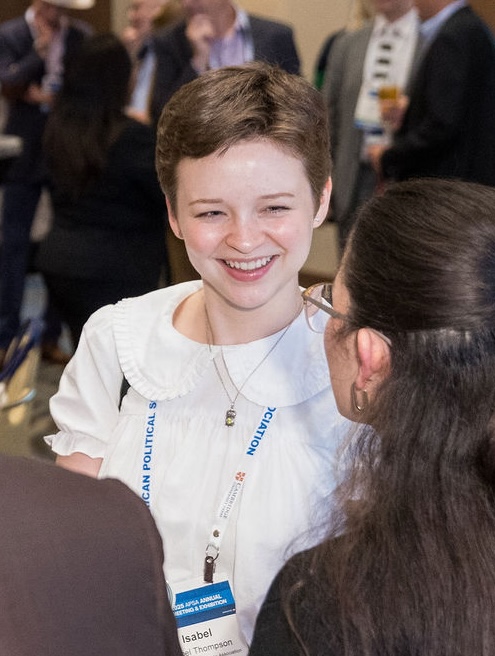
My Disability, Health, and Bodies certificate has helped me in finding work that I find meaningful and intellectually activating.
... [T]aking those courses gave me a foundation of theories and frameworks that will form the center of my professional life moving forward.
—Isabel Thompson (SIS BA/'23)
Q&A with Isabel
Why did you choose to pursue Disability Studies? What were some of your favorite courses? How did it complement your major?
I chose the Disability, Health, and Bodies Certificate because I enrolled in a course in my junior year called Mental Health, Madness, and Neuroqueerness, taught by Dr. Toby Aho. It was in that class that I was formally introduced to the foundations of critical disability theory and began to locate myself within the disabled community. Encouraged by Dr. Aho, I enrolled in the new DHB certificate program and ultimately became one of the first undergraduates to complete it. This field of study also gave me a new lens through which to examine my work as an International Studies major. I came to understand that American empire, and Western imperialism more broadly, are sites for the continual reproduction of disability. The framing of disability as a product of state violence has long existed at the margins of international relations scholarship, and is something I find extremely interesting.
Did you do any internships during your time at AU?
In my senior year, I worked as a Communications Intern for USAID’s Inclusive Development Hub within their Disability Rights, Physical Rehabilitation, and Assistive Technologies portfolio. In this role, I worked with USAID specialists to create communication materials for development projects centered on disability inclusion. This was the first position I was in that directly connected my academic interests in international relations with my desire to work with disabled communities. During that same period, I also interned with the Critical Design Lab at Vanderbilt University. In this role, I supported their Remote Access Archive team by transcribing virtual interviews with prominent scholars, artists, and activists in the disability justice field.
What have you done for work since graduating?
For the past two or so years, I have worked in Diversity, Equity, and Inclusion programming at the American Political Science Association. In this role, I support political scientists at all career stages and fund research that often exists at the margins of the discipline. For example, I co-led the 2025 and 2026 APSA Oral History Project, conducting interviews with more than ten senior scholars of color during regional political science conferences.
How did your degree help you with your job search and in your career?
My DHB certificate has helped me in finding work that I find meaningful and intellectually activating. My career is obviously a work in progress, but taking those courses gave me a foundation of theories and frameworks that will form the center of my professional life moving forward. I likely would have had much less direction had I not discovered my interest in disability scholarship through this program.
Program Director